Deconstructing Temporality: The Chateau de Chaumont Tapestry as a Blueprint for Avant-Garde Textile Innovation
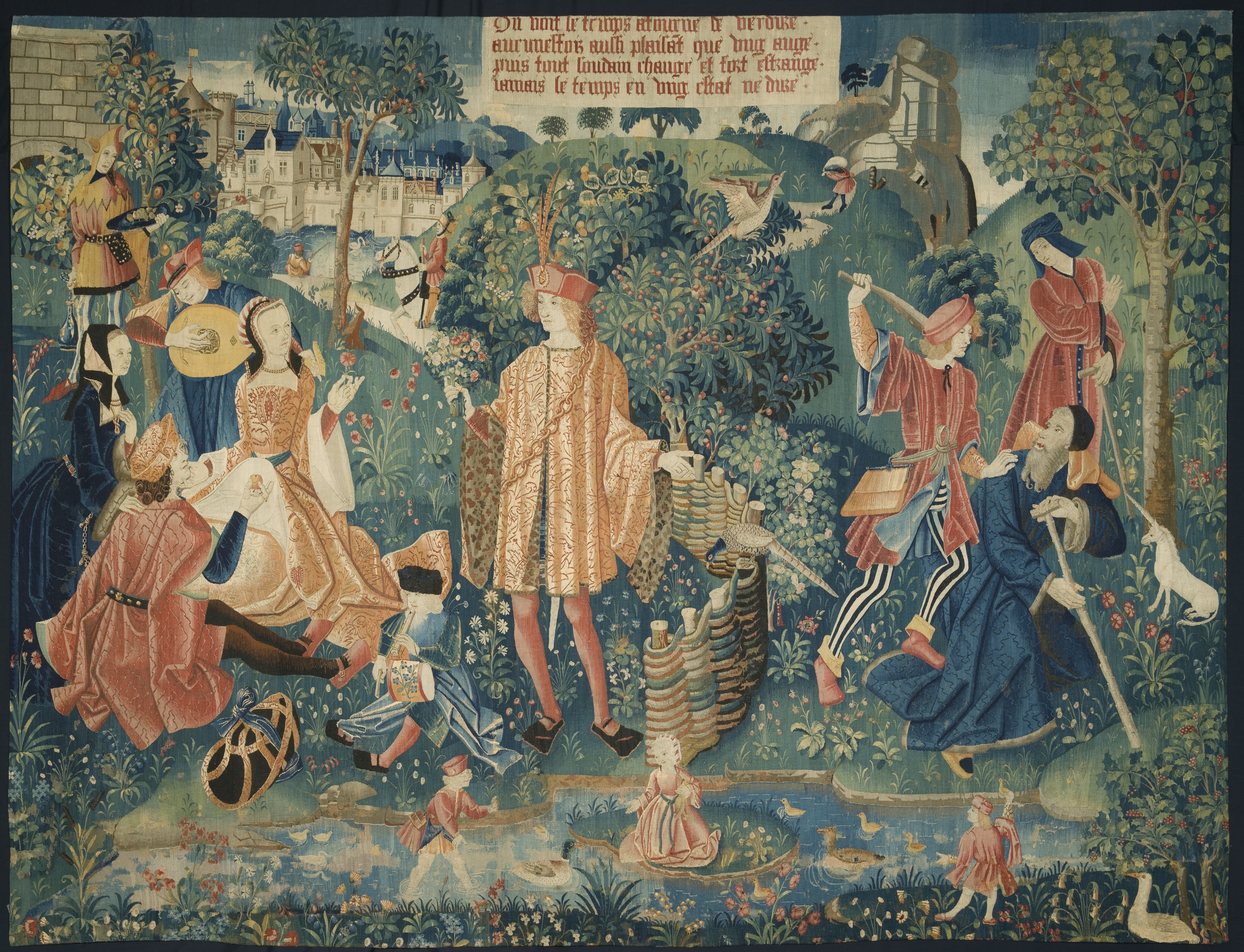
At Zoey Fashion Lab, our mandate extends beyond the mere analysis of fabric; we engage in the archaeological excavation of narrative, structure, and cultural memory embedded within each thread. The subject of this deconstruction—a fragment attributed to the Chateau de Chaumont set, purportedly woven in Lyon, France, during the early 16th century—presents a paradox of materiality and temporality. Composed of silk and wool in a tapestry weave, this artifact is not a relic to be preserved under glass but a living DNA strand, a genetic code for radical, avant-garde construction. This analysis dissects the physical and conceptual architecture of the piece, proposing a methodology for translating its historical density into a futuristic fashion language that challenges the linear progression of style.
I. Material Dialectics: Silk and Wool in Antithetical Harmony
The technical foundation of this tapestry lies in its binary material composition: the lustrous, high-twist silk warp against the matte, bulky wool weft. In conventional textile science, these fibers are antagonists—one speaks of aristocratic refinement, the other of rustic utility. Yet, in the Chaumont fragment, their opposition generates a third, subversive textural reality. The silk, likely dyed with madder or woad, provides a luminous ground that catches ambient light, creating a shifting, moiré effect. The wool, conversely, absorbs light, rendering deep, velvety shadows. This is not a compromise but a deliberate tension.
For the avant-garde application, we must reject the notion of blending these fibers. Instead, we propose a structural juxtaposition: a garment where raw, unspun wool is trapped between translucent panels of silk organza, creating a "fossilized" air pocket. The wool acts as a thermal and visual insulator, while the silk acts as a fragile membrane. This technique—which we term Dermal Wefting—produces a surface that is simultaneously protective and vulnerable, echoing the tapestry's original function as both insulation and artistic display. The weave's density, approximately 8-10 warps per centimeter, informs our digital knitting patterns, allowing us to program gradient compressions that mimic the original's irregular, hand-tensioned surface.
II. The Tapestry Weave as a Non-Linear Narrative System
The tapestry weave is fundamentally a technique of interruption. Unlike a woven cloth where weft travels continuously, tapestry wefts are discontinuous, turning back upon themselves to create pictorial forms. This creates vertical slits—the "chaînes" or interlocking points—which are the structural scars of the weaver's choice. In the Chaumont fragment, these slits are not errors; they are the cartography of a decision-making process. Each slit represents a moment where the weaver halted one color narrative to begin another, leaving a physical gap that was later sewn shut.
Our avant-garde interpretation converts these slits into functional, kinetic seams. We propose a garment system where the "slits" are left intentionally open, laced with metallic cords or transparent polymer filaments, allowing the wearer to adjust the silhouette’s tension in real-time. This is Parametric Tapestry: a dress that can be reconfigured from a closed, columnar form to an open, deconstructed drape, depending on the wearer's movement or the environment's thermal demands. The historical slit, a point of weakness, becomes a point of agency. Furthermore, the weft's irregularity—the slight undulations where wool meets silk—is translated into a 3D-printed lattice that mimics the hand-beating of the weft, ensuring that no two garments share an identical surface topography.
III. The Lyon Conundrum: Industrial Provenance vs. Artisanal Soul
Attributing this piece to Lyon in the early 1500s is provocative. Lyon was not yet the undisputed silk capital it would become later in the century; that title belonged to Tours. However, Lyon’s position as a trading hub between Italy and Northern Europe made it a nexus for cross-pollination. The Chaumont set, likely commissioned for a château on the Loire, would have been a product of this cosmopolitan exchange. The design—often featuring verdure, mythological scenes, or allegorical figures—was not "invented" by a single artist but was a compilation of Flemish cartoonists, Italian colorists, and local weavers.
This collaborative, decentralized origin is a direct precursor to the modern fashion collective. For Zoey Fashion Lab, this suggests a rejection of the singular "designer genius" in favor of a distributed authorship. Our avant-garde line will be developed through an open-source digital interface, where textile engineers, graphic artists, and end-consumers contribute to the "cartoon" (the full-scale design pattern). The final garment will carry a digital watermark—a QR code woven into the selvedge—that traces every contributor’s input, from the initial wool carding to the final silk finishing. This transforms the garment from a static product into a living archive, a "New DNA Strand" that encodes its own genesis.
IV. Temporal Distortion: The Avant-Garde as Historical Collision
The most radical aspect of this analysis is the treatment of time itself. The early 16th century was an era of profound anxiety—the Reformation, the discovery of the New World, and the collapse of the feudal order. The tapestries of that period served as portable palaces, projecting stability and order through dense, repetitive imagery. The avant-garde fashion of today faces a similar cultural vertigo, yet our tools are different. We do not seek to hide chaos but to expose it.
Therefore, our design strategy employs chrono-fracturing. We take the Chaumont fragment’s color palette—the muted ochres, deep forest greens, and faded crimson—and subject them to digital chromatic aberration, splitting each hue into its component wavelengths. The resulting palette is not "historical" but hyper-historical, a neon-infused memory of the original. A coat constructed from this fabric will appear to shimmer with the ghost of its 500-year-old self, yet its silhouette—sharp, asymmetrical, with exposed seams—is unequivocally future-facing. The garment does not reference the past; it ingests it, metabolizing the historical material into a new, aggressive energy.
V. Conclusion: From Artifact to Algorithm
The Chateau de Chaumont tapestry fragment is not a finished work. It is a starting point, a set of instructions encoded in twisted fiber. For Zoey Fashion Lab, the act of deconstruction is not an act of destruction but of translation. We translate the tensile strength of silk into a structural support system for a dress that can stand without a mannequin. We translate the wool’s thermal mass into a smart textile that adjusts its porosity based on body heat. We translate the weaver’s slits into a modular system of fasteners that allow for infinite reconfiguration.
In this new paradigm, the "New DNA Strand" is not a metaphor. It is a literal sequence of digital code—derived from the pixel analysis of the tapestry’s surface—that generates the knitting, weaving, and cutting instructions for our collection. The historical French tapestry becomes an algorithm for a future that has not yet been woven. This is the ultimate avant-garde gesture: not to destroy the past, but to prove that its potential has never been fully realized. The fragment is not a memory; it is a prophecy, and we are its weavers.