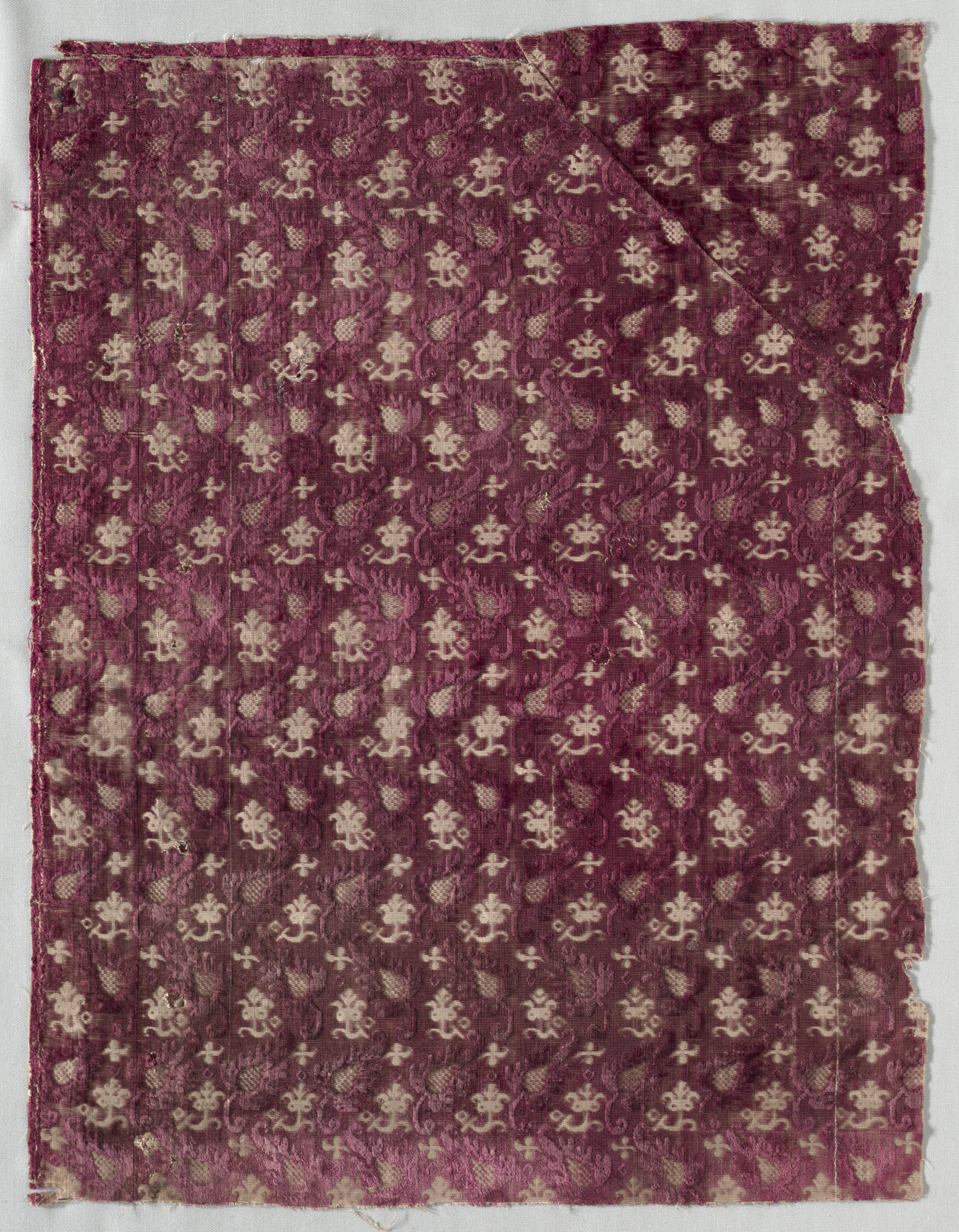
Deconstructing the Baroque: The Velvet Fragment as a New DNA Strand for Avant-Garde Design
At Zoey Fashion Lab, we do not merely study historical textiles; we interrogate them. We dissect their physicality, decode their socio-cultural syntax, and re-sequence their genetic material for contemporary expression. The subject of this analysis—a 17th-century Italian velvet fragment—presents a paradox of immense creative potential. On the surface, it is a relic of aristocratic opulence, a testament to the weaver’s art. Beneath that surface lies a complex architectural system of light, texture, and structure that, when viewed through the lens of our New DNA Strand methodology, becomes a blueprint for radical, avant-garde construction. This fragment is not a museum piece; it is a living, mutable organism awaiting its next evolutionary leap.
Technical Autopsy: The Binary of Cut and Uncut Velvet
The fragment’s technical foundation—the coexistence of cut and uncut velvet—is its primary genetic marker. This is not a mere decorative nuance; it is a fundamental duality that governs the fabric’s entire behavioral profile. In technical terms, cut velvet (ciselé) is achieved by severing the pile loops after weaving, creating a dense, plush, and light-absorbing surface. Uncut velvet (terry pile), conversely, leaves the loops intact, forming a resilient, springy, and light-refracting structure. The 17th-century Italian weavers exploited this binary to create pictorial depth, often depicting pomegranate or thistle motifs where the raised, cut pile formed the pattern and the uncut loops formed the ground or vice versa.
Structural Implications for the Lab
For our purposes, this binary is not merely visual but kinetic and tactile. The cut pile offers compression and absorption; the uncut pile offers tension and rebound. When we subject this fragment to our New DNA Strand analysis, we identify this as a ‘pressure differential system.’ An avant-garde garment constructed from this principle would not be flat. It would be a topographical map of varying densities. We propose engineering panels where the uncut loops are left exposed in high-friction zones (elbows, shoulders, hips) to provide structural give, while the cut pile is deployed in areas requiring sculptural definition (bodice, collar, cuffs). The garment would breathe, move, and respond to the wearer’s body unlike any synthetic stretch fabric, because its elasticity is derived from the yarn’s own architecture, not from added spandex.
Color and Light: The Alchemy of the Void
The fragment’s original palette—likely deep ruby, ecclesiastical purple, or verdant green derived from natural dyes like kermes, logwood, or weld—is not our primary concern. We are concerned with the behavior of light within those chromatic fields. Cut velvet absorbs light, creating a void of near-blackness. Uncut velvet, with its looped crowns, catches light and scatters it, producing a shimmering halo effect. This creates a chiaroscuro that is not painted but woven. In the 17th century, this was used to simulate the flicker of candlelight on aristocratic garments, a symbol of wealth and divine presence.
Deconstructing the Glow
For the avant-garde, we propose a radical inversion. Instead of using color to define form, we will use textural light differentials. We can deconstruct the fragment’s color palette entirely, re-dyeing the velvet in monochromatic, industrial tones—acidic whites, graphite greys, or even optical blacks. In doing so, the only visual information becomes the interplay between the matte, absorbent cut pile and the glossy, reflective uncut loops. The garment becomes a study in non-verbal communication, where the body’s movement creates a shifting pattern of light and shadow. This is not about ornamentation; it is about atmospheric manipulation. The wearer becomes a living sculpture, their silhouette defined not by seams but by the strategic placement of light-absorbing and light-reflecting zones.
The New DNA Strand: From Relic to Reactive Membrane
Our New DNA Strand methodology is predicated on the idea that historical techniques can be re-sequenced for contemporary performance. This velvet fragment provides a perfect case study for this process. We identify three core genetic traits to extract and mutate:
Trait 1: The Pile as a Micro-Structure. We will not weave velvet in the traditional sense. Instead, we will use laser-cutting and ultrasonic welding to create a synthetic pile on non-woven technical fabrics. This allows us to replicate the cut/uncut binary on materials like recycled polyester or bio-based nylon, achieving the same tactile depth without the weight of silk or the labor of hand-weaving. This is not a reproduction; it is a translation.
Trait 2: The Loop as a Kinetic Hinge. The uncut loops are not static. They can be pulled, stretched, and released. We propose integrating micro-elastic filaments into the loop structure, creating a fabric that can actively contract and expand. Imagine a sleeve that shortens when the arm is raised and elongates when lowered, not through mechanics, but through the natural tension of the loop architecture. This is biomimetic design, inspired by the velvet’s own resilience.
Trait 3: The Void as a Design Element. The cut pile’s light-absorbing quality is a form of negative space. In our avant-garde application, we will use this to create garments that appear to have holographic or digital cutouts. By selectively shearing the pile in precise, algorithmic patterns, we can create the illusion of transparency or digital glitching, even though the fabric is fully opaque. This is a trompe-l’oeil for the 21st century, where the ‘digital’ is rendered through pure physical texture.
Avant-Garde Application: The ‘Baroque Glitch’ Collection
Based on this analysis, we propose a capsule collection titled ‘Baroque Glitch’. The garments will be oversized, architectural silhouettes—cocoon coats, asymmetric dresses, and modular vests—constructed from our re-engineered velvet hybrid. The surface will be a chaotic yet controlled landscape of cut and uncut zones, referencing the original fragment’s floral motifs but abstracting them into fractured, pixel-like patterns. The color palette will be stark: optical white, carbon black, and a single, shocking signal orange, used only to highlight the uncut loops’ reflective properties.
The collection’s conceptual core is the deconstruction of historical power. The 17th-century velvet spoke of absolute monarchy and religious authority. Our version speaks of fragmentation, digital noise, and the fluidity of identity. It is a garment that does not impose a static silhouette but offers a reactive membrane, a second skin that changes with the wearer’s movement and the ambient light. It is not a costume; it is a statement of technological and philosophical evolution.
Conclusion: The Fragment as a Living Code
This 17th-century Italian velvet fragment, when stripped of its historical context and analyzed through the New DNA Strand framework, is revealed not as a dead artifact but as a living code. Its cut and uncut piles are not just decorative techniques; they are a binary language of absorption and reflection, compression and release, void and form. By re-sequencing these genetic traits, Zoey Fashion Lab can produce garments that are not merely avant-garde in style but are fundamentally new in their structural and kinetic behavior. The fragment is our Rosetta Stone, translating the opulence of the Baroque into the reactive, deconstructed language of the future. We do not preserve the past; we mutate it.