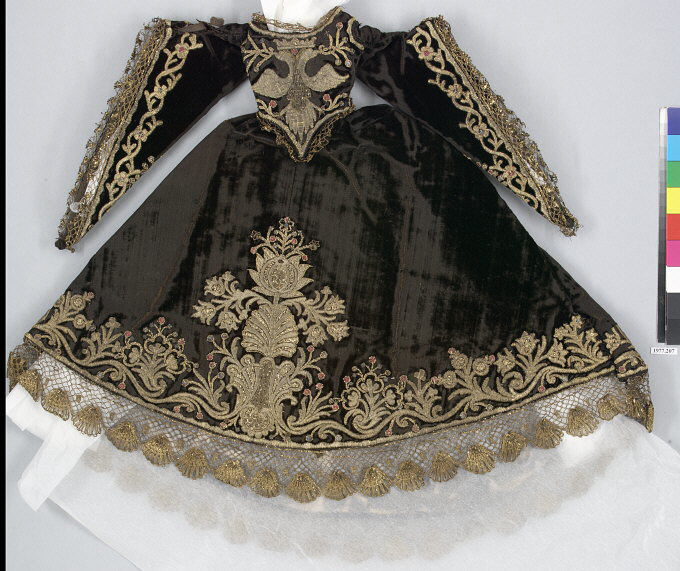
The Statue Robe: Deconstructing Immobility for the SS26 Frontier
The avant-garde imperative is not to predict the future, but to architect its anxieties. In the SS26 collection, Zoey Fashion Laboratory presents the Statue Robe—a garment that does not drape, flow, or conform. It arrests. It calcifies. Born from the Global Frontier, a conceptual territory where geopolitical borders dissolve into data streams and material scarcity becomes the ultimate luxury, this robe is a study in controlled immobility. Constructed from liquid silk and rigid metal thread, it is not a dress; it is a wearable manifesto against the tyranny of perpetual motion.
Silhouette as Structural Provocation
The Statue Robe abandons the organic curve for the fractured vertical. Its silhouette is a deliberate misreading of classical statuary—not the Venus de Milo, but a cyborg caryatid supporting an invisible digital pediment. The shoulders are exaggerated, not padded but cantilevered, jutting forward like the prow of a vessel. This is achieved through a hidden exoskeleton of metal thread, which is woven not merely as embellishment but as the garment’s load-bearing skeleton. The silk, in turn, is treated as a tension membrane, stretched taut between these metallic anchor points. The result is a robe that stands independent of the body, creating a negative space—a void between fabric and flesh that challenges the traditional intimacy of couture. Here, the future silhouette is not about the body’s contours but about the architecture of absence around it.
Material Dialectics: Silk vs. Metal Thread
Materiality in the Statue Robe is a dialectical battle, not a harmonious blend. The silk—a 22-momme charmeuse with a liquid, almost molten finish—represents the ephemeral, the historical, the feminine. It is the ghost of couture’s past. The metal thread, a twisted alloy of copper and steel, is the brutalist future—industrial, unforgiving, and conductive. The innovation lies in their non-hierarchical integration. The metal is not applied atop the silk; it is woven into the very warp and weft, creating a fabric that is simultaneously fluid and armored. When light strikes the robe, it does not diffuse softly; it fractures into sharp, metallic glints that disrupt the eye. This is not a garment for passive viewing. It demands a kinetic response from the observer, forcing a recalibration of what constitutes luxury—no longer softness, but tensile strength.
Deconstructive Immobility: The Anti-Flow Doctrine
Where contemporary fashion fetishizes movement—the fluttering hem, the billowing sleeve—the Statue Robe proposes a radical alternative: the power of stillness. Deconstruction here is not about ripping seams to expose raw edges; it is about disassembling the very concept of drape. The robe’s hem is weighted with a continuous strand of metal thread, causing it to fall with an unnatural, gravitational finality. It does not sway; it drops. The sleeves are articulated at the elbow with a hinged metal joint, allowing only a limited, mechanical range of motion. This is a deliberate provocation against the fast-paced, athleisure-driven market. The wearer of the Statue Robe does not walk; she processes. She does not gesture; she articulates. This is a garment for the post-human era, where stillness is not passivity but a form of radical presence—a refusal to be swept along by the relentless current of trend cycles.
Global Frontier: A Cartography of Tension
The Global Frontier origin is not a marketing tagline; it is a design philosophy embedded in the robe’s construction. This is a garment born from the friction between cultures, where silk—historically a commodity of the East—is recontextualized through the industrial metallurgy of the West. The metal thread is not polished to a mirror shine; it retains a raw, oxidized patina, suggesting a material that has crossed deserts, oceans, and server farms. The robe’s silhouette references the draped himation of ancient Greece, but its structural logic is closer to a suspension bridge. This is couture for a world where identity is no longer national but nodal—connected, yet isolated. The Statue Robe is a portable monument, a fragment of a larger, unfinished architecture of global consciousness. It does not represent any single culture; it represents the tension between all of them.
SS26 Context: The Preemptive Archive
Within the SS26 narrative, the Statue Robe functions as the collection’s preemptive archive—a garment that exists not to be worn, but to be remembered. In a season dominated by bio-fabricated textiles and AI-generated patterns, this robe offers a counter-narrative of hand-intensive, almost archaeological construction. Each metal thread is individually tensioned and locked into place, a process that takes over 200 hours. This is not efficiency; it is ritual. The robe’s future-forward aesthetic is thus paradoxically rooted in the most archaic of couture techniques. It asks a critical question: in a world of instant digital reproduction, what is the value of a garment that cannot be copied, only reconstructed? The answer lies in its immobility. The Statue Robe is a protest against the ephemerality of the digital image. It is a physical, tangible object that will outlast the season, the trend, and possibly the very notion of seasonal fashion itself.
Conclusion: The Robe as Ruin
The Statue Robe is not a garment for the present; it is a ruin of the future, excavated from a time that has not yet occurred. Its silk will fade, its metal thread will oxidize further, but its silhouette will remain—a frozen gesture of defiance against the fluidity of modern existence. For Zoey Fashion Laboratory, this is the ultimate avant-garde act: not to create clothing, but to create artifacts that challenge the ontology of dress. The Statue Robe stands as a testament to the idea that true innovation is not about moving faster, but about standing still with intent. It is a monument to the tensile strength of both material and concept, a definitive statement that the future of couture lies not in the body’s motion, but in the architecture of its pause.