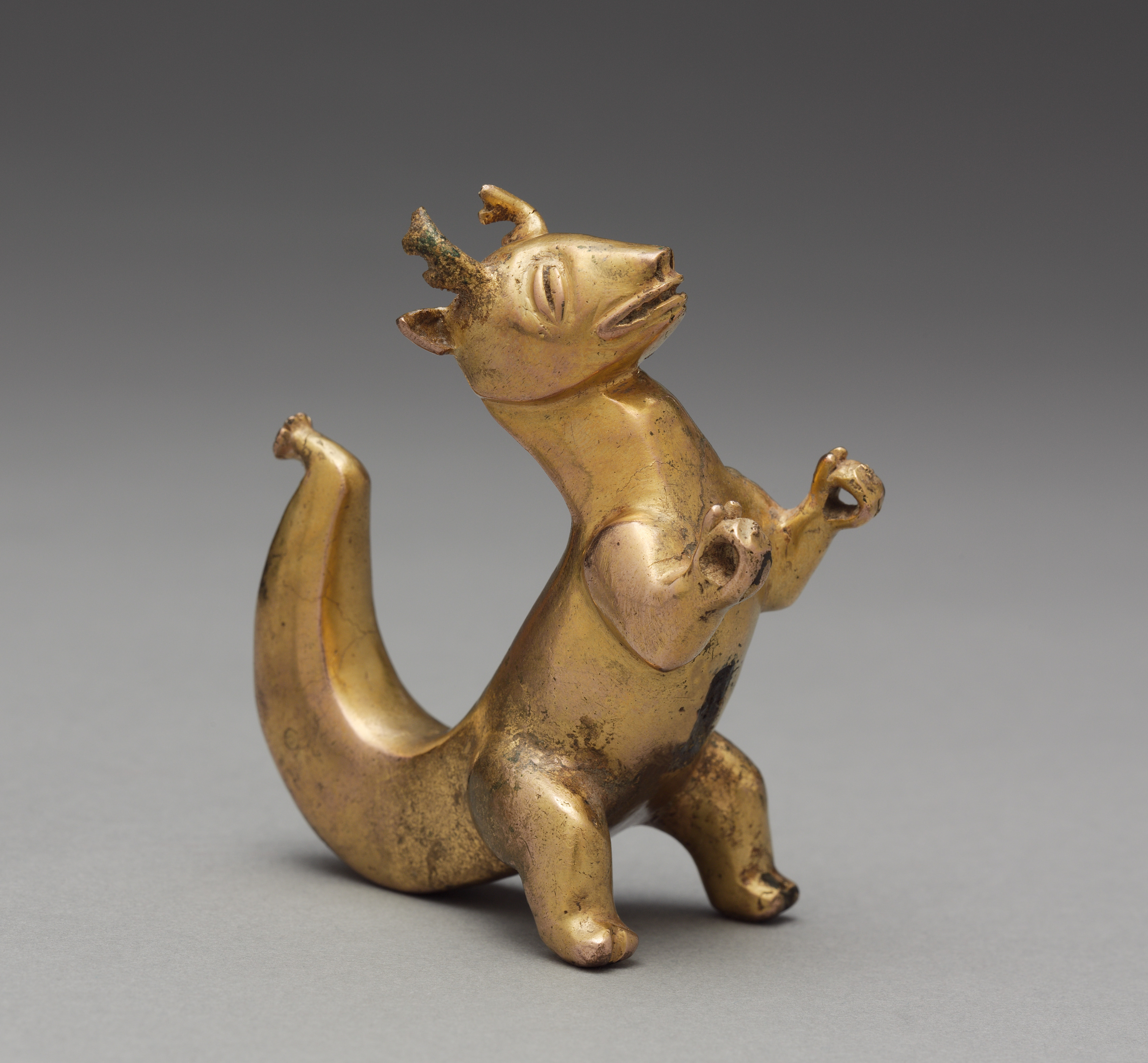
Technical Analysis & Material Resonance: The Cast Gold Imperative
The artifact’s primary technical specification—cast gold—is not merely a material choice but the foundational lexicon of its narrative. For the 5th-7th century artisans of the Isthmus, gold was not currency but condensed cosmology, a tangible piece of the sun’s power and permanence. The casting process itself, likely using the lost-wax (cire perdue) method, is a transformative act of creation and destruction: a temporary, malleable form (wax) is sacrificed to create an eternal, immutable one (gold). This alchemy mirrors the very themes of life, death, and eternity encoded in the pendant’s imagery. The weight and cool touch of the gold against the skin would have served as a constant, potent reminder of spiritual protection and elite status. For the Zoey Lab, this dictates a material philosophy where technique is inseparable from meaning. Avant-garde reinterpretations must engage with materials that carry their own profound histories and transformative properties—perhaps bio-accreted metals, recycled gold with traceable narratives, or composite materials that visually reference metallurgy but perform with contemporary lightness.
Deconstructing the Duality: Mirror & Sarcophagus
The provided reference, “Mirror with Split-Leaf…”, offers the critical conceptual framework: a stark duality. One side presents a polished silver mirror adorned with intricate gold split-leaf or palmette motifs. The other side is a cold stone sarcophagus panel telling a life narrative in relief. This is not mere decoration; it is a metaphysical instrument.
The Mirror Side (Order & The Present Self): The polished silver represents clarity, reflection, and the visible world. The gold split-leaf motif—a recurring theme in Panamanian International Style metalwork—is more than flora. It symbolizes vitality, growth, and perhaps the Tree of Life. Its “split” nature could signify bifurcation, choice, or the duality of existence itself. This side engages with the living wearer, a personal, gleaming interface between the self and the immediate world.
The Sarcophagus Side (Narrative & The Eternal Self): The shift to stone and浮雕 (relief) is a descent into the eternal. This side is not for daily reflection but for the final, enduring narrative. It speaks of lineage, journey, and the transition to the afterlife. The “life narrative” in relief is a public, eternal testament, contrasting with the mirror’s private, fleeting moment.
Synthesis for Avant-Garde Formulation
The pendant, therefore, is a portable threshold. It mediates between life and death, the ephemeral and the eternal, the personal and the ancestral. The “International Style” of its origin indicates it was part of a shared visual language across elite networks in ancient Central and South America, making it an object of both personal power and cosmopolitan connection.
Reconstruction for Zoey Fashion Lab: The Avant-Garde Pendant as Wearable Threshold
For Zoey Fashion Lab, this analysis moves beyond historical replication into the realm of conceptual wearables. The new “Pendant” must embody this profound duality through contemporary avant-garde lenses: deconstruction, hyper-materiality, and interactive narrative.
1. Form & Duality: The Fractured Interface
The object should be a non-literal, segmented form. Imagine a pendant that is not one unified shape, but two interlocking or opposing planes. One plane, mirror-polished titanium or liquid metal, acts as the “mirror” surface, catching and distorting the wearer’s reflection and environment. Embedded upon or within it are not symmetrical palmettes, but laser-etched or 3D-printed fractal patterns derived from the split-leaf, symbolizing organic growth in a digital age.
The reverse becomes our “sarcophagus panel.” Instead of stone, use matte, textured biopolymer or sintered ceramic, evoking a tactile, ancient feel. The “narrative” here is not a fixed relief but a dynamic data field. This could be a scannable QR matrix linking to a personal digital archive, a micro-engraved line from a user-submitted story, or a surface that changes slowly through oxidation or photochromism, literally writing its own history through interaction with the environment.
2. Material & Technical Dialogue
Honor the cast gold’s significance through contrast and conceptual pairing. Use gold electroformed over organic, degradable cores (like seed pods or leaves), creating a fragile form captured in eternity—a direct commentary on the original’s life/death duality. Alternatively, juxtapose recycled, ethically sourced gold with aerospace aluminum or carbon fiber, creating a dialogue between ancient value and futuristic performance. The weight and balance must be meticulously calculated; the pendant should feel like a deliberate, conscious object when worn, its presence shifting from cool to warm against the skin.
3. Wearable Concept: The Dialogic Object
This pendant is not passive. Its avant-garde expression lies in forcing a dialogue.
For the Wearer: It becomes a modern talisman. The “mirror” side offers a moment of self-interrogation, a distorted reflection questioning identity. The “narrative” side serves as a personal anchor—a encrypted story, a memorial, a intention. It is a cognitive accessory.
For the Observer: It presents an enigmatic, fractured aesthetic. The complete narrative is inaccessible, hinting at privacy in an exposed age. It challenges the notion of jewelry as mere ornament, positioning it as a carrier of complex data and personal archaeology.
Conclusion: From Archaeological Artifact to Neurological Artifact
The original Panamanian pendant was a nexus of spiritual belief, social status, and artistic exchange. Zoey Fashion Lab’s avant-garde interpretation transposes this nexus into a contemporary key. It becomes a neurological artifact for the 21st century, mediating not between life and an imagined afterlife, but between the digital self and the physical self, between public presentation and private memory. It transforms the ancient duality of mirror and sarcophagus into the modern duality of interface and archive. By deconstructing the form, material, and function of the original, we reconstruct an object that resonates with the same profound purpose: to be a worn threshold, a conversation between what is seen, what is known, and what endures.