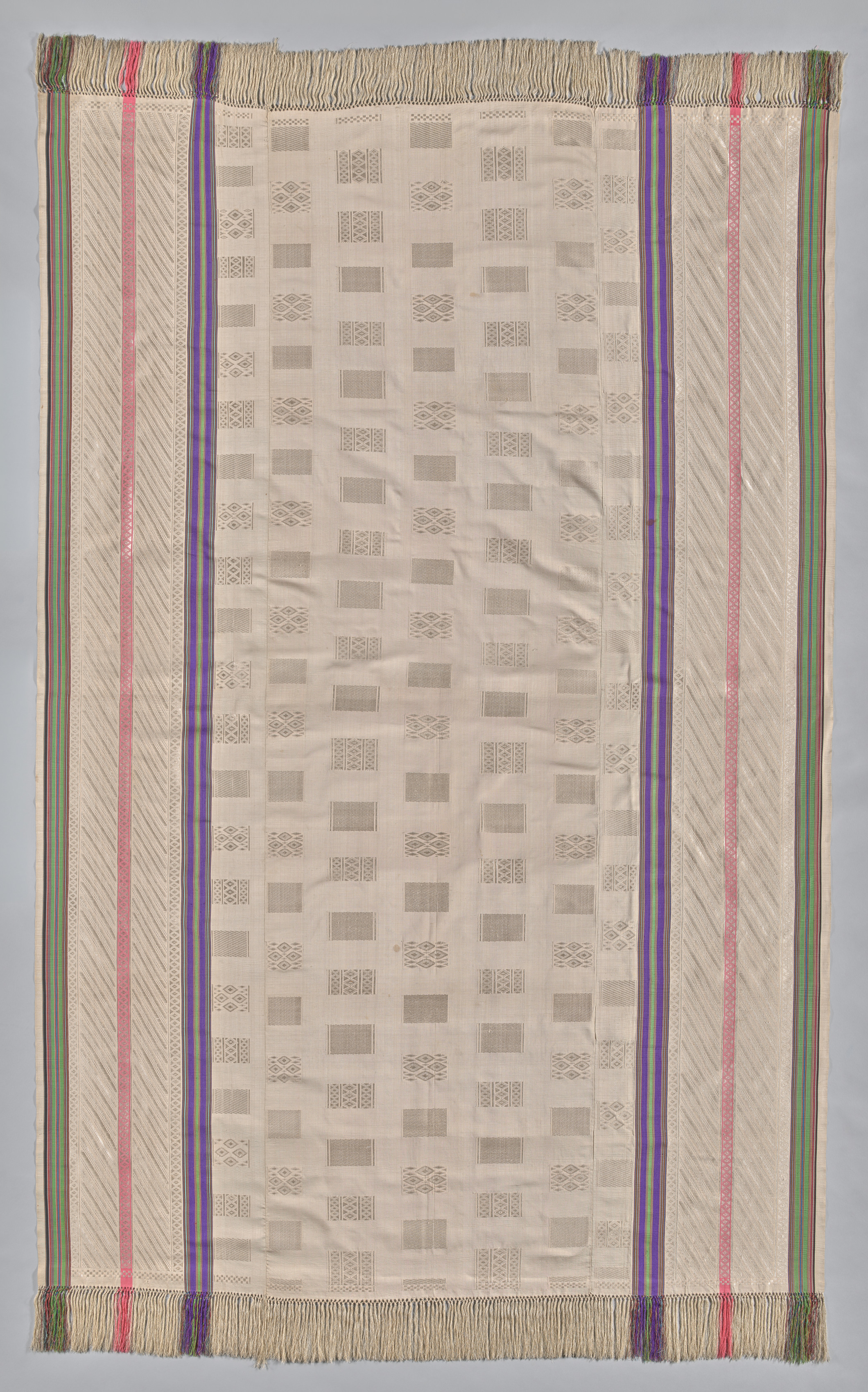
Deconstructing the Wrapper: The Lamba Akotifahana as a Proto-Avant-Garde Artifact
At Zoey Fashion Lab, our mandate is not merely to observe textiles but to interrogate their structural DNA. Today, we turn our analytical lens to a singular artifact: the Lamba Akotifahana from the Merina Kingdom of Madagascar. Attributed to an unknown weaver, this silk wrapper—rendered in the classic Merina style—is often classified as a ceremonial textile. However, through our deconstructionist framework, we identify it as a proto-avant-garde object, one that anticipates the conceptual and material disruptions of 20th-century fashion by several centuries. This analysis will dissect its technical composition, its symbolic subversion, and its uncanny resonance with contemporary design philosophy, positioning the Lamba as a new DNA strand in the evolution of wearable art.
Technical Autopsy: The Alchemy of Silk and Dye
The immediate technical reading of the Lamba Akotifahana reveals a mastery of warp-faced plain weave, a structure that prioritizes the longitudinal threads, creating a dense, lustrous surface that catches light with a liquid quality. The material—wild silk, likely from indigenous Borocera moths—is not the smooth, uniform filament of cultivated Bombyx mori. Instead, it is a coarse, irregular, and deeply textured fiber. This is the first point of avant-garde divergence: the deliberate rejection of perfection. Where haute couture historically chased flawlessness, the Merina weaver embraces the imperfect as an expressive register, allowing the natural irregularities to create a tactile, almost sculptural surface.
The dyeing process further complicates the technical narrative. The palette—often deep indigo, rich madder red, and ochre—is achieved through ikat resist-dyeing on the warp threads before weaving. This is not a surface application of color; it is a premeditated, structural intervention. The weaver must calculate the pattern’s placement with mathematical precision, knowing that the dye will bleed and blur slightly during the resist process. The resulting motifs—geometric lozenges, stylized floral forms, and abstracted ancestral symbols—are not crisp or graphic. They are soft-edged, ghostly, and atmospheric. This blurring is a radical act. It rejects the Cartesian clarity of Western pattern-making in favor of a diffuse, dreamlike aesthetic that prefigures the painterly distortions of Impressionism and the optical experiments of Op Art. The dye does not decorate the silk; it becomes part of its structural integrity, a fusion of color and fiber that challenges the hierarchy between material and ornament.
Symbolic Subversion: The Wrapper as a Site of Resistance
Beyond its material complexity, the Lamba Akotifahana functions as a potent social text. In Merina society, the wrapper was worn by high-ranking women and used in life-cycle rituals, from birth to burial. Yet, the unknown weaver’s choices suggest a quiet rebellion. The sheer scale of the textile—often over three meters in length—transforms the wearer into a mobile architectural presence. The wrapper does not conform to the body; it dictates the body’s movement, creating volume, shadow, and a commanding silhouette. This is a pre-emptive strike against the Victorian corset and the later restrictive tailoring of Dior’s New Look. The Lamba is a garment of agency, where the wearer negotiates space on her own terms, wrapping and re-wrapping the textile to create an ever-changing form.
The ikat motifs themselves are a coded language. While often interpreted as purely decorative, closer analysis reveals a lexicon of power. The lozenge, a recurring diamond shape, is not merely geometric; it is a symbol of the hasina—the sacred life force in Malagasy cosmology. By embedding this symbol into the fabric, the weaver transforms the wrapper into a wearable talisman, a protective shield of spiritual authority. This is a profound subversion of the Western notion of fashion as mere vanity. Here, dress is ontological—it is a declaration of being, a negotiation with the ancestral realm, and a visible assertion of the wearer’s place in the cosmic order. The avant-garde, with its obsession with identity and the body as a canvas, finds an uncanny precursor in this practice.
Comparative Analysis: The Lamba and the Avant-Garde Canon
When we place the Lamba Akotifahana alongside canonical avant-garde works, the parallels are startling. Consider the deconstructed garments of Rei Kawakubo and Yohji Yamamoto. Their slashed, asymmetrical, and deliberately unfinished designs are often read as a rebellion against Western tailoring. Yet, the Merina weaver had already achieved this rupture centuries earlier. The Lamba’s raw silk edges, its intentional color bleeding, and its refusal to conform to a fixed silhouette are direct antecedents to the Japanese designers’ philosophy of wabi-sabi—the beauty of imperfection and transience. The unknown weaver is, in effect, the first deconstructionist, treating the fabric not as a passive material but as a living collaborator in the creative act.
Furthermore, the Lamba’s scale and wrapping technique evoke the performative installations of artists like Christo and Jeanne-Claude. The act of wrapping the body in a three-meter silk panel is a temporary, site-specific intervention. The wearer becomes a living sculpture, and the textile’s drape is a dynamic, kinetic event. This is not a static garment; it is a choreographic score that unfolds with every gesture. This aligns with the avant-garde’s shift from object to experience, from the garment as a fixed product to the garment as a process. The Lamba is not a dress; it is a happening.
The New DNA Strand: A Blueprint for Zoey Fashion Lab
For Zoey Fashion Lab, the Lamba Akotifahana is not a historical curiosity but a generative blueprint. We identify three core principles extracted from this textile that will inform our next collection:
1. Material Agency: We will reject synthetic perfection and embrace irregular, locally-sourced fibers with inherent textural variance. Our fabrics will be living, not static, with natural slubs and uneven weaves that add depth and narrative.
2. Structural Color: We will move beyond surface printing and adopt resist-dyeing and warp-ikat techniques to embed color into the fabric’s core, creating a gradient of opacity and a soft-focus effect that changes with movement and light. The garment’s color will be an event, not a fixed attribute.
3. Transformative Silhouette: We will design modular, wrap-based garments that allow the wearer to reconfigure the piece for different contexts. The garment will offer agency, not constraint, echoing the Lamba’s ability to adapt to the wearer’s body and intention.
In conclusion, the Lamba Akotifahana by an unknown Merina weaver is a masterclass in radical innovation. It dismantles the binary between craft and art, between tradition and rebellion. Its silk and dye are not just materials; they are a philosophical argument for a fashion that is structurally intelligent, symbolically potent, and profoundly human. At Zoey Fashion Lab, we do not merely study this garment—we inherit its disruptive DNA, and we weave it into the future.