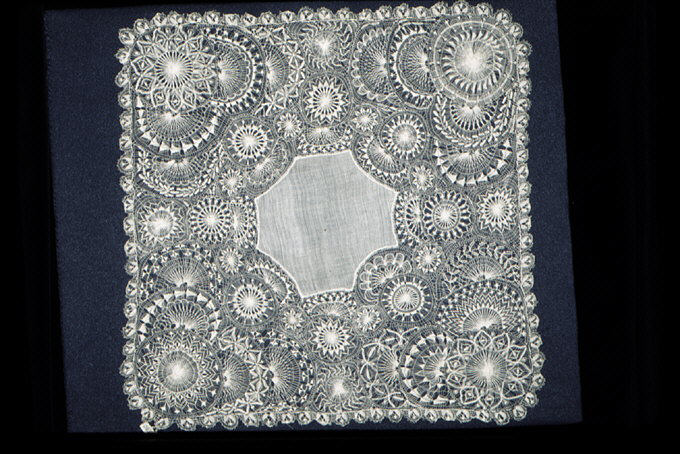
The Handkerchief Reimagined: Deconstructing Paraguayan Lace for the SS26 Silhouette
In the rarefied atmosphere of avant-garde fashion, the mundane object is not merely a source of inspiration; it is a provocation. The lace handkerchief—a relic of sentimental modesty, a whisper of a bygone era—presents a singular challenge. For Zoey Fashion Laboratory’s SS26 study, we isolate this object from its historical context of coy utility and elevate it into a structural proposition. The Paraguayan ñandutí, or embroidered net, offers an extraordinary lexicon of geometric tension and organic flow. Our task is not to adorn the body with this handkerchief, but to interrogate the very architecture of clothing through its lens. We propose a radical re-reading: the handkerchief as a load-bearing membrane, a cartographic fragment of identity, and a blueprint for a new, fluid futurism.
From Sentimental Relic to Structural Membrane
The conventional handkerchief is defined by its perimeter—a finite, neat square of folded intimacy. The Paraguayan ñandutí, however, subverts this boundary. Its name, meaning "spider web" in Guaraní, alludes to a radial, almost cosmological structure. The embroidered net is not a solid field but a system of voids and dense, raised threads. For SS26, we reject the handkerchief’s flatness. Instead, we treat the embroidery as a tensile architecture, a network of micro-struts and connective filaments that can be manipulated to create volume without weight.
Consider the primary silhouette: the Exoskeletal Cocoon. Here, a single, oversized handkerchief—perhaps 120cm square—is not folded but stretched over a rigid, internal frame of recycled carbon fiber. The lace’s open net becomes a transparent, breathable shell. The dense, floral embroidery clusters are positioned strategically at the shoulders and hips, acting as structural nodes that distribute tension. The result is a garment that appears to hover around the body, a ghost of clothing that defines space through absence. The wearer’s skin becomes part of the design, a living canvas behind the intricate web. This is not a dress; it is a wearable proposition about the relationship between interior and exterior, between the hidden and the revealed.
The Deconstructive Grid: Fragmentation and Reassembly
Our second approach involves violent deconstruction followed by precise reassembly. We slice the handkerchief into radial segments, each piece a wedge of the original circle. These segments are then re-sewn at radical angles, creating a flared, asymmetric skirt that defies the body’s natural rotation. The embroidered edges, typically the finished border, are now left raw, fraying into a delicate fringe that catches light and movement. This technique, which we term cartographic draping, maps a new geography onto the human form. The handkerchief’s original center—often the most densely embroidered point—becomes a focal point at the small of the back or the nape of the neck, drawing the eye to unexpected loci of gravity.
The materiality of the Paraguayan net is crucial here. It is not a fragile, gossamer tulle; it is a robust, hand-worked cotton or silk blend that holds its shape with surprising tenacity. This allows for cantilevered volumes. A sleeve can be constructed to jut out from the shoulder, supported by the internal tension of the embroidery itself, with no visible seam or wiring. The lace acts like a pre-stressed concrete shell, strong in compression and tension. The result is a futuristic silhouette that is both organic and engineered, reminiscent of a satellite dish or a blooming cactus flower.
Material Alchemy: The Net as a Digital Interface
To move beyond mere craftsmanship, we must consider the handkerchief’s potential as a phygital interface. The open grid of the ñandutí is a perfect matrix for embedded technology. Imagine micro-LEDs woven into the dense embroidery, tracing the floral patterns with ephemeral light. The handkerchief becomes a wearable screen, broadcasting biometric data or abstract visual poetry. For SS26, we propose a prototype where the lace’s negative spaces are filled with a thermochromic polymer. As the wearer’s body temperature rises, the net shifts from an opaque ivory to a translucent, electric cyan, revealing the skin beneath in a slow, organic bloom. This is not decorative gimmickry; it is a commentary on vulnerability and visibility in the digital age. The handkerchief, historically a tool for concealing emotion, becomes a medium for radical transparency.
Silhouette Innovations: The Asymmetrical Orbit
Our third silhouette, the Asymmetrical Orbit, abandons the vertical axis entirely. Multiple handkerchiefs of varying sizes are joined edge-to-edge, creating a vast, undulating plane. This plane is then wrapped around the torso in a spiral, with the embroidered centers acting as magnetic foci. The garment is secured with a single, sculptural clasp of frosted resin, mimicking the look of frozen water. The effect is a dress that has no front or back, only a continuous, flowing trajectory. The net’s transparency layers over itself, creating moiré patterns that shift with every step. This silhouette challenges the very notion of a garment’s "fit." It is not tailored to the body; it is a dynamic environment that the body inhabits. The wearer becomes a kinetic sculpture, and the handkerchief, a portable piece of Paraguayan sky.
Conclusion: A Manifesto for the Intimate Future
The Paraguayan lace handkerchief is not a nostalgic artifact. It is a manifesto. Its intricate, labor-intensive construction speaks to a value system that rejects fast fashion’s disposability. Its open net speaks to a future of breathability, adaptability, and transparency. For Zoey Fashion Laboratory, SS26 is not about designing clothes; it is about designing possibilities. We use the handkerchief as a starting point to question the fundamental tenets of dress: structure, opacity, and permanence. The resulting silhouettes are not easy. They demand a wearer who is confident in their own ambiguity, who understands that fashion is a form of intellectual and emotional expression. The ñandutí, once a humble square of cloth, becomes a portal to a future where clothing is not a covering but a conversation—a delicate, powerful, and radically open dialogue between the self, the world, and the infinite spaces in between. This is the definitive avant-garde statement: the smallest, most intimate object, re-engineered to redefine the largest possible horizon.