The Immaterial Armature: Deconstructing Laozi for SS26
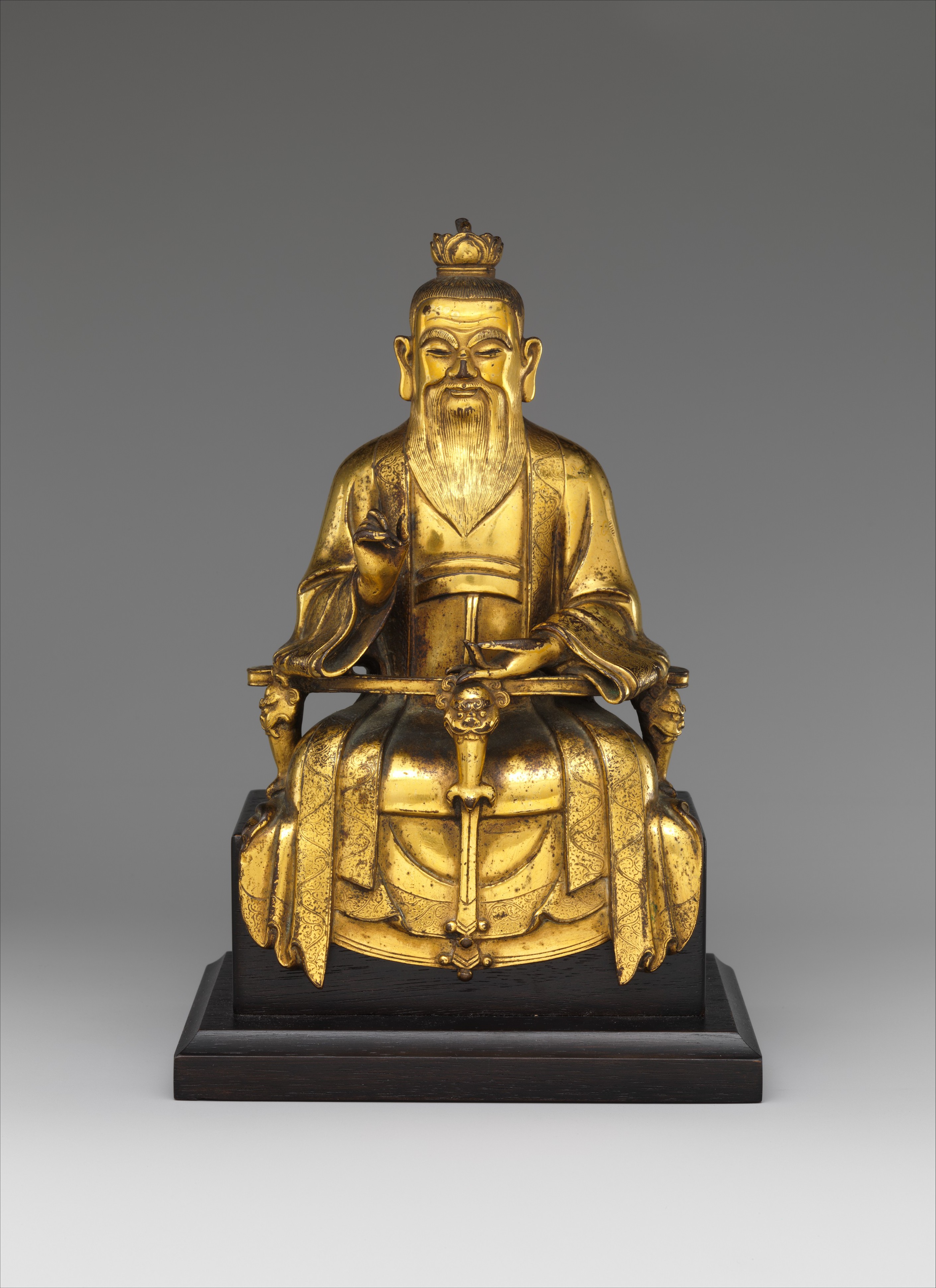
In the relentless forward-march of fashion’s vanguard, the past is not a relic but a reactive agent—a catalyst for the unbuilt. For Zoey Fashion Laboratory’s SS26 manifesto, we turn not to the sterile futurism of chrome and circuitry, but to the paradoxical stillness of Daoist philosophy. Our subject is Laozi, the legendary sage, rendered not in silk and ink, but in gilt copper alloy. This is not historical costume; it is a metaphysical excavation. We are extracting the qi of the Daodejing and forging it into a wearable architecture of absence. The result is a collection that interrogates the very notion of silhouette, proposing that the future of fashion lies not in addition, but in strategic deletion and the sculptural power of negative space.
From Static Idol to Kinetic Void: The Core Thesis
The traditional representation of Laozi—a seated, bearded elder, often astride an ox—is a study in gravitational permanence. Our gilt copper alloy source material, with its dense, reflective surface, offers a paradox: weight that appears weightless, solidity that dissolves into light. For SS26, we reject the literal figuration. Instead, we deconstruct the iconography of the sage into its constituent philosophical principles: wu wei (effortless action), pu (the uncarved block), and the cyclical nature of the Dao. These become our pattern pieces. The garment is no longer a covering; it is a philosophical diagram worn on the body.
Our primary structural innovation is the "Void-Core Silhouette." Imagine a jacket constructed from panels of liquid-metal-finish technical jersey and laser-sintered copper-alloy mesh. The shoulders are not padded but cantilevered, extending outward in a sharp, asymmetrical arc that mimics the tilted axis of a celestial body. Yet, at the center of the torso, a deliberate absence: a geometric cut-out that begins at the sternum and sweeps around to the lumbar spine, exposing the skin. This is not a mere cut; it is a portal. It represents the Daoist concept of the empty vessel—the unworked clay whose utility lies in its hollowness. The garment’s power is not in what it covers, but in the void it frames.
Material Alchemy: The Gilt Copper Dialectic
The choice of gilt copper alloy is not arbitrary. Copper, in its raw state, is mutable, conductive, and prone to oxidation—a metaphor for the mortal, changing self. The gilding, a thin layer of gold, is the immutable, eternal principle. This dialectic is the collection’s material heartbeat. We will not simply mimic the metal’s color. Instead, we will deploy it in three distinct states:
- Milled Exoskeleton: Panels of precision-cut, gold-toned alloy, hinged with micro-silicone joints, creating a flexible yet rigid armor that moves with a robotic, yet organic, fluidity. This is the sage’s external form—the persona presented to the world.
- Oxidized Underlayer: Beneath the exoskeleton, a base layer of copper-toned, acid-washed silk organza, deliberately tarnished to a deep, verdigris green. This represents the internal process—the quiet, unseen transformation of the spirit.
- Vaporized Finish: For draped elements, a technical crepe treated with a metallic foil that fractures and peels at stress points, suggesting the impermanence of all material constructs.
This tripartite materiality creates a living garment that changes character with movement and light. Under a sharp spotlight, it is a monument of gold. In shadow, it recedes into a dark, oxidized relic. The wearer becomes a mobile installation, a walking meditation on the dual nature of existence.
Structural Innovations: The Architecture of Effortlessness
Our construction techniques challenge traditional couture ateliers. We are abandoning the shoulder seam. In its place, a continuous, spiraling seam that begins at the left hip, ascends across the back, and terminates at the right clavicle. This single, unbroken line of stitching—executed in a copper-alloy thread—visually and structurally binds the garment to the body’s kinetic center, the dantian. The result is a silhouette that appears to have been grown rather than sewn, a garment that achieves its shape through tension and release, not rigid tailoring.
The "Ox-Form" Trousers: A Study in Asymmetrical Flow
Laozi’s mythical departure on an ox inspires our most radical bottom silhouette. The "Ox-Form" trousers are a hybrid of a wide-leg pant and a sculpted kilt. The left leg is constructed from a single, unbroken panel of the vaporized crepe, falling in a fluid, columnar line to the floor. The right leg, however, is a complex construction of the milled exoskeleton panels, articulated to flare dramatically at the hip, mimicking the powerful haunch of the animal, before tapering to a sharp, cuffless ankle. The asymmetry is not decorative; it is a dynamic imbalance, forcing the wearer into a posture of deliberate, unhurried movement—the physical embodiment of wu wei. One side is fluid potential (the Dao), the other is structured actuality (the manifestation).
Standalone Avant-Garde Study: SS26 as a Conceptual Manifesto
This is not a collection for the timid. It is a standalone study, a thesis on the future of garment construction. The gilt copper alloy is not a trend; it is a philosophical statement. The futuristic silhouettes are not science fiction; they are the logical conclusion of a design process that prioritizes concept over convention. The structural innovation lies in our refusal to accept the body as a static mannequin. Instead, we treat the body as a vessel, a temporary container for the eternal Dao.
The final piece in the study is a full-length cloak, the "Daodejing Mantle." It is constructed from hundreds of individual, hand-linked rings of the gilt copper alloy, creating a chainmail of immense weight and fluidity. But the innovation is in its closure: there is none. The mantle is held to the body solely by a single, magnetic clasp at the nape of the neck. It does not wrap; it hangs, an armored waterfall that moves as one continuous, liquid mass. It is heavy, yet it feels weightless. It is ancient, yet it is utterly of the future. It is the ultimate expression of our thesis: that the most profound statement in fashion is not what you add, but what you dare to leave open. This is the new Dao of couture.