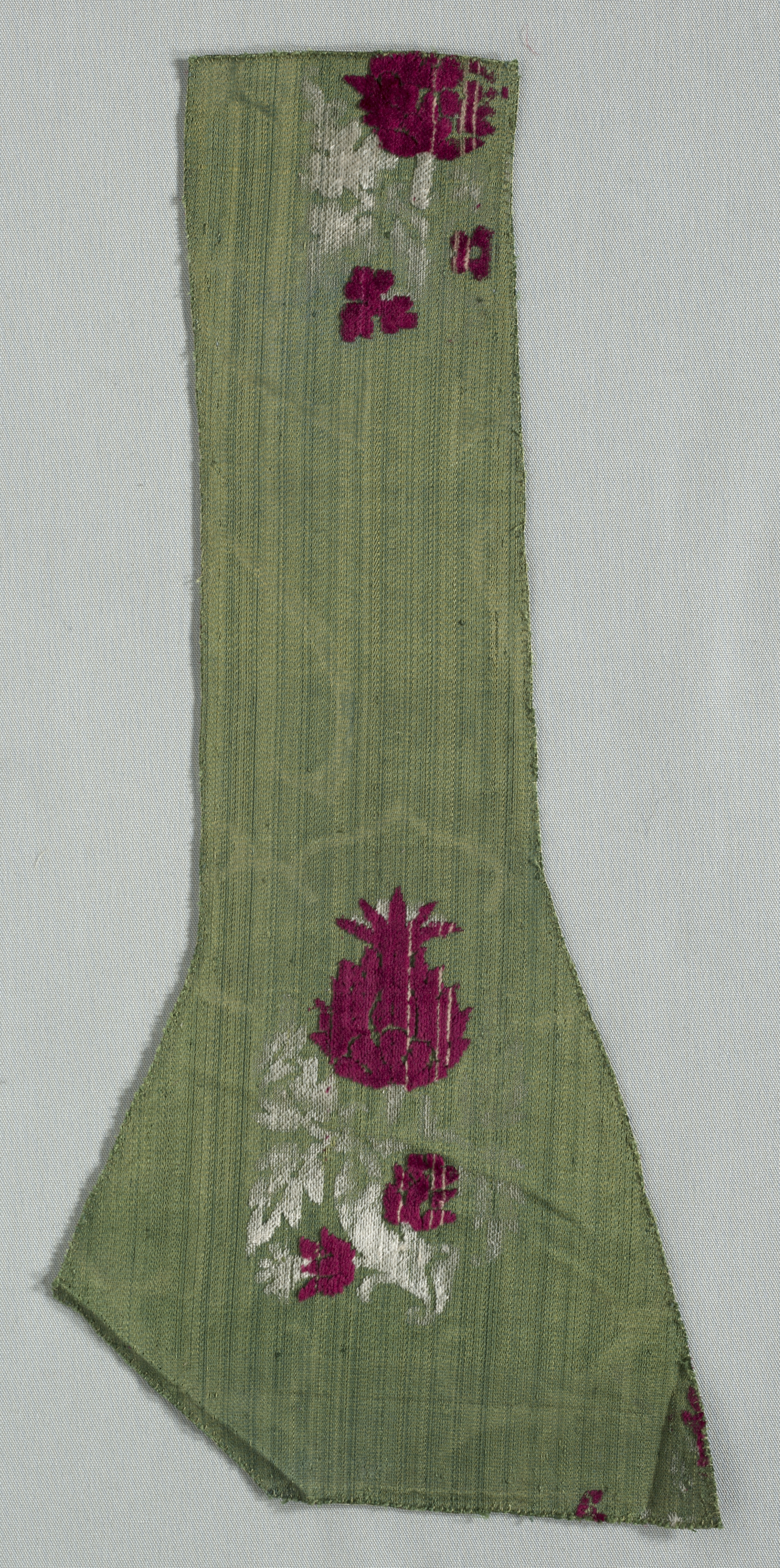
Deconstructing the Velvet Fragment: A Technical and Conceptual Analysis for Zoey Fashion Lab
At Zoey Fashion Lab, our mandate extends beyond the mere replication of historical textiles. We engage in a process of fabric deconstruction—a forensic and poetic examination that isolates the structural, tactile, and cultural DNA of a material to inform avant-garde design. The subject of this analysis is a singular Velvet Fragment, originating from Italy in the mid-15th century. This piece, composed of cut and voided silk velvet, is not merely an artifact; it is a New DNA Strand—a genetic code that, when decoded, offers a radical blueprint for contemporary construction, drape, and surface manipulation.
I. Technical Autopsy: The Weave as Architecture
The fragment’s technical construction is the first site of deconstruction. Mid-15th century Italian velvet, particularly from centers like Florence or Venice, represents the apex of medieval textile engineering. The term “cut and voided” is critical. In this weave, two distinct warp systems are employed: the ground warp (often linen or silk for stability) and the pile warp (pure silk). The pile is lifted over small metal rods; when the rods are removed and the loops are sliced, a dense, plush surface is created. The “voided” aspect refers to the deliberate absence of pile in specific areas, allowing the ground weave to show through, creating a contrasting matte versus lustrous pattern.
For the avant-garde designer, this is not a decorative afterthought but a structural dualism. The voided areas act as negative space, creating a topographical map of light and shadow. In our reinterpretation, we propose a deconstructed velvet where the pile is not uniformly cut. Instead, we advocate for a controlled, laser-etched voiding process, where the ground weave is exposed in algorithmic, non-representational patterns. This transforms the historical “pattern” into a dynamic interface—a fabric that changes its visual density based on movement and viewing angle. The technical lesson is one of relational tension: the plush versus the flat, the opaque versus the translucent. Our new strand will amplify this by using a monofilament ground warp, making the voided areas semi-transparent, thereby creating a garment that oscillates between solidity and ethereality.
The Role of Silk: A Liquid Metal Substrate
The choice of silk is paramount. The original fragment’s silk pile provides an unparalleled depth of color—a chromatic intensity that cannot be replicated by synthetic fibers. Silk’s triangular cross-section refracts light like a prism, producing a shimmering, almost liquid effect. In the 15th century, this was a symbol of divine light and earthly wealth. For Zoey Fashion Lab, we reinterpret silk not as a luxury signifier but as a responsive membrane. We propose a hybrid yarn: a core of recycled silk filament wrapped in a bio-engineered cellulose derivative. This yields the same refractive index but with enhanced moisture-wicking and structural memory. The result is a velvet that breathes, holds a sculptural fold, and responds to body heat—a fabric that is alive in a manner the original could only suggest.
II. Historical Context: The Fragment as a Rupture
The mid-15th century is a period of profound transition—the cusp of the Renaissance, where the medieval guild system began to yield to early capitalist production. This velvet fragment is a product of that rupture. It was likely part of a pallotto (altar frontal) or a sumptuous court garment, designed to convey ecclesiastical or aristocratic power. The “voided” areas often depicted pomegranate motifs or heraldic devices, symbolizing fertility and lineage. To deconstruct this is to acknowledge the fabric’s original function as a tool of social stratification.
Our avant-garde approach must therefore engage in a form of semantic sabotage. We strip the fragment of its original iconography. We do not reproduce the pomegranate or the heraldic eagle. Instead, we isolate the process of voiding—the act of removal—and turn it into the primary aesthetic. The “void” becomes a metaphor for the erasure of historical hierarchies. In our designs, the voided areas will be irregular, jagged, and organic, resembling digital glitches or biological cell division. This is a deliberate commentary on the fragmentary nature of history itself—we cannot reconstruct the past, only re-contextualize its remnants. The garment becomes a wearable archive, where the missing pile is as significant as the present plush.
From Relic to Prototype
The fragment’s small size—likely less than a square meter—is also instructive. It is a synecdoche, a part standing for a lost whole. For the avant-garde, this suggests a design methodology based on modularity. We propose garments constructed from small, tessellated velvet panels, each with its own unique voiding pattern. These panels can be joined via visible, structural seams—a celebration of construction rather than an erasure of it. This is a direct opposition to the 15th-century desire for seamless, uninterrupted luxury. Our approach is deconstructivist, echoing the work of Rei Kawakubo or Martin Margiela, but with a technical specificity derived from this historical source. The garment is never finished; it is a kit of parts, allowing for reconfiguration and personalization.
III. The New DNA Strand: Translating Heritage into Future Systems
To synthesize this analysis, we define the New DNA Strand as a multi-scalar system:
1. Material Level: We will develop a velvet with a variable pile height, using a double-beam loom equipped with programmable jacquard heads. This allows for a gradient from 2mm to 8mm pile within a single weave, creating a tactile topography without the need for post-production cutting. The voided areas will be achieved through a soluble PVA (polyvinyl alcohol) yarn that dissolves in hot water, leaving behind precise, clean-edged voids that mimic the historical technique but with infinite complexity.
2. Structural Level: The ground weave will be a silk-organza base, providing rigidity and a crisp sound when the fabric moves—a stark contrast to the soft, silent plush of the pile. This creates an auditory dimension to the garment, a rustling that speaks to the fabric’s dual nature. We will also integrate a conductive yarn within the ground weave, enabling the garment to respond to touch—LEDs embedded in the pile can illuminate the voided areas, turning the historical “pattern” into an interactive light show.
3. Conceptual Level: The design philosophy is “Archival Futurism.” We are not creating a costume or a pastiche. We are using the 15th-century velvet as a grammar—a set of rules about tension, contrast, and removal—to write a new sentence. The garment will be asymmetric, with exaggerated, sculptural shoulders that reference the rigid formality of courtly dress, but the hem will be raw, frayed, and unfinished, exposing the warp threads. This is a deliberate juxtaposition of the precious and the abject, the finished and the processual.
Conclusion: The Fragment as a Living System
In conclusion, the Italian velvet fragment is not a static object of study but a catalyst for innovation. Its technical brilliance—the cut and voided weave—provides a blueprint for creating fabrics with inherent contrast and depth. Its historical weight demands a critical response, one that subverts rather than replicates. By isolating the void as a primary design element and by treating the fragment as a modular, incomplete system, Zoey Fashion Lab will produce a capsule collection that is both deeply rooted in textile history and radically forward-looking. The New DNA Strand is thus a living archive—a velvet that is simultaneously ancient and futuristic, plush and void, silent and responsive. This is the essence of deconstruction: not to destroy, but to reveal the underlying architecture of beauty and to rebuild it in a new, disruptive image.