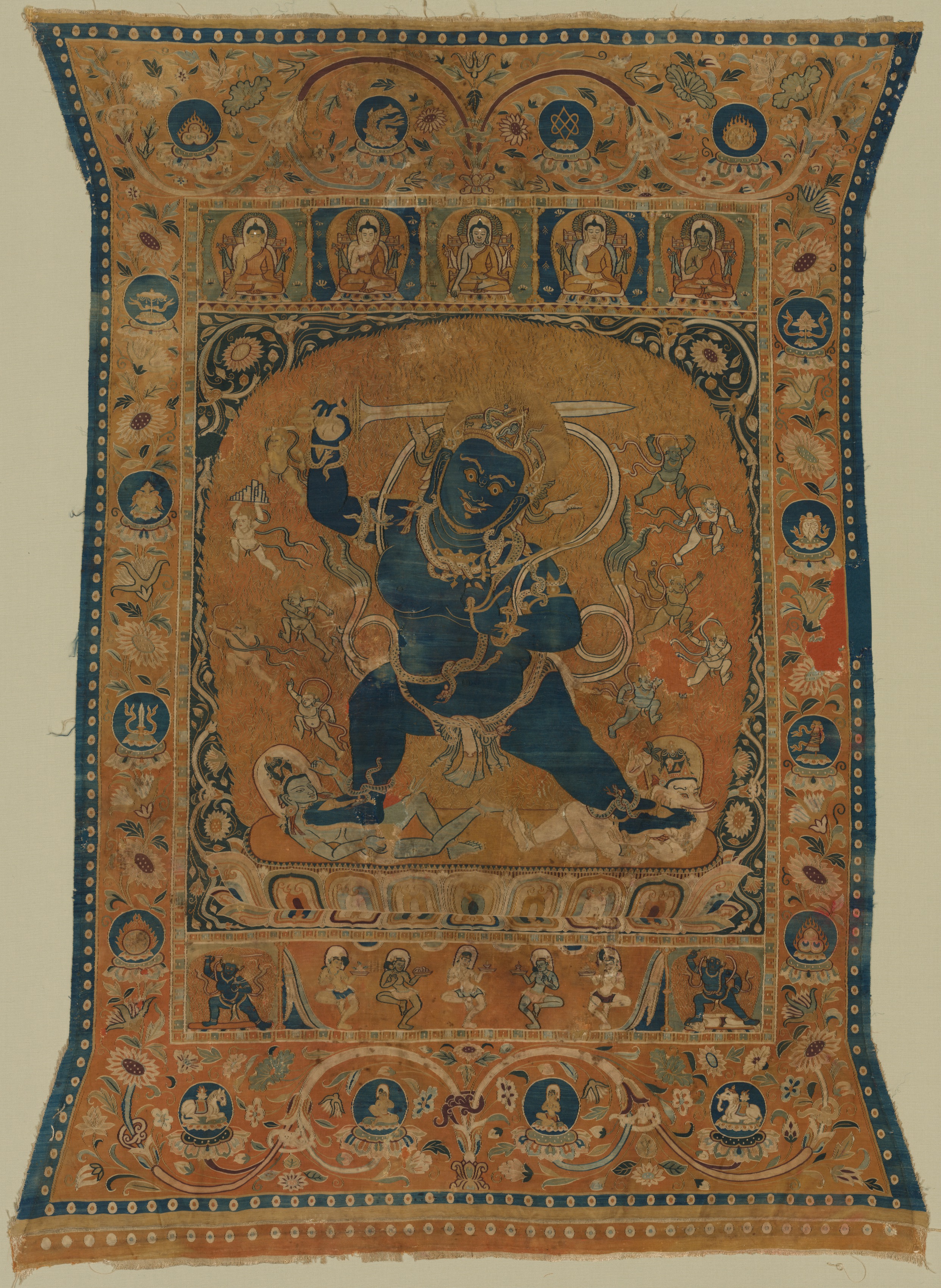
Deconstructing the Sacred: Achala as an Avant-Garde Textile Manifesto
At Zoey Fashion Lab, we do not merely observe artifacts; we interrogate them. We strip away the patina of reverence to expose the raw, structural DNA of their creation. The subject of this analysis—Achala, King of the Wrathful Ones, a 16th-17th century Chinese thangka rendered in silk tapestry with pearls—presents a paradox that is irresistible to the avant-garde sensibility. Hailing from Zhejiang Province, likely the imperial ateliers of Hangzhou, this piece is not a static religious icon. It is a proto-deconstructionist object, a violent collision of material opulence and spiritual ferocity, of imperial technique and esoteric intent. For the modern fashion house, this thangka is a blueprint for radical innovation, challenging our assumptions about texture, structure, and the very function of adornment.
The Wrathful Aesthetic: Deconstructing the Divine Body
Achala, the “Immovable One,” is depicted not in serene meditation but in a state of controlled fury. His bulging eyes, bared fangs, and dynamic posture are not expressions of anger but of transcendent destruction—the annihilation of ignorance. In our deconstructionist framework, this iconography translates directly into silhouette. The traditional thangka’s flat, frontal presentation is a denial of Western perspective, a deliberate flattening that anticipates the modernist canvas. For Zoey, this suggests a radical departure from the sculpted, three-dimensional body. We envision garments that embrace two-dimensionality, that use aggressive, angular draping to mimic Achala’s flaming aura. The “wrathful” expression is not a literal face but a structural attitude: sharp shoulder pads that jut like vajra blades, asymmetric hems that slash across the body, and rigid, unyielding fabrics that refuse to drape softly. The garment becomes a weapon, not a covering.
Furthermore, the materiality of the thangka—silk tapestry (kesi)—is a study in contradictions. Kesi, meaning “cut silk,” is a technique where the weft threads are broken and re-joined to create pictorial detail, leaving tiny slits or gaps. These are not flaws; they are the structural signature of the maker’s hand. In haute couture, this translates to a deliberate embrace of the imperfect. We propose a textile methodology that celebrates the “cut” as a design element: seams left open, threads intentionally frayed, and panels joined with visible, architectural gaps. This is not deconstruction for its own sake, but a philosophical echo of Achala’s role—to cut through illusion. The pearls, traditionally sewn onto the surface, become three-dimensional pixels, breaking the flatness of the silk. In our lab, we re-imagine these pearls not as delicate embellishment but as tactile, weighted armor, clustered densely on a bodice or cascading down a sleeve to create a surface that is at once precious and aggressive.
Archive Resonance: The Politics of Hybridity
The archive note, “Archive Resonance: 在人类文明的长河中,器物与绘画不仅是时代技艺的结晶,更是文化碰撞与美学交融的无声见证。十六至十七世纪....” (In the long river of human civilization, objects and paintings are not only the crystallization of the era’s skills, but also silent witnesses to cultural collision and aesthetic fusion. 16th-17th century...), is crucial. This thangka was created in China, yet it depicts a deity of Indian Vajrayana Buddhism, rendered using a Chinese imperial technique. This is a cross-cultural synthesis that predates globalization by centuries. The avant-garde mandate is to make this synthesis visible, not to hide it. We reject the notion of a “pure” cultural origin. Instead, we champion the hybrid as the primary mode of contemporary expression.
For Zoey, this means building collections that are not bound by geography. We take the structural logic of the kesi loom and fuse it with the ergonomic cutting of Japanese origami, the volumetric draping of 16th-century Spanish court dress, and the functional minimalism of modern sportswear. The thangka’s mandala-like composition—a central deity surrounded by a structured cosmos—becomes a template for garment mapping. The central figure is the torso, the radiating flames are the sleeves, and the lotus pedestal is the skirt. This is not a costume; it is a wearable cosmology. The pearls, sourced from freshwater rivers, are not just decorative but are a commentary on trade routes and the movement of materials across Asia. We use them to trace a cartography of exchange on the body, placing them along seams to map the journey of silk from Hangzhou to the steppes and back.
Avant-Garde Application: From Thangka to Runway
The translation from sacred textile to avant-garde fashion requires a radical re-contextualization. We propose a capsule collection, “Immovable,” that embodies these principles. The first piece is a “Kesi Armor”—a structured jacket made of raw silk and technical mesh, with deliberate slits at the elbows and shoulders to mimic the tapestry’s cut-weft technique. Instead of pearls, we use micro-ceramic beads, glazed in a high-fire, volcanic black, to echo Achala’s wrathful energy. The silhouette is severe, with a high, mandarin collar that rises to the chin, and sleeves that are cut to appear as if they are about to burst into flame—asymmetrical, jagged, and lined with a burnt-orange organza.
The second piece, “Vajra Gown”, is a floor-length sheath that appears to be woven from a single, continuous thread, but upon closer inspection, is composed of hundreds of interlocking panels. This is a direct reference to the kesi technique’s meticulous labor. The gown is constructed in a deep, indigo blue—the color of the night sky and of the wrathful deity’s complexion—and is entirely covered in a dense, pixelated pattern of hand-stitched, matte black sequins. This is not glitter; it is a tactile, armor-like surface that absorbs light, creating a void on the body. The “pearls” are re-imagined as a belt of large, baroque, freshwater pearls, but they are strung on a rigid wire, forcing them to stand away from the body like a structural cage. This is the avant-garde gesture: taking the most precious, organic material and alienating it, making it architectural rather than decorative.
Conclusion: The Immovable Force of Innovation
Achala, King of the Wrathful Ones, is not a relic. He is a force of creative destruction, a reminder that true innovation arises from the violent collision of ideas, materials, and cultures. The thangka from Hangzhou is a testament to the fact that the most profound art is born from tension—between the sacred and the profane, the flat and the sculptural, the imperial and the esoteric. At Zoey Fashion Lab, we draw our energy from this tension. We do not copy the thangka; we deconstruct its principles to build a new language of form. The “Immovable” collection is not about stillness; it is about the immovable conviction to challenge the status quo, to cut through the fabric of convention, and to wear one’s wrath as a badge of radical, beautiful defiance. The pearls are not ornaments; they are the hardened tears of a culture in flux, and we wear them as proof that fashion is the most potent archive of the human spirit.