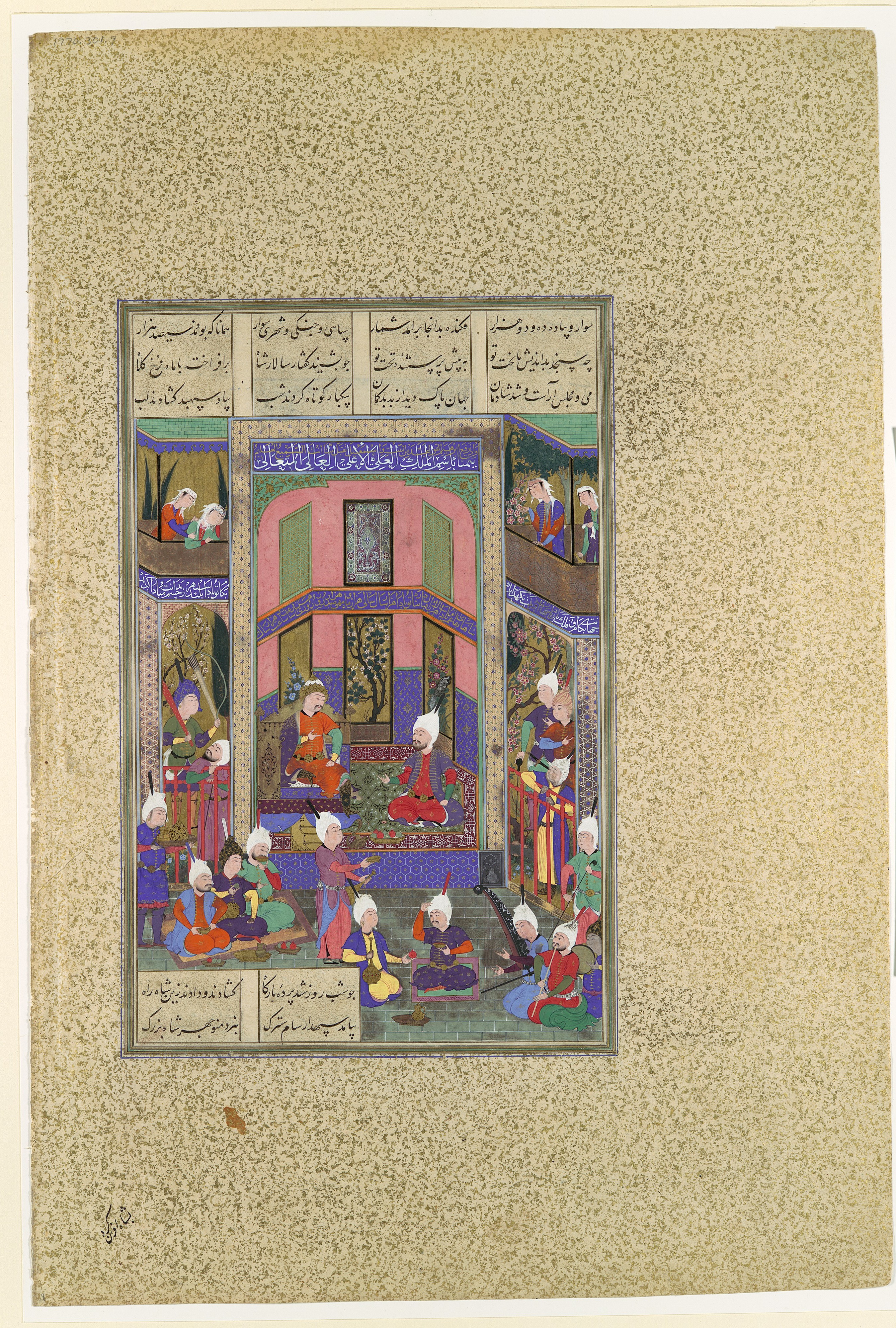
The Sovereign’s Seam: Deconstructing Power Geometry from Folio 80v
In the rarefied ether of Zoey Fashion Laboratory, we do not merely observe historical artifacts; we dissect their latent sartorial codes. The 16th-century Persian miniature, “Manuchihr Welcomes Sam but Orders War upon Mihrab,” from the Shahnama of Shah Tahmasp, is not a relic but a blueprint for a post-humanist wardrobe. For SS26, we extract the structural logic of absolute authority—the tension between ceremonial embrace and martial decree—and translate it into garments that function as architectural armor for the psyche. This is not costume; this is wearable statecraft.
I. The Geometry of Duality: Silhouette as Political Syntax
The folio’s composition hinges on a violent dichotomy: the horizontal plane of welcome (Sam’s arrival) versus the vertical thrust of conflict (the order against Mihrab). Our SS26 silhouette mirrors this through bifurcated volume displacement. Imagine a coat that is asymmetrically constructed—a single, exaggerated shoulder panel that sweeps forward like the Shah’s decree, while the opposite side is ruthlessly tailored to the body, echoing the stillness of the court. This is “diplomatic tailoring”: the garment’s front speaks in sweeping, cape-like arcs (the embrace), while the back is precision-cut with razor-sharp darts that mimic the calligraphic edge of a war edict. The hemline is not even; it is a topographic map of the battlefield, rising sharply at one hip and cascading into a train that drags like a banner of conquest.
Further structural innovation lies in the “throne collar.” Derived from the miniature’s ornate architectural frames, we construct a high, rigid collar that extends upward and outward, not unlike a lotus leaf, but rendered in a bio-engineered, metallic organza. It does not merely encircle the neck; it frames the face as a sovereign emblem, isolating the wearer’s gaze as the single point of authority. The collar is articulated with micro-hinges, allowing it to fold flat for transport or erect into a full halo of power—a kinetic response to the wearer’s social environment. This is futurism rooted in protocol, where the body’s posture is dictated by the garment’s engineered rigidity.
II. Material Alchemy: The Metallurgy of Command
The Shahnama’s palette—opaque watercolor, silver, and gold—is not decorative. It is a hierarchy of luminance. For SS26, we reject flat metallic prints. Instead, we employ “liquid metal mosaic”: thousands of micro-sequins, each hand-dipped in a different alloy of silver, bronze, and palladium, are applied in a gradient that mimics the miniature’s illuminated sky. But the innovation is in the reactive substrate. The base fabric is a smart textile embedded with thermochromic pigments. When the wearer’s body temperature rises (in conflict or passion), the silver areas shift to a deep, oxidized black, while the gold remains constant—a literal manifestation of the Shah’s unwavering will amidst chaos.
We also introduce “edict leather.” This is not traditional hide but a lab-grown, mushroom-based mycelium composite, embossed with a pattern that recreates the miniature’s intricate arabesques—yet the pattern is not static. It is laser-cut with a lattice of perforations that, when stretched over a pneumatic frame, open like the gates of a citadel, revealing a layer of reflective, chrome-plated mesh beneath. The garment breathes with the wearer’s decision-making. In moments of stillness, it appears as solid, gilded armor; in motion, it fractures into a thousand shards of light, echoing the chaos of the impending war.
III. The Sleeve of Sam: Engineering the Embrace
Sam’s arrival is depicted with a sense of sweeping motion, his robes billowing. We capture this in the “welcoming sleeve”—an extreme, exaggerated appendage that is not a sleeve at all, but a detachable volumetric module. Constructed from a spiral-wound, carbon-fiber skeleton, it unfolds from a compact cuff into a three-meter arc of iridescent, feather-light silk. The structure is based on a tensegrity system, where compression and tension are balanced to create a form that stands independent of the arm’s movement. This is not about utility; it is about ceremonial presence. The wearer can choose to deploy this module for a moment of grand reception, then retract it with a magnetic pull, reverting to a stark, militaristic silhouette. It is a garment that performs diplomacy as a physical act.
IV. Ornament as Ordinance: The New Regalia
The miniature’s gold detailing is not merely decorative; it is a visual weapon of status. Our SS26 accessories are “calligraphic weaponry.” We create belts that are not leather straps but flexible, 3D-printed metal spines, each link engraved with a micro-inscription from the Shahnama’s poetry. When worn, they function as a corset of discipline, cinching the waist into an extreme, wasp-like form—a silhouette that is both futuristic and deeply historical. The clasp is a “royal seal”: a massive, cabochon-cut piece of lab-grown obsidian, set in a fractal, titanium frame. It does not simply fasten; it declares the end of negotiation.
Headpieces are paramount. We introduce the “Mihrab halo”—a circular, metallic frame that hovers around the head via a hidden magnetic neck brace. It is not attached to the skull; it orbits it. The frame is etched with a pattern that, when viewed from an angle, casts a shadow resembling the pointed arch of a mihrab (prayer niche). This is spiritual architecture as fashion, a constant reminder of the divine mandate behind mortal conflict. The effect is unsettling, ethereal, and undeniably powerful.
V. The Verdict for SS26: Power is a Tailored Proposition
“Manuchihr Welcomes Sam but Orders War upon Mihrab” is not a story of the past. It is a prophecy of the future of fashion. The avant-garde imperative is to merge the ceremonial with the martial, to create garments that are not worn but inhabited. The SS26 Zoey Fashion Laboratory collection rejects softness as weakness and ornament as mere decoration. Instead, we propose a wardrobe of strategic ambivalence—garments that can embrace and attack in the same breath, that shift from welcoming arcs to aggressive, angular lines at the wearer’s will. The future is not a passive drape; it is an active, engineered stance. This is not about clothing the body; it is about arming the spirit for the negotiations of tomorrow. The call to war has been issued, and the only appropriate response is a perfectly tailored one.