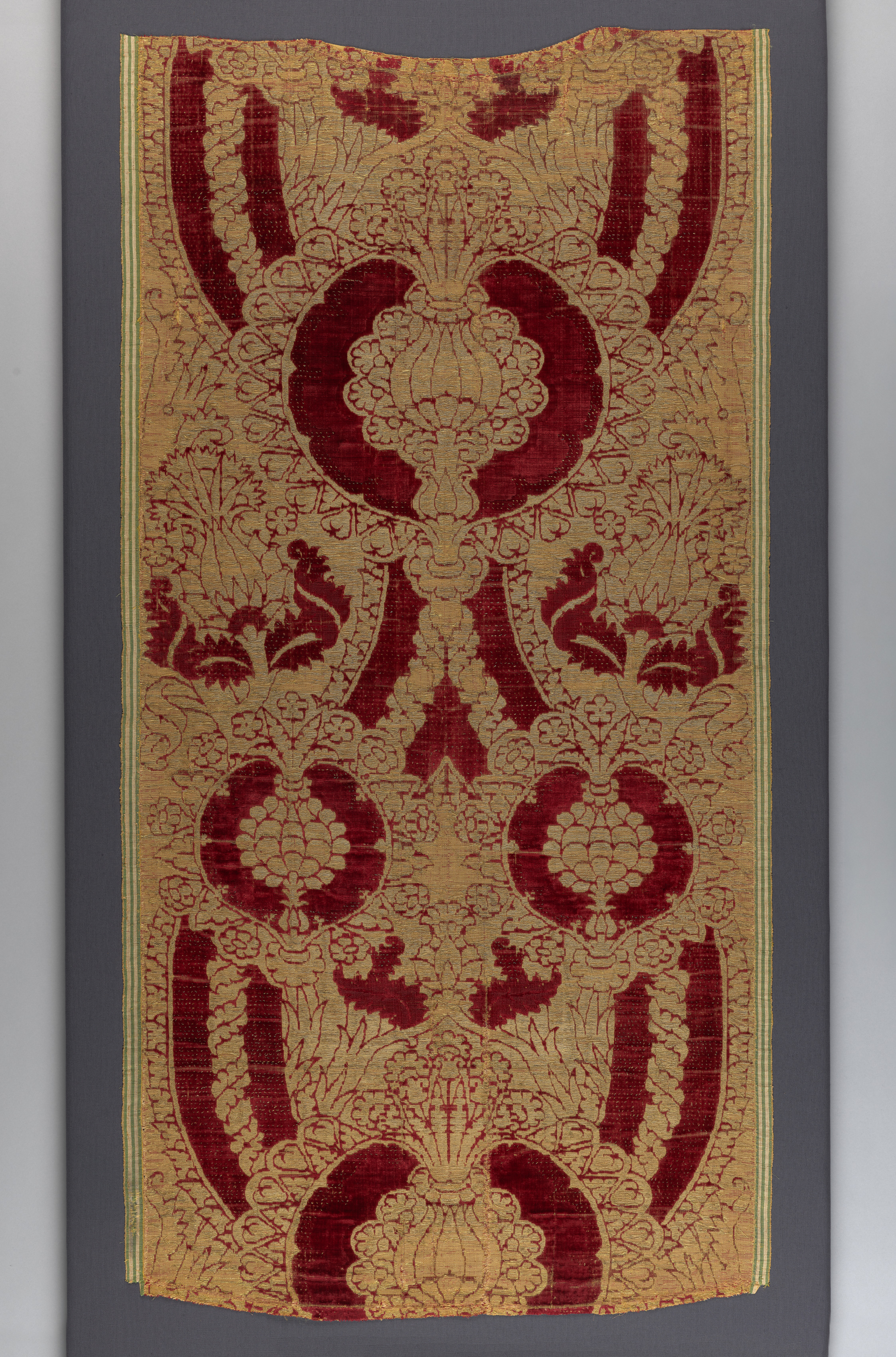
Deconstructing the Archive: Silk Velvet with Gold in Pomegranate Pattern
At Zoey Fashion Lab, we do not merely study historical textiles; we interrogate them. We dissect their physicality, their socio-economic implications, and their latent potential for contemporary disruption. This analysis focuses on a singular artifact: a fragment of silk velvet woven with gold thread, featuring a pomegranate pattern, attributed to 15th-century Italy, possibly Florence. This is not an exercise in historical preservation. It is an act of violent, creative extraction. The reference to the Mirror with Split-Leaf—a duality of gilded surface and funerary narrative—provides the conceptual key to unlocking this fabric’s avant-garde future.
The fabric presents a paradox: it is simultaneously a symbol of ultimate luxury and a memento mori. Its technical construction—the cut pile of two heights, the uncut loops, the gold-thread loops—creates a surface that is not flat but topographical. It is a landscape of light and shadow, of opulence and decay. For the avant-garde designer, this is not a constraint but a launchpad. We will not replicate the pomegranate; we will weaponize its semantic weight.
Technical Autopsy: The Grammar of Texture
The technical virtuosity of this velvet is its first point of departure. The use of cut pile in two heights is a masterclass in optical illusion. The higher pile catches light, appearing almost luminous, while the lower pile recedes into shadow, creating a subtle, three-dimensional bas-relief. This is not mere decoration; it is a primitive form of pixelation. The uncut pile loops add a secondary layer of texture, a matte, almost granular surface that disrupts the smooth flow of the cut pile. Finally, the gold-thread loops function as metallic punctuation, drawing the eye along the sinuous curves of the pomegranate and its split-leaf foliage.
From an avant-garde perspective, this complexity is a challenge to modern flatness. Our current fashion landscape is dominated by digital prints and synthetic textures that simulate depth. This velvet possesses actual, physical depth. The avant-garde application is to exaggerate this. Imagine a garment where the two pile heights are not a subtle variation but a stark contrast—one side shaved to a near-flat, almost sheer silk, the other left at its full, plush height. The gold loops, instead of being woven into the pattern, could be left as loose, dangling fringes, creating a kinetic, metallic fringe that moves with the body, blurring the line between textile and jewelry.
The pattern itself—the pomegranate—is a loaded symbol. In 15th-century Florence, it was a sign of fertility, resurrection, and imperial power. It was a motif for the elite, woven into the fabric of their ceremonial robes and altar cloths. The avant-garde move is to strip it of its regal context and re-contextualize it as a raw, organic form. We are not interested in the pomegranate as a heraldic emblem. We are interested in its internal structure—the clustered seeds, the leathery rind, the crown-like calyx. This is a form that can be abstracted, exploded, and re-assembled.
Conceptual Resonance: The Mirror and the Tomb
The provided reference—Archive Resonance: 一面是光洁银镜上以黄金镶嵌的纷繁棕叶纹,另一面是冰冷石棺板上以浮雕诉说的生命叙事—is the theoretical fulcrum of this analysis. The translation is clear: one side is a polished silver mirror inlaid with gold palm leaves; the other is a cold sarcophagus slab narrating life through relief. This duality is the essence of the velvet. The gilded surface represents the mirror—the vanity, the display, the worldly power of the Florentine merchant class. The underlying structure, the dense silk warp and weft, represents the tomb—the inevitable decay that awaits all this splendor.
For Zoey Fashion Lab, the avant-garde response is to make this duality visible. We propose a collection that is literally two-faced. One side of a garment could be the pristine, gilded velvet, untouched and radiant. The other side would be the same velvet, but intentionally degraded—the pile crushed, the gold thread tarnished, the pattern distorted through heat or chemical treatment. This is not about creating a "distressed" look for commercial appeal. This is about creating a dialectical garment that forces the wearer and the observer to confront the transience of beauty.
The "split-leaf" motif in the mirror reference is also crucial. It suggests a rupture, a division. In our deconstruction, we will apply this to the silhouette. The traditional use of such velvet was for voluminous, structured garments—gowns, copes, and hangings. Our avant-garde silhouette will be asymmetric, fragmented. A single sleeve in full velvet, the other arm bare. A bodice constructed from overlapping, un-hemmed panels of the velvet, each panel slightly shifted to reveal the raw edges and the gold thread's metallic core. This is a deconstruction of the form to match the deconstruction of the symbol.
Material Alchemy: From Archive to Action
The material itself must be transformed. We cannot simply cut up a 15th-century artifact. Instead, we will use the velvet as a generative algorithm. We will analyze the weave structure, the density of the pile, and the placement of the gold loops to create a digital map. This map will then be used to produce a new textile, one that is not silk and gold but a high-performance synthetic that mimics the optical properties of the original while offering new capabilities.
Imagine a fabric that is woven with thermochromic threads that change color with body heat, making the pomegranate pattern bloom or fade in real-time. Imagine a fabric that incorporates micro-LEDs in the place of the gold loops, creating a garment that is not just reflective but emissive. This is the alchemy of the avant-garde: taking the historical DNA and splicing it with futuristic technology. The pomegranate is no longer a static symbol of the past; it is a living, breathing organism on the wearer's body.
Conclusion: A New Archive
The 15th-century Florentine velvet is not a relic to be admired from behind a glass case. It is a blueprint for radical innovation. By understanding its technical grammar—the two pile heights, the uncut loops, the gold accents—and its conceptual resonance—the mirror and the tomb—we can create garments that are not merely clothing but are philosophical statements.
Zoey Fashion Lab will not recreate the pomegranate. We will explode it. We will use its pattern to create asymmetric, deconstructed silhouettes that challenge the wearer's relationship with their own body. We will use its gold to create light, not just reflect it. The final product will be a garment that is both a celebration of human craftsmanship and a critique of its own mortality. It will be a wearable archive, one that does not look backward but propels us into an uncertain, thrilling future. This is the true resonance of the archive: not a static echo, but a dynamic, disruptive force.