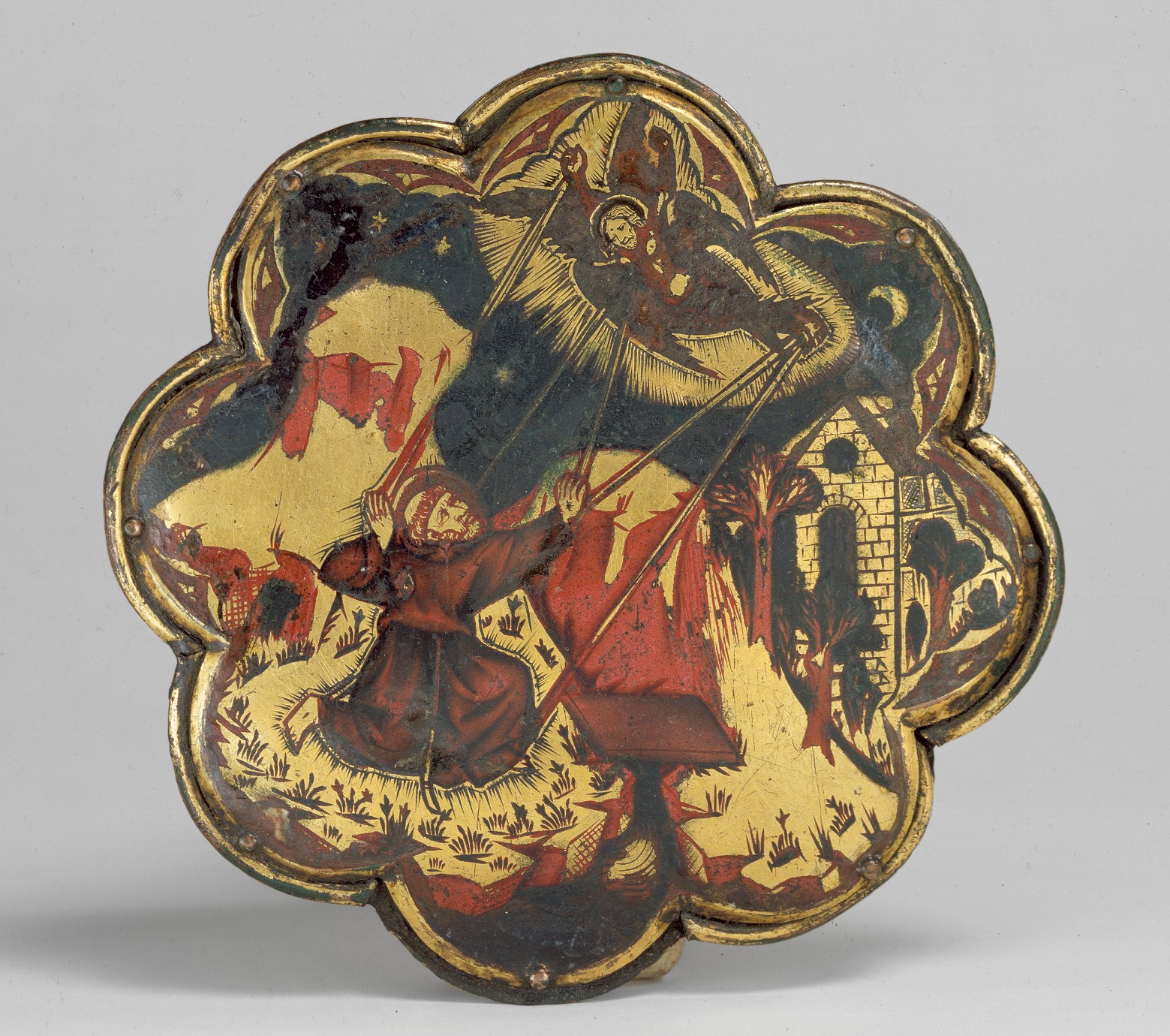
The Reliquary Reconfigured: Gilded Copper, Enamel, and the Architecture of the Sacred
In the rarefied echelons of avant-garde couture, where garment construction transcends mere apparel to become a dialogue with history, materiality, and the metaphysical, the Morse with Saint Francis of Assisi Receiving the Stigmata emerges not as a relic of medieval piety but as a prophetic blueprint for Spring/Summer 2026. This Italian masterpiece—executed in gilded copper with translucent and champlevé enamel—offers a radical departure from linear fashion narratives. For Zoey Fashion Laboratory, this object is not ornament; it is structural doctrine. Its fusion of rigid metalwork, luminous vitreous surfaces, and a narrative of corporeal transcendence demands a reimagining of the female silhouette as a site of sacred engineering.
Deconstructing the Divine: Materiality as a Futurist Lexicon
The Morse, historically a clasp for a bishop’s cope, operates on a principle of tension and release—a metallic fulcrum holding voluminous fabric in place. In our SS26 translation, this becomes the central thesis for a new jacket architecture. We abandon the soft shoulder in favor of a sculpted, gilded-copper alloy exoskeleton that mimics the champlevé technique: recessed channels carved into the metal, then filled with pigmented resin to create a mosaic of light and shadow. Imagine a bolero jacket where the entire back is a single, articulated plate, its surface etched with the stigmatic wounds—not as gruesome marks, but as luminous, translucent enamel portals, backlit by micro-LED filaments. The wearer becomes a walking reliquary, her spine encased in a modern-day morse, a clasp that does not merely close a garment but consecrates it.
The material hierarchy is inverted. Where the original Morse uses gilded copper as a base for enamel, our couture version elevates copper to a primary structural element—oxidized, brushed, and laser-welded into honeycomb lattices that reference the saint’s habit, but rendered with the precision of aerospace engineering. The translucent enamel, here a bio-sourced glass polymer, is not applied but grown in situ, creating a gradient from opaque obsidian at the hem to a crystalline, almost invisible transparency at the collar. This is not nostalgia; it is material alchemy for the post-human era.
Silhouette as Stigmata: The Body as a Field of Transcendence
The iconography of Saint Francis receiving the stigmata—the seraphic vision, the rays of divine light piercing flesh—demands a silhouette that is simultaneously fragmented and monumental. For SS26, we propose the “Seraphic Drape”: a gown that begins as a rigid, architectural cuirass over the bust and sternum, echoing the frontal pose of the saint, then erupts into a cascade of asymmetric, knife-pleated panels. These panels are not sewn but clasped at intervals with miniature morse-like brooches, each one a microcosm of the original—gilded, enameled, and set with a single, faceted crystal that catches light like a ray of divine intervention.
The key innovation lies in the negative space. The stigmata are traditionally depicted as wounds on hands, feet, and side. Our silhouette translates these as strategic apertures: a circular cut-out over the left ribcage, framed by a gilded copper ring; a slit from wrist to elbow that reveals a sheer, iridescent underlayer; a dramatic high-low hem that exposes the ankle and foot, clad in a champlevé-inspired 3D-printed boot with enamel inlays. These are not mere cut-outs; they are portals, engineered to create a visual rhythm of revelation and concealment, mirroring the saint’s ecstatic surrender.
Translucent Enamel and the Luminescence of the Future
The champlevé technique—where enamel is fired into recessed cells—finds its futuristic counterpart in our “Luminous Lattice” system. We have developed a flexible, conductive textile that mimics the cellular structure of the original enamelwork. Each cell is a micro-thin photovoltaic film, capable of harvesting ambient light and re-emitting it as a soft, ethereal glow along the garment’s seams. The result is a couture piece that breathes with light, its luminosity varying with the wearer’s movement and environment. In a darkened gallery, the gown becomes a constellation; in direct sunlight, it is a shimmering mirage. This is not wearable tech as gadget; it is wearable theology, where light itself is the divine material.
For the “Stigmatic Sleeve”, we draw directly from the Morse’s translucent enamel. The sleeve is constructed from multiple layers of sheer, organza-like polymer, each laser-cut with a different pattern of the stigmata rays. When layered, they create a moiré effect that shifts with the arm’s movement, suggesting the invisible rays of the seraphic vision. The cuff is a rigid, gilded copper band, engraved with a contemporary reinterpretation of the Latin inscription, but in a binary code that spells out “PAX ET BONUM” (peace and good). This is couture as cryptography, where ancient blessings are encoded for a digital age.
Structural Innovation: The Morse Mechanism as a Fastening Philosophy
Beyond aesthetics, the Morse offers a profound lesson in kinetic fastening. Its function as a clasp—a single, ornate point of closure—inspires a new generation of “Reliquary Closures” for SS26. We propose a series of garments that are not constructed with seams or zippers but are assembled via a system of interlocking, gilded copper components. A jacket, for instance, is composed of three independent panels—front, back, and sleeve—that click together via magnetic, enamel-coated hinges. The wearer becomes the artisan, participating in the ritual of dressing as a liturgical act. This modularity allows for infinite silhouette permutations: a floor-length cape becomes a cropped bolero; a structured bodice becomes a standalone top. The Morse’s singular clasp is thus exploded into a system of infinite connections, reflecting the fluidity of identity in the contemporary world.
The “Stigmata Train” is the collection’s apotheosis. A 12-foot train, constructed from gilded copper mesh and translucent enamel scales, is attached to the shoulders via a single, oversized morse. As the wearer walks, the train undulates like a metallic serpent, its scales catching and refracting light. The hem is weighted with small, champlevé enamel charms, each one a miniature depiction of a different wound site, creating a subtle, percussive rhythm against the floor. This is not a garment for the faint of heart; it is a processional armor for the modern deity, a declaration that the sacred and the futuristic are not oppositional but symbiotic.
Conclusion: A New Canon for the Avant-Garde
The Morse with Saint Francis of Assisi is a testament to the medieval artisan’s ability to fuse the divine with the material. For Zoey Fashion Laboratory, it is a catalyst for a radical re-reading of couture’s potential. SS26 will not be a season of trends; it will be a manifesto in metal and glass. By deconstructing the reliquary’s structural logic, embracing its material contradictions, and reinterpreting its spiritual narrative through a futuristic lens, we create garments that are not merely worn but inhabited. The gilded copper is no longer a sign of earthly wealth but of technological transcendence; the translucent enamel, a window to a soul that is both ancient and unborn. This is the definitive avant-garde study: where history is not a museum piece, but a living, breathing prototype for the future of fashion.