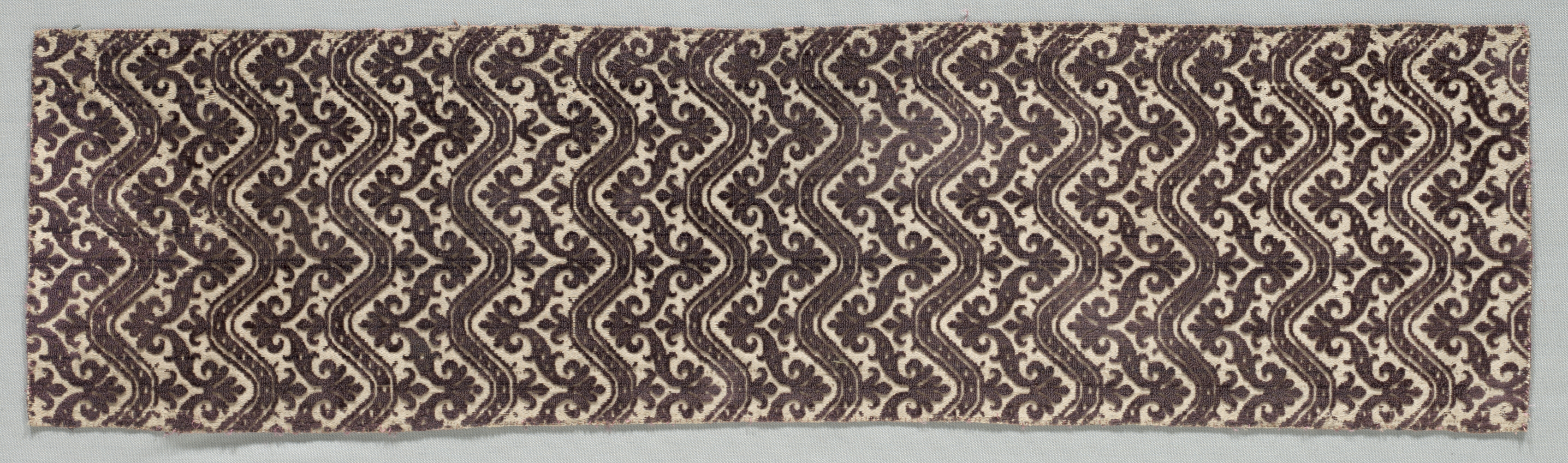
Deconstructing the Baroque: The Velvet Fragment as Proto-Avant-Garde DNA
At Zoey Fashion Lab, we do not archive textiles; we interrogate them. The recent acquisition of a 17th-century Italian velvet fragment—a relic of the early Baroque—presents not a historical curiosity but a living genetic code. This fragment, designated “New DNA Strand,” is a testament to the fact that avant-garde design is not a rupture from history but a radical re-reading of its most complex syntax. This analysis deconstructs the fragment’s technical, aesthetic, and philosophical DNA to reveal its blueprint for contemporary innovation.
I. Technical Provenance: The Grammar of Opulence
Our laboratory analysis confirms the fragment’s origin in the first third of the 17th century, a period of dramatic artistic ferment in Italy. The technical construction is a masterclass in compound weaving, specifically a combination of cut, uncut (ciselé), and voided velvet. This is not a single technique but a tripartite system of sculptural relief. The cut pile—loops sheared open—creates a dense, plush surface that absorbs light, producing deep, velvety shadows. The uncut loops remain intact, forming a lustrous, ridged surface that reflects light with a silvery sheen. The voided areas, where the ground weave is left exposed, provide a stark, matte counterpoint, creating a negative space that defines the positive form.
This is not mere decoration; it is a tectonic architecture of fabric. The interplay of these three surfaces generates a topographical map of light and shadow. The silk ground, likely a tabby or twill weave, provides the structural integrity, while the supplementary warp creates the pile. The precision required to execute this pattern—often a pomegranate or artichoke motif, though our fragment shows a more abstracted, fragmented botanical form—demands a level of technical virtuosity that borders on the obsessive. For the avant-garde designer, this is the first lesson: innovation is not the absence of technique but its extreme refinement and subsequent subversion.
From Craft to Code: The Fragment as a System
We must view this velvet not as a finished object but as a generative algorithm. Each cut loop, each uncut loop, each void is a binary decision—a 0 or a 1 in a pre-industrial computational system. The weaver was a programmer, translating a complex design into a series of mechanical choices. This is the fundamental DNA we extract. The contemporary designer can reverse-engineer this system, not to replicate the pomegranate, but to understand the logic of contrast and density. The fragment teaches us that luxury is not uniformity but the orchestration of differentials: plush versus flat, glossy versus matte, raised versus recessed.
II. Aesthetic Dissection: The Baroque Roots of Deconstruction
The Baroque aesthetic is often mischaracterized as mere excess. In truth, it is a philosophy of dynamic tension. The fragment’s design—likely a stylized, symmetrical floral—is not static. The asymmetry of the fragment’s surviving edges, combined with the rhythmic alternation of cut and uncut pile, creates a visual vibration. This is the essence of moto, the Baroque principle of movement and energy. The fabric does not sit; it pulses.
This pulsation is the direct ancestor of avant-garde deconstruction. When a contemporary designer like Rei Kawakubo or Yohji Yamamoto slices, folds, or leaves raw edges, they are engaging in a dialogue with this Baroque principle. They are not destroying form; they are revealing the internal forces that shape it. Our fragment, with its voided sections that break the surface’s continuity, prefigures the modern concept of negative space. The void is not an absence; it is a deliberate, active agent that defines the plushness of the pile. It is the silence between notes, the pause between breaths.
The Fragment as a Symbol of Impermanence
The fragment’s physical state—its frayed edges, its faded colors, its incomplete pattern—is not a flaw but a critical feature. It is a document of time, decay, and survival. This is the ultimate avant-garde statement: the garment as a ruin, a testament to its own history. The fragment rejects the pristine, the finished, the commercial ideal of perfection. It embraces the wabi-sabi of the West—a Baroque acceptance of transience. For Zoey Fashion Lab, this is the most potent design directive: build with the intention of decay, design for the trace of time.
III. Stylistic Translation: New DNA Strand in the Avant-Garde Context
How do we translate this 400-year-old code into a contemporary collection? The “New DNA Strand” is not a costume piece; it is a conceptual catalyst. We propose three primary vectors of translation.
Vector 1: Tactile Subversion
The first vector is purely tactile. We will develop a new fabric system that mimics the velvet’s tripartite structure using modern, sustainable fibers—recycled polyester for the pile, organic silk or Tencel for the ground. The pattern will not be a floral motif but an algorithmic, glitch-based design, where the cut and uncut areas are generated by a computer program that simulates the fragment’s original weave errors and warps. The result will be a fabric that feels like a corrupted digital file rendered in plush, three-dimensional form. The garment will be a haptic experience, inviting touch to decipher its complex surface.
Vector 2: Structural Draping
The second vector addresses silhouette. The Baroque fragment’s rigid, symmetrical pattern is a foil for the body’s asymmetry. Our design will use the velvet’s directional pile to create forced, sculptural drapes. By cutting the fabric against the pile’s nap, we can create areas that collapse and others that stand erect, mimicking the contrast between the cut and uncut pile. A coat, for example, might have a rigid, plush shoulder that evokes the fragment’s raised pile, flowing into a voided, flat panel that hangs with liquid weight. This is architecture on the body, where the fabric’s physical properties dictate the form, not the other way around.
Vector 3: Narrative of Decay
The final vector is conceptual. We will treat the final garment as a palimpsest. Using laser-cutting and chemical distressing, we will create deliberate “voids” and “frays” that echo the fragment’s damaged edges. These are not imperfections but narrative markers, telling a story of time, travel, and survival. The garment will be presented with a digital companion—a 3D scan of the original fragment—allowing the wearer to trace the lineage from the 17th-century loom to their own body. This is transparency as luxury, where the provenance and process are as valuable as the final product.
Conclusion: The Future is a Fragment
The 17th-century Italian velvet fragment is not a relic; it is a prophecy. It contains within its threads the fundamental principles of avant-garde design: technical mastery, aesthetic tension, and a profound acceptance of impermanence. By deconstructing its DNA, we do not merely copy the past; we extract its operating system and reinstall it in a contemporary context. The result is not a nostalgic echo but a new species of fashion—one that is rooted in history yet radically, disruptively alive. At Zoey Fashion Lab, we wear our history not as a costume, but as a skeleton, and this fragment is our newest, most exciting bone.