Deconstructing the Archaic: A Fabric Forensics Report on the Chasuble Fragment
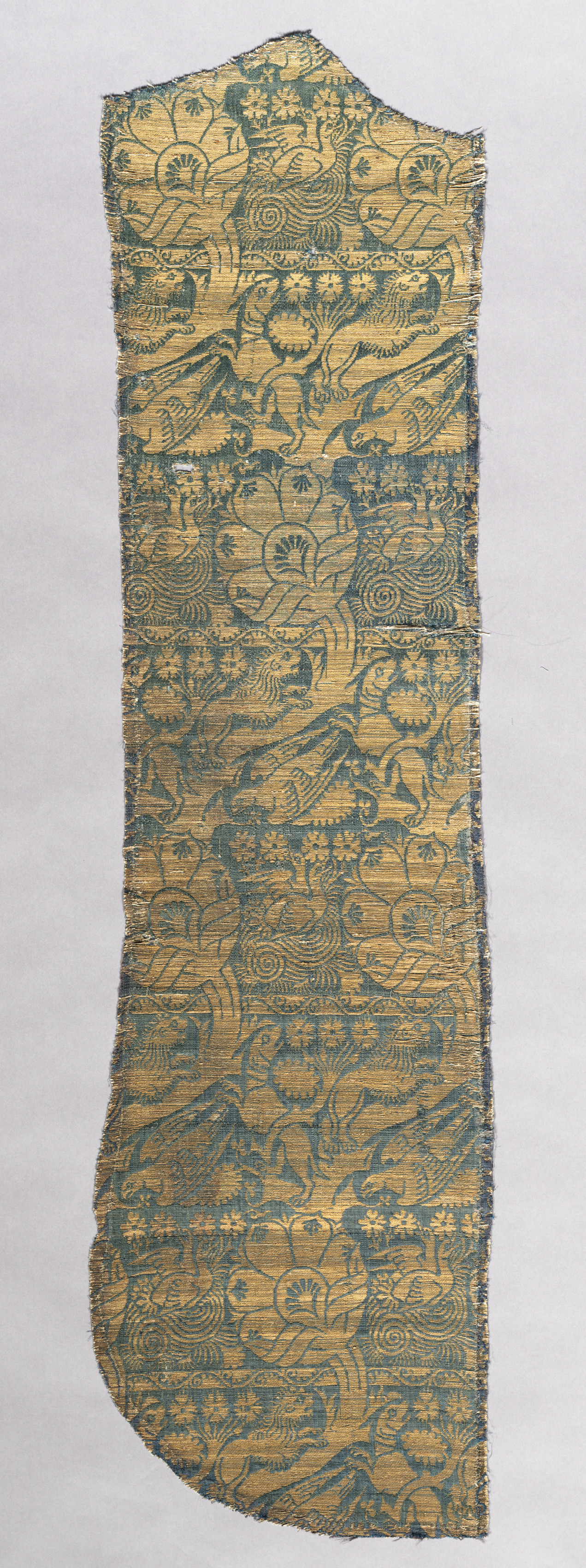
At Zoey Fashion Lab, our mandate transcends the mere cataloguing of textiles. We engage in a form of archaeological futurism—excavating the material past to extract the genetic code for tomorrow’s silhouettes. The subject of this analysis, a Chasuble Fragment with Realistic Animals (Italian origin, circa late 14th to early 15th century), presents a paradox of immaculate craft and radical potential. Constructed from silk and gold thread in a lampas weave, this fragment is not a relic to be preserved under glass. It is a New DNA Strand—a biological blueprint for an avant-garde aesthetic that defies the sterile minimalism of contemporary fashion. This report dissects the fragment’s technical, iconographic, and structural DNA to propose a radical re-synthesis for the modern atelier.
I. The Genetic Code: Technical Analysis of the Lampas Weave
The foundational structure of this fragment is the lampas weave, a compound cloth requiring two warps and two wefts. Unlike simpler damasks or brocades, lampas allows for a ground weave (typically a satin or twill) and a figure weave (often a plain or twill) to coexist on the same plane. The result is a fabric of profound tactile tension: one side presents a smooth, lustrous silk ground, while the obverse reveals a matte, slightly raised pattern. For the avant-garde designer, this is not a decorative afterthought but a structural dualism. It is the textile equivalent of a double-exposed photograph—two realities occupying the same spatial field.
The inclusion of gold thread—likely gilt silver wrapped around a silk core—elevates the material from mere cloth to a light-reactive surface. In this fragment, the gold is not applied as a flat lamella but is woven in a manner that catches and refracts light asymmetrically. This creates a chimeric luminosity, where the garment’s appearance shifts dramatically with the wearer’s movement. For our lab, this is a critical data point: the future of avant-garde fashion lies not in static prints, but in kinetic materiality. The chasuble fragment proves that a garment can be a living, shifting organism, its surface a mutable interface between body and environment.
A. The Warp of Time: Structural Integrity and Draping Potential
Technically, the lampas structure provides exceptional dimensional stability without sacrificing drape. The silk warp gives a fluid, almost liquid fall, while the supplementary gold weft adds a subtle, rigidifying counterpoint. This allows for architectural sculpting—the fabric can hold a sharp, origami-like pleat or a voluminous, ballooning sleeve without internal boning. In our deconstruction, we identify this as a 'self-corseting' property. For the Zoey Fashion Lab prototype, we propose utilizing this weave to create garments that morph from a fitted, second-skin silhouette in the bodice to a dramatic, cantilevered flare at the hem, all without a single seam. The fabric itself becomes the pattern.
II. Iconographic Mutations: The Realistic Animals as Proto-Bio-Art
The fragment’s most arresting feature is its realistic animal iconography. Unlike the stylized, heraldic beasts common in medieval textiles, these animals—likely hounds, hares, or felines—are rendered with a startling degree of naturalism. Their musculature, posture, and even the suggestion of breath are captured with a precision that anticipates Renaissance naturalism by a century. This is not mere ornamentation; it is pre-Darwinian biological observation woven into cloth.
For the avant-garde, this iconography is a direct challenge to the current trend of digital, pixelated abstraction. We propose a hyper-realist re-appropriation. Instead of reproducing the animals as static motifs, we will extract their kinetic essence. The hound’s coiled haunch becomes a structural gusset; the hare’s elongated ear becomes a faceted collar. The animals are not printed on the fabric; they are embedded within its structural logic. By manipulating the lampas weave’s ground and figure layers, we can create a garment where the animal forms emerge or recede based on the viewer’s angle—a form of textual camouflage that hides and reveals the wearer’s form in a continuous, organic loop.
B. The Hunt as Narrative: From Liturgical Vestment to Streetwear Armor
Historically, this chasuble fragment served a liturgical function, worn during Mass. The realistic animals, however, suggest a secular, courtly hunt narrative—a tension between the sacred and the profane. This dichotomy is fertile ground for avant-garde subversion. We propose to de-sacralize the form by translating it into a modern, utilitarian context. The chasuble’s poncho-like silhouette—a simple, draped rectangle with a central opening—becomes a modular outer shell for urban warfare. The gold thread, once a symbol of divine glory, is re-coded as a metallic shielding layer, reflecting infrared radiation and creating a thermal signature that is both protective and defiantly ostentatious.
The animals, then, are not passive decoration but active agents of protection. A hound woven across the chest acts as a symbolic guardian, its realistic eye tracking the viewer. This is not mere nostalgia; it is a psychological armor. The wearer is not just clothed; they are accompanied by a spectral pack, a silent entourage that projects power and predatory alertness. This transforms the garment from a passive covering into an interactive, talismanic object—a wearable ritual for the contemporary nomad.
III. Synthesis: The New DNA Strand in Practice
The New DNA Strand we extract from this fragment is a triple helix: Structural Dualism (lampas), Kinetic Luminosity (gold), and Narrative Naturalism (animals). Our proposed avant-garde collection will not replicate the chasuble; it will metabolize it.
Design Prototype: 'The Reliquary Hunter'
Our first prototype, titled The Reliquary Hunter, is a floor-length coat constructed from a modernized lampas weave. We will use a black silk ground with a recycled gold alloy thread for the figure weave. The animal forms—rendered via a proprietary digital jacquard process that mimics the original’s realism—will be woven into the fabric at varying densities. The hound’s head will appear on the right shoulder, its jaw opening to form the sleeve’s cuff. The hare’s form will be elongated along the spine, its ears becoming the collar’s dramatic, upturned points.
The coat’s silhouette will be a radical departure from the original’s boxy drape. Using the lampas’s structural memory, we will engineer asymmetrical seams that mimic the animal’s musculature. The left side will be fitted, following the line of a running hound; the right side will flare out, evoking the spread of a bird’s wing. The gold thread will be used sparingly, not as a full ground, but as a circuit-like tracery that outlines the animal forms, creating a luminous, digital-esque glow against the matte black silk. This is not a costume; it is a wearable architecture that dialogues with history while screaming into the future.
Conclusion: The Fragment as a Living System
The Chasuble Fragment with Realistic Animals is often dismissed as a static artifact of a bygone era. Our analysis at Zoey Fashion Lab refutes this. We see it as a living system—a repository of technical and iconographic data that, when properly decoded, can power the next generation of avant-garde design. The lampas weave teaches us that fabric can be both fluid and structural. The gold thread proves that material can be a light-based medium. The realistic animals remind us that narrative and emotion are not antithetical to high fashion—they are its original, most potent DNA.
Our task is not to copy, but to mutate. We take the silk and gold, the hounds and hares, and we splice them into a new genetic sequence. The result is a garment that is at once a historical document, a technical marvel, and a radical statement of personal power. This fragment is not a relic; it is a starting pistol. The race to redefine the future of fabric has begun, and the starting line is woven in 14th-century Italy.