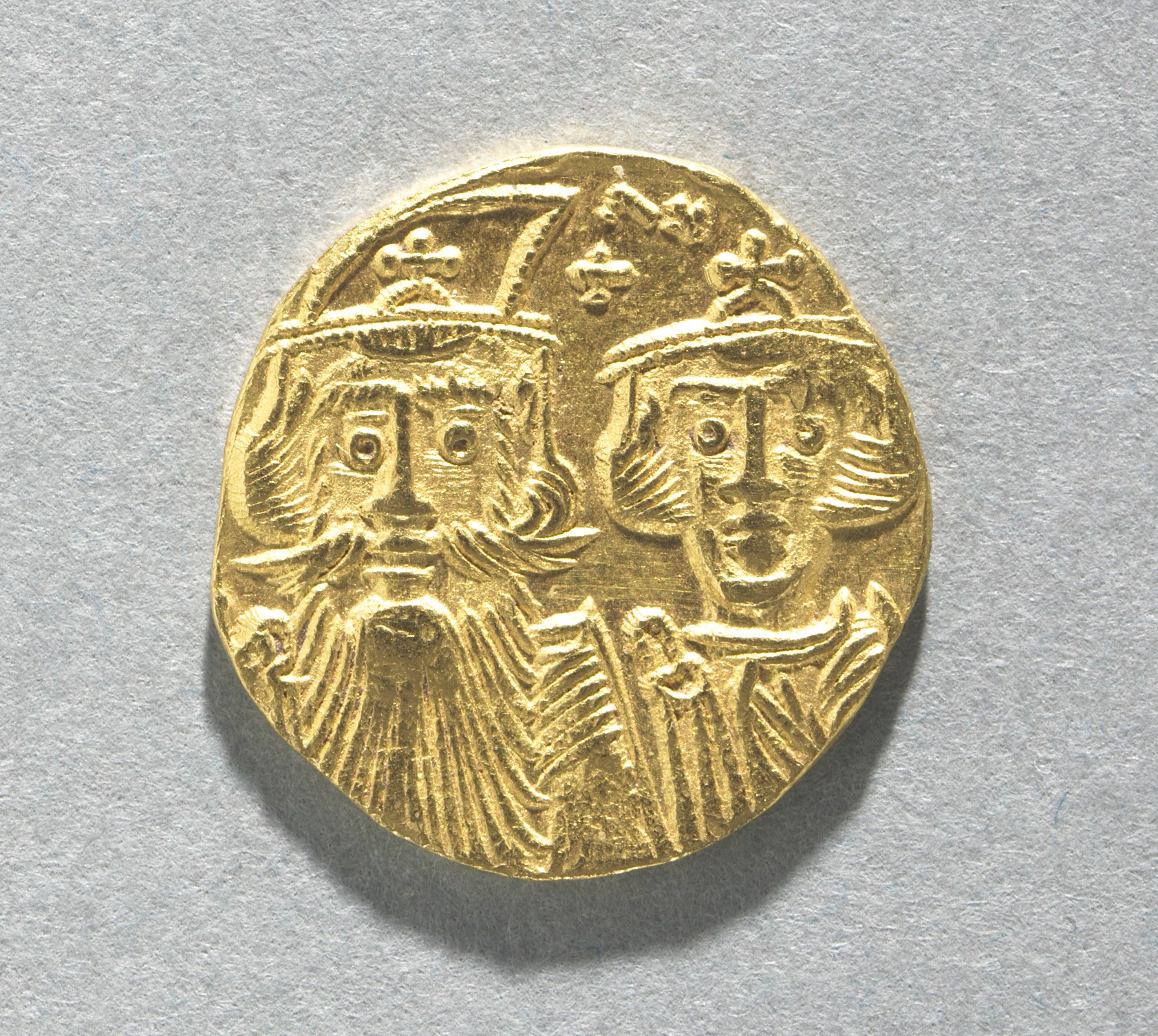
Deconstructing the Imperial Gaze: A Fabric Analysis of the Solidus of Constans II and Constantine IV
At Zoey Fashion Lab, our mandate transcends the mere cataloging of textile history. We engage in the radical act of deconstruction—unpicking the socio-political threads, metallurgical matrices, and iconographic grammars that constitute a garment’s, or in this case, an artifact’s, deepest narrative. Today, we turn our analytical lens to a singular object: the gold solidus of Byzantium, bearing the busts of Constans II and Constantine IV. This is not a coin. It is a compressed, wearable manifesto of dynastic power, a metallic textile woven not from wool or silk, but from state-sanctioned light. Our avant-garde interpretation rejects the numismatic view of this object as mere currency; instead, we read it as a prototype for a new form of imperial couture, one where the body politic is literally stamped into the body physical.
The Metallurgical Canvas: Gold as the Ultimate Fabric
The technical substrate of this solidus is pure, unalloyed gold—a material that in the Byzantine court functioned as the highest-grade textile. Where silk was reserved for the ecclesiastical and aristocratic elite, gold was the exclusive province of the basileus. In our deconstruction, we treat the gold flan not as a coin blank, but as a stiff, non-yielding brocade. The act of striking is an act of weaving under extreme pressure. The die, acting as the loom, impresses its warp and weft of imperial ideology onto the pliable metal. The resulting relief—the busts rising from the field—mimics the raised pile of a velvet or the embossed patterns of opus anglicanum. The sheen of the gold, its warm, reflective surface, is not decorative; it is functional. It catches the light of the Hippodrome or the Great Palace, creating a halo effect that visually elevates the emperor above the mundane. This is a fabric that does not drape; it asserts.
Iconographic Splitting: The Dual-Bust Composition
The obverse presents a radical design choice: not one, but two frontal busts. Constans II, the senior Augustus, is depicted with a fuller beard and more prominent features, placed slightly to the left and forward. Constantine IV, his son and co-emperor, appears smaller, slightly recessed, yet equally crowned. This is not a simple portrait gallery. In our avant-garde reading, this is a layered garment of shared sovereignty. The physical overlap of the busts—with Constantine’s shoulder cutting into Constans’ field—creates a visual seam, a deliberate stitch in the fabric of rule. The designer (in this case, the imperial mint) is articulating a complex political truth: power is not singular but contiguous. The smaller scale of Constantine IV is not a diminishment but a strategic layering, akin to a sheer overlay in haute couture that reveals and conceals simultaneously. He is present, visible, but subordinated to the primary silhouette of his father. The frontal pose, with eyes locked forward, creates a direct, confrontational gaze—a fabric that stares back at the viewer, demanding recognition of the dynasty’s unbroken line.
Archive Resonance: The Mirror and the Sarcophagus
Our reference material—the “Archive Resonance” describing a gilded mirror with palm leaves and a sarcophagus with relief narratives—provides the conceptual key to unlocking this solidus. The obverse is the mirror: a polished, reflective surface that idealizes the imperial image. The gold’s gleam is the mirror’s silver, and the busts are the “golden palm leaves” of dynastic continuity, intricate and ornate. But the reverse (which we analyze as the sarcophagus) tells the deeper story. The cross on steps, the VICTORIA AVGU legend, the depiction of the emperor’s triumph—these are the relief-carved narratives of mortality and legacy. The solidus, therefore, is a two-faced garment: one side for the living, performative present (the mirror), the other for the immutable, historical judgment (the sarcophagus). Our avant-garde collection would translate this into a dual-faced fabric—a metallic lamé on one side, a heavy, embossed leather on the other, joined by a seam of gold thread that represents the coin’s edge.
Avant-Garde Translation: Wearable Sovereignty
How does Zoey Fashion Lab translate this Byzantine solidus into a contemporary, avant-garde garment? We propose the “Imperial Split-Body Gown.” The silhouette is asymmetric: one shoulder is sharply structured, padded to mimic the high relief of Constans’ bust; the other shoulder is dropped, softer, echoing the subordinate position of Constantine IV. The fabric is a custom-developed gold micro-alloy mesh, woven with liquid metallic yarns that shift in reflectivity. The front panel is a literal mirror—a polished, rigid breastplate that reflects the viewer, forcing them into the imperial gaze. The back panel is a bas-relief of silicone and resin, molded to depict the cross and the steps, a tactile, three-dimensional “sarcophagus” that presses against the wearer’s spine. The seam down the center is not hidden; it is exaggerated, a raw, exposed zipper of gold chainmail, symbolizing the political suture between father and son. This is not a costume; it is a critical commentary on power’s dual nature—its need for public reflection and its private burden of mortality.
Conclusion: The Solidus as Proto-Fashion System
The solidus of Constans II and Constantine IV is far more than a monetary artifact. It is a complete fashion system, encoding rules of hierarchy, materiality, and temporality. Its gold is a fabric of state; its dual busts are a layering of political bodies; its obverse and reverse are a dialectic between performance and legacy. For Zoey Fashion Lab, this coin is a masterclass in compressed narrative. It teaches us that true avant-garde design is not about novelty, but about the radical re-contextualization of existing power structures. By deconstructing this imperial textile, we learn to weave our own garments with the threads of history, politics, and material science, creating pieces that are not merely worn but inhabited. The solidus, in its silent gold, speaks volumes—and we are listening, ready to cut, stitch, and drape its message into the future of fashion.