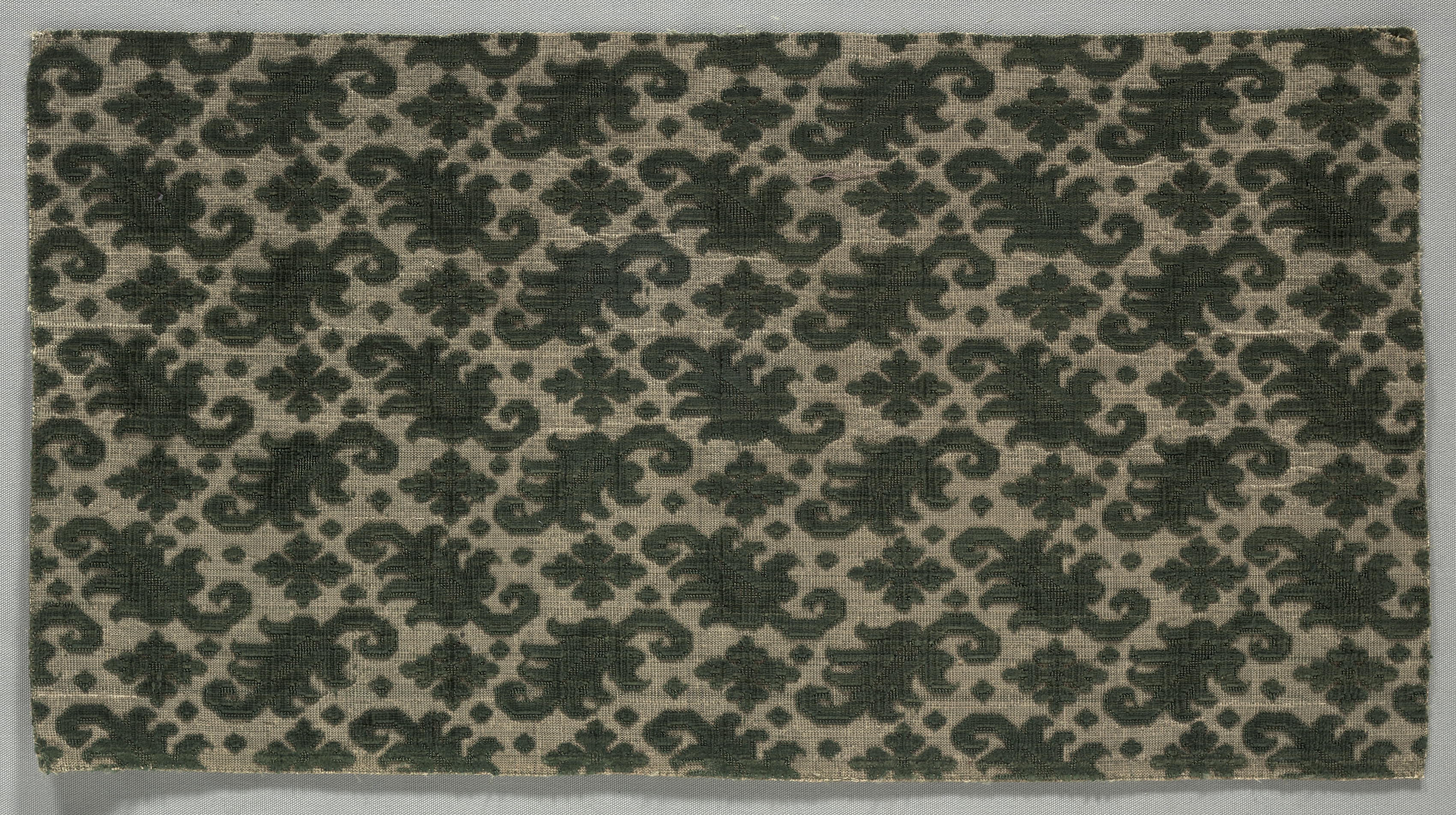
Deconstructing the Baroque: A Technical and Conceptual Analysis of the 17th-Century Velvet Fragment
At Zoey Fashion Lab, our mandate extends beyond the mere cataloging of historical textiles. We engage in a process of fabric deconstruction, treating each artifact not as a static relic but as a living DNA strand—a repository of genetic information that informs our avant-garde design language. The subject of this analysis, a silk velvet fragment originating from Italy in the first third of the 17th century, presents a singular opportunity to decode the opulence of the Baroque era and re-sequence its core principles into a contemporary, disruptive aesthetic. This fragment is not merely a piece of cloth; it is a blueprint for volume, light, and subversion.
Technical Provenance: The Anatomy of Cut and Uncut Pile
Our initial examination focuses on the technical construction, which is the primary source of the fragment’s textural intelligence. The piece employs a sophisticated combination of cut and uncut velvet (ciselé), a technique that was the pinnacle of Italian silk weaving in the early Seicento. The uncut pile, formed by loops of silk over wire rods, creates a matte, absorbent surface that plays with diffused light. In contrast, the cut pile—where the loops are severed—opens the fibers, allowing for a deeper, richer color saturation and a plush, tactile depth. This dual-pile structure is not merely decorative; it is a system of optical modulation. The uncut loops act as shadow wells, while the cut pile functions as light wells, creating a three-dimensional topography on a two-dimensional plane.
From a deconstructionist perspective, this technical duality is our primary extraction point. In our avant-garde applications, we do not simply replicate this weave. Instead, we isolate its binary logic. We conceptualize the cut pile as a symbol of release and exposure, while the uncut pile represents tension and restraint. For Zoey Fashion Lab, this translates into designs that juxtapose slick, bonded surfaces against raw, looped fringes, or that use laser-etched patterns to simulate the "cut" on a synthetic base, creating a modern dialogue between destruction and preservation.
Chromatic Identity and the Illusion of Depth
The original dye palette of this fragment—likely a deep, madder-root crimson or a walnut-based umber—was achieved through natural mordants, resulting in a color that is simultaneously dense and luminous. The optical depth of the velvet is not a function of the dye alone, but of the interaction between the pile height and the light angle. When the pile is brushed against the grain, the color shifts dramatically, appearing almost black; when smoothed, it flares into a vivid, saturated hue. This chameleonic behavior is a critical element of our analysis.
For our avant-garde line, we translate this chromatic instability into photochromic and thermochromic treatments. We are engineering a modern "velvet" that responds to body heat or ambient UV light, shifting between deep, somber tones and electric, vivid accents. This is not a nostalgic homage; it is a functional evolution of the original’s inherent property. The 17th-century weaver used pile height to control light; we use responsive chemistry to control perception. The fragment teaches us that color is not a static value but a dynamic performance, and our garments are the stage.
Structural Grammar: The Weight of Opulence
The weight and drape of this Italian velvet are formidable. The high density of the silk pile and the tightness of the ground weave create a fabric that is architectural rather than fluid. It holds pleats and folds with a sculptural permanence, standing away from the body in a manner that echoes the rigid formality of Spanish-influenced Italian court fashion. This is a fabric that dictates posture; it does not conform to the wearer, but rather the wearer conforms to its imposing volume.
In our deconstruction, we challenge this authoritarian drape. We take the structural grammar of the velvet—its ability to hold a crease, its substantial hand—and subvert it. We cut it on the bias to force a fluidity it never originally possessed. We slice it into ribbon-like strips and re-weave it with elastic or metallic threads, creating a hybrid textile that retains the visual weight of velvet but possesses the stretch and give of a contemporary performance fabric. This is a deliberate act of sartorial rebellion. We are not respecting the fragment’s original intent; we are interrogating its limitations to discover new possibilities for the human form.
Deconstructive Reinterpretation: The New DNA Strand
The reference to a "New DNA Strand" is precise. Our process involves extracting the genetic markers of this fragment—its pile ratio, its color depth, its structural rigidity—and splicing them into an avant-garde context. The result is not a costume, but a conceptual garment. For instance, a modern evening coat might feature a body of ultra-light technical mesh, but with a 3D-printed polymer overlay that mimics the exact loop-and-cut pattern of the original, scaled to a monstrous proportion. This creates a visual echo of the Baroque without the physical burden.
Alternatively, we explore degradation as a design principle. The fragment shows natural wear, fading, and pile loss in certain areas. We treat this not as damage, but as a cartography of use. Our avant-garde pieces intentionally distress new velvet using enzymatic washes and high-pressure water jets, creating a "faux-antique" topography that tells a story of time passing. This is the ultimate act of deconstruction: we are not preserving the past, but simulating its decay to question our own contemporary obsession with perfection.
Conclusion: From Relic to Revelation
This 17th-century Italian velvet fragment is far more than a sample of historical craftsmanship. For Zoey Fashion Lab, it is a catalyst for radical innovation. By dissecting its technical construction, chromatic behavior, and structural authority, we have extracted a new design language that speaks to our avant-garde ethos. We honor the fragment not by copying it, but by mutating its DNA. The cut and uncut pile becomes a metaphor for the tension between exposure and concealment; the deep, shifting colors become a platform for responsive technology; the rigid drape becomes a challenge to be overcome.
In our hands, the velvet fragment is transformed from a relic of the past into a revelation for the future. It is a testament to the fact that true innovation in fashion does not occur in a vacuum, but through a deep, critical, and often violent engagement with the textiles that came before us. This analysis confirms that the Baroque spirit—its drama, its excess, its love of texture—is not dead. It is merely waiting for a new medium through which to express itself, and at Zoey Fashion Lab, we are that medium.