Deconstructing the Frontier: Silk, Metal, and the Architecture of Tomorrow
The contemporary fashion landscape is saturated with nostalgia, a relentless recycling of archival silhouettes that offers comfort but little cognitive friction. Within this echo chamber, the avant-garde serves as the necessary rupture—a violent, beautiful break from the familiar. For the SS26 season, Zoey Fashion Laboratory presents a singular study in material opposition: a garment constructed from the paradoxical union of silk and metal thread, anchored by the intricate, almost archaeological craft of bobbin lace. This is not merely a dress; it is a thesis on the future of structural possibility, a standalone object that interrogates the very definitions of softness, strength, and the human form.
At first glance, the piece appears to be a study in contradiction. Silk, the epitome of liquid drape and historical luxury, is here subjugated. It does not flow; it is forced into tension. The metal thread, far from being a subtle embellishment, acts as a rigid exoskeleton, a network of conductive sinews that pull the fabric into sharp, angular planes. This is the core of the Laboratory’s innovation: the silhouette is not cut; it is engineered. Traditional pattern-making relies on seams and darts to shape fabric to the body. This piece inverts that logic. The metal threads, woven directly into the silk ground, are the primary structural agents. They act like pre-stressed concrete in architecture, creating cantilevered volumes that defy gravity and the body’s natural contours.
The Silhouette as a Cartographic Event
The resulting form is a futuristic topography. The shoulder, typically a locus of softness, is re-imagined as a sharp, asymmetrical blade that extends several inches beyond the anatomical acromion. This is not a padded shoulder pad of the 1980s, but a self-supporting architectural projection, a cantilever that creates a negative space between the arm and the torso. The waist is not cinched but rather defined by a dramatic, metallic lattice that flares outward, creating a peplum-like structure that is less fabric and more a series of rigid, geometric plates. The overall silhouette is a hybrid: an hourglass that has been digitized and distorted, a nod to the feminine form that is simultaneously a rejection of its natural softness in favor of a machined, post-human ideal.
This is a deliberate move toward what we might term "Frictional Fluidity." The garment does not move with the wearer; it moves against them. The silk, where visible, shimmers and shifts, offering a glimpse of the body beneath, only to be abruptly halted by the metallic rigidity. This creates a kinetic friction, a dialogue between the organic and the mechanical. The wearer is not a passive mannequin but an active participant in a performance of resistance. Every step, every turn, is a negotiation with the garment’s internal logic. This is the future of couture: not clothing that adapts to the body, but a body that must adapt to the clothing, forcing a new posture, a new gait, a new way of inhabiting space.
Bobbin Lace: The Algorithm of Antiquity
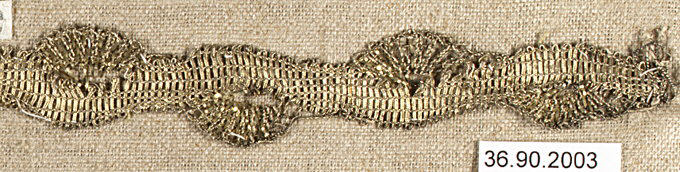
The inclusion of bobbin lace is the most intellectually provocative element of the piece. At first, it seems a nostalgic relic, a nod to 16th-century European craftsmanship. However, the Laboratory re-contextualizes it as a proto-algorithmic system. Bobbin lace is not drawn; it is plotted. It is a series of pins and threads manipulated according to a strict set of rules, creating a lattice of negative and positive space. In this piece, the lace is not used as a decorative trim. Instead, it forms entire panels of the garment, particularly in the bodice and along the spine. The lace is executed using the same metal thread, transforming a traditionally delicate craft into a rigid, almost chainmail-like mesh.
This is a profound semantic shift. The lace is no longer a symbol of fragility or Victorian modesty. It becomes a skeleton of data, a visible network of connections that suggest a garment that is less about covering and more about mapping. The openwork of the lace allows for strategic glimpses of skin, not as a sensual reveal, but as a clinical observation. The body is the substrate; the lace is the information layer. This aligns with the SS26 theme of "Global Frontier," suggesting a fashion that is not bound by geography but by the immateriality of data streams and digital networks. The lace is the physical manifestation of that network, a wearable code that speaks to a future where our clothing is as interconnected and intelligent as our devices.
Structural Innovation and the New Materialism
The technical achievement here cannot be overstated. The fusion of silk and metal thread requires a complete rethinking of the weaving and lace-making process. The tension must be calibrated to the milligram; a single error would cause the silk to tear or the metal to kink. The dress is constructed in modular sections, each one built and then joined via intricate, hand-finished metallic rivets that are themselves part of the design. This is a move away from the seam as a point of weakness to the seam as a point of articulation, a joint in a mechanical exoskeleton.
This piece is a definitive statement for SS26: the future of avant-garde is not in formless volume or exaggerated proportions alone, but in the intelligent manipulation of material properties. It is a move from "fashion as clothing" to "fashion as engineering." The garment is a functional object, but its function is not merely to cover or to adorn. Its function is to challenge, to provoke a new awareness of the body’s potential and its relationship to the technological sublime. It is a standalone masterpiece that will not be replicated, a singular artifact from the Global Frontier that asks us to consider not what we wear, but how we exist within the architecture of our own making.