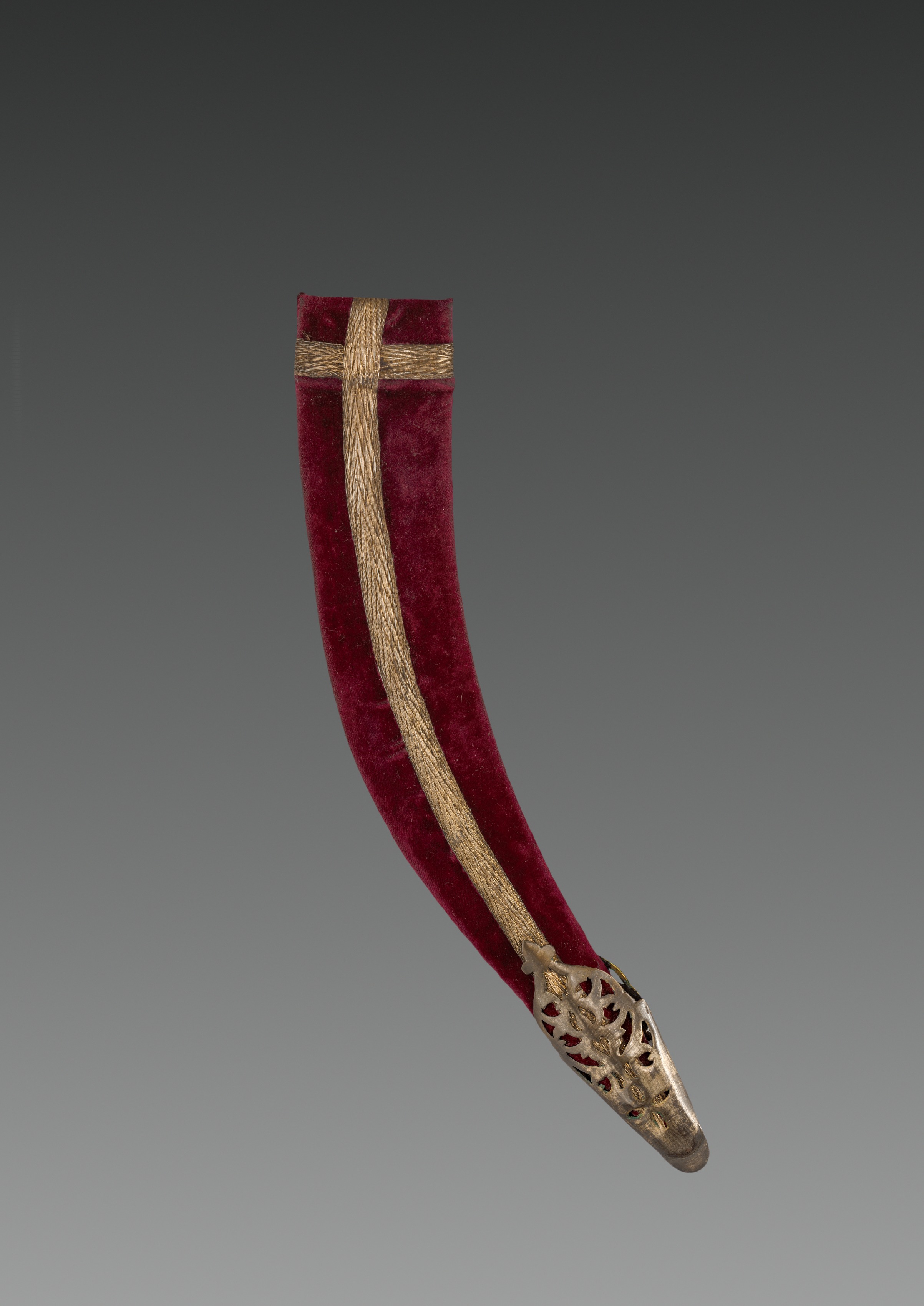
Technical Deconstruction: The Dagger as a Textile Artifact
The object in question, an Indian dagger housed within a red velvet sheath, presents a profound case study in material contradiction and symbolic layering. Our analysis begins not with the blade, but with its container—the true subject of our deconstruction. The sheath is a tripartite construction: a core of wood, a skin of red velvet, and an epidermis of metallic thread embroidery. This stratification is fundamental. The wood provides structure and intent; it is the armature of violence, rendered inert. The velvet performs a dual function: it is both a luxurious barrier and a sensual attractor. Its deep crimson pile absorbs light, creating a visual softness that belies the hard form within. The metallic thread, often gold or silver zari work traditional to Indian embellishment, acts as a dazzling, protective grid. It is armor rendered as ornament, a net of light cast over darkness.
Origin and Symbolic Re-contextualization: From Weapon to Reliquary
Originating in India, the dagger carries historical DNA of royalty, ceremony, and martial prowess. In Mughal or Rajput contexts, such an item was less a common tool and more a regal accessory, a symbol of authority and honor. The velvet case transforms it from a functional weapon into a ceremonial reliquary. Our reference to a "New DNA Strand" is apt. We are not merely looking at a dagger; we are examining a genetic splice of heritage and futurism. The traditional craftsmanship of the embroidery—likely using techniques like zardozi—is the old genetic code. The avant-garde lens through which we view it is the mutation, the new sequence that allows for radical reinterpretation.
The velvet sheath effectively performs a gender subversion. It takes a historically masculine-coded object of power and violence and swathes it in a textile deeply associated with opulence, theatre, and tactile femininity. This creates a potent tension: power is no longer naked and threatening; it is veiled, inviting closer inspection, demanding engagement on aesthetic as well as symbolic terms. The dagger becomes a metaphor for concealed strength, for beauty that contains an edge.
Avant-Garde Application: Principles for Zoey Fashion Lab
For Zoey Fashion Lab, this artifact is not an inspiration for literal replication, but a blueprint for a design philosophy. The core tenets extracted are: Contained Threat, Ornamental Armor, and Genetic Splicing.
Contained Threat: Silhouette and Structure
This principle translates to garments that imply power and structure beneath a soft exterior. Imagine a tailored wool-blend coat, severe in its architectural lines, but entirely lined in plush, blood-red velvet. The external silhouette commands authority; the hidden interior offers a private, sensual experience. Alternatively, a gown with a rigid, boned corset structure—echoing the wooden core—sheathed in liquid velvet, creating a form that is both imposing and fluid. The "dagger" is the woman's form itself, contained and amplified by its casing.
Ornamental Armor: Embellishment as Function
The metallic thread embroidery is our key. Instead of mere decoration, we treat embellishment as functional stitching, as a protective exoskeleton. This could manifest as:
Structural Embroidery: Using heavy zari threads or metallic bullion wires to create seams that not only decorate but also shape and support the garment, like gilded structural ribs on a bodice.
Vulnerability Mapping: Placing dense, metallic embroidery over areas culturally coded as vulnerable (the heart, the spine, the neck), transforming them into the most fortified, luminous points of the design. This is armor declared as beauty.
Deconstructed Hardware: Repurposing actual metallic elements from weaponry or machinery—chains, filigree, engraved plates—and embedding them into velvet or felted wool, creating a hybrid textile of soft and hard, warm and cold.
Genetic Splicing: Cultural Code & Futurism
This is the most critical layer. We do not appropriate the Indian motif; we splice its genetic code. We extract the principle of layered symbolism and re-encode it with contemporary narratives.
Imagine a collection where each piece is a "sheath" for a modern identity. A utility-style vest, made not of canvas but of velvet, embroidered with circuit-board patterns in metallic thread—splicing regal textile with digital DNA. A sari-inspired drape, constructed from neoprene and velvet, with embroidery that mimics biometric data streams or cryptographic keys. The red velvet becomes a constant—a symbol of passion, danger, and luxury—while the "metallic thread" evolves into laser-cut acrylic, conductive yarns, or heat-reactive polymers that change pattern with body temperature.
Conclusion: The New DNA Strand
The Indian dagger in its red velvet case is a complete fashion manifesto. It teaches us that true avant-garde design lies not in sheer novelty, but in the intelligent, disruptive recombination of deep cultural codes. For Zoey Fashion Lab, the path forward is to design garments that are reliquaries for contemporary identity.
Each piece should possess the wooden core of a strong, intentional concept. It should be sheathed in the emotional resonance of textiles like velvet—tactile, memorable, and laden with historical meaning. Finally, it must be wound through with the "metallic thread" of innovation—whether technical, material, or symbolic—that acts as both dazzling surface and structural integrity. The final creation should feel like a cherished, dangerous heirloom from a future that has already learned from the past. It is not a costume of power; it is the elegant, potent, and beautifully contained evidence of it.