Executive Analysis: The Velvet Fragment as a New DNA Strand
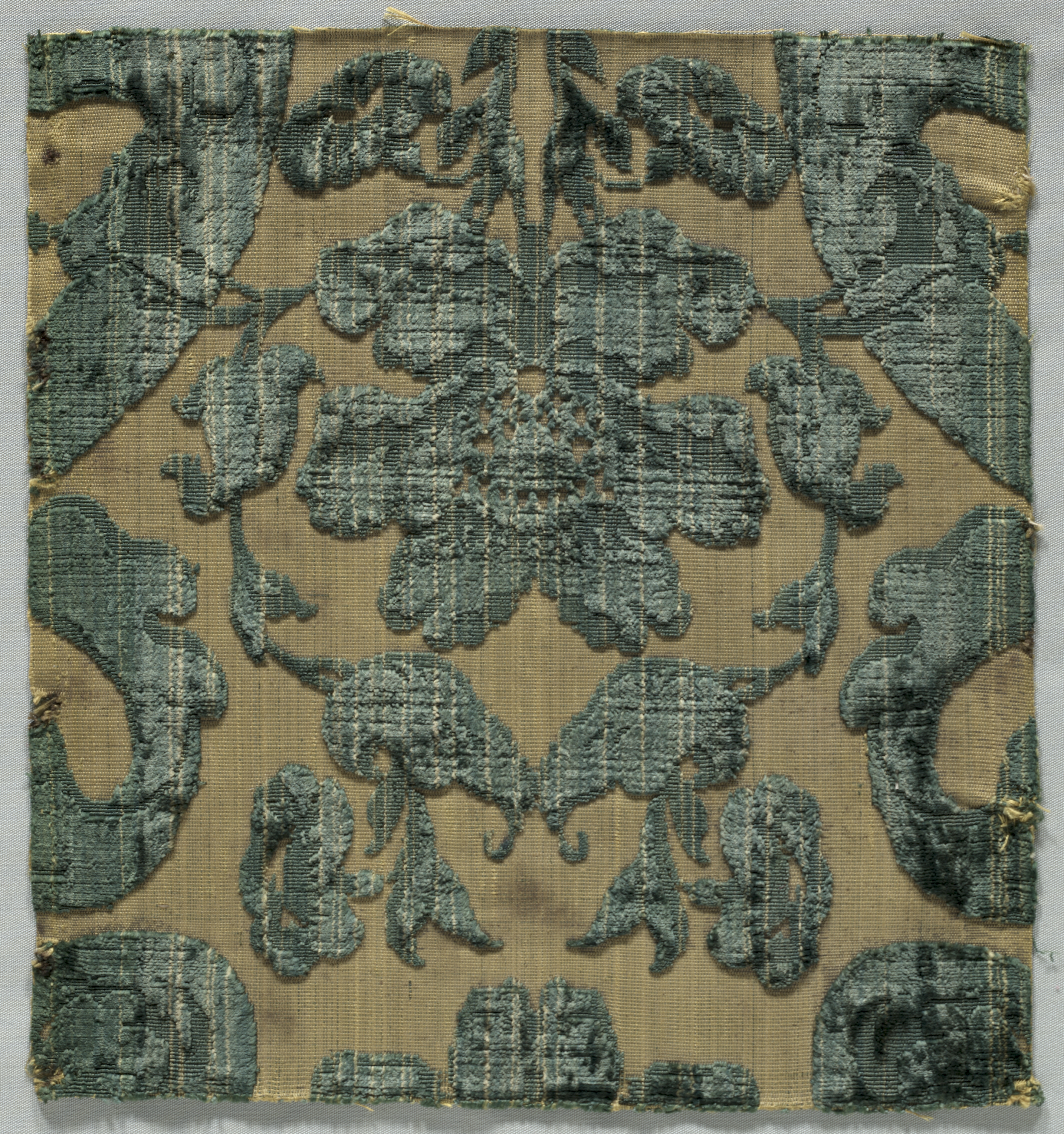
In the hallowed archives of textile history, few materials command the reverence of Italian velvet from the early 17th century. For Zoey Fashion Lab, this fragment is not merely a relic; it is a genetic blueprint—a New DNA Strand that, when decoded through an avant-garde lens, offers infinite possibilities for structural innovation, tactile subversion, and narrative depth. This analysis deconstructs the fragment’s physical, historical, and sensory architecture, proposing a radical methodology for its integration into contemporary, forward-thinking collections.
I. Material Genesis: The Technical Anatomy of 17th-Century Velvet
The fragment in question, likely produced in the bustling textile hubs of Venice, Genoa, or Florence, represents the apex of Renaissance craftsmanship. Its construction is a marvel of two-pile velvet, where silk threads are woven over metal wires that are subsequently cut, creating a dense, lustrous surface. The technical specifications are critical for our laboratory’s purposes:
1. Fiber Composition and Structural Integrity
The ground warp and weft are of fine, high-twist silk, providing exceptional tensile strength. The pile, however, is the star—a looped or cut pile of varying height, often exceeding 2 millimeters. This discrepancy in pile height creates a chameleonic light absorption that modern flat-weave textiles cannot replicate. For Zoey Fashion Lab, this is not a surface; it is a micro-topography. The fragment’s edges, frayed by centuries, reveal the internal skeleton—a lattice of interlacing threads that suggests a cellular structure, reinforcing the “DNA Strand” metaphor.
2. Color and Patina: The Alchemy of Time
Early 17th-century Italian velvets were dyed with natural pigments—madder root for crimson, woad for indigo, and weld for yellow. The fragment likely exhibits a deep, oxidized burgundy or a faded ecclesiastical purple. Crucially, the patina—the uneven fading, the subtle discoloration where light has kissed the pile—is not a defect but a narrative index. It records centuries of touch, display, and ritual. In avant-garde design, this patina is a pre-distressed finish, a form of ready-made storytelling that cannot be artificially aged with authenticity.
II. Historical Context: The Liturgical and Aristocratic Echo
To recontextualize this fragment, we must understand its original life. These velvets were commissioned for ecclesiastical vestments, princely doublets, and sumptuous upholstery in palazzos. The patterns—often pomegranates, artichokes, or intricate geometric pomegranate motifs derived from Ottoman influences—were symbols of eternity, fertility, and divine power. The fragment’s scale and border suggest it may have been part of a chasuble or a wall hanging.
For Zoey Fashion Lab, this historical weight is not a constraint but a counterweight. The avant-garde thrives on tension. By extracting the fragment’s motif logic—the rhythmic repetition of organic forms—we can generate new, algorithmically distorted prints. The original symmetry is broken, stretched, and re-spliced, creating a mutated heritage that acknowledges the past while refusing to be bound by it.
III. Deconstruction Protocol: Translating the Fragment into Avant-Garde Language
Our laboratory’s methodology involves a three-stage process: Extraction, Transmutation, and Re-synthesis. The velvet fragment serves as the primary genetic material.
Stage 1: Extraction – The Tactile Blueprint
We begin by mapping the fragment’s surface using high-resolution 3D scanning. This captures not just color but the pile direction, density variations, and wear patterns. This data is converted into a digital “height map.” From this map, we derive a new weave structure—not velvet, but a hybrid jacquard with variable-height loops using recycled nylon and bio-based silk. The goal is to replicate the fragment’s sensory paradox: a surface that is simultaneously soft and rigid, plush and skeletal.
Stage 2: Transmutation – The Genetic Splicing
Here, we break the fragment’s visual code. The original pomegranate motif is deconstructed into its constituent vectors. These vectors are then recombined with glitch aesthetics—data corruption, pixelation, and chromatic aberration. The result is a print that appears to be a digital error but is, in fact, a deliberate homage. We also extract the fragment’s frayed edges as a design feature. Instead of hemming, we laser-cut raw edges and treat them with a resin to prevent unraveling, creating a fossilized fragility—a deliberate archaeological look.
Stage 3: Re-synthesis – The Garment as Living Organism
The final stage is garment construction. The re-synthesized fabric is used in unconventional ways:
- Inverted Linings: The mutated velvet print is used as an outer shell, while the inner layer is a stark, technical mesh, exposing the construction seams.
- Modular Panels: The fabric is cut into cellular, hexagonal panels that are connected with visible, metallic snaps—suggesting a biological exoskeleton.
- Weighted Draping: The original velvet’s heavy drape is exaggerated by integrating micro-chain weights into the hems, creating a gravitational pull that mimics the fragment’s historical solemnity.
IV. The Avant-Garde Imperative: Subverting Luxury
True avant-garde fashion does not simply use luxury; it interrogates it. The velvet fragment, in its original context, was a signifier of immense wealth and religious authority. Our re-interpretation must challenge this. By pairing the velvet-derived textile with industrial rubber, recycled plastics, or transparent PVC, we create a visual dissonance. The sacred is juxtaposed with the profane; the historical with the hyper-contemporary. This is not a costume; it is a philosophical statement on the transience of value and the permanence of texture.
Furthermore, the fragment’s imperfections—the moth holes, the fading, the stains—are celebrated. We will reproduce these imperfections through bio-etching, where enzymes selectively degrade the fabric in predetermined patterns. This creates a garment that is pre-aged, but with a narrative that is entirely new. The wearer is not wearing a vintage piece; they are wearing a synthetic memory.
V. Sustainability and the Circular DNA
In an era of ecological crisis, the New DNA Strand concept extends to sustainability. The original velvet was a resource-intensive product. Our re-synthesis uses closed-loop manufacturing, where all offcuts are regenerated into new fibers. The fragment itself is not physically cut or damaged; it serves only as a data source. This is non-invasive deconstruction—we extract the idea of the velvet, not its physical matter. This approach aligns with Zoey Fashion Lab’s commitment to circular avant-gardism, where innovation does not come at the cost of the planet.
VI. Conclusion: The Future is a Fragment
The early 17th-century Italian velvet fragment is not a dead object. It is a living archive, a strand of cultural DNA that, when sequenced and re-expressed, yields garments that are provocative, intellectual, and deeply tactile. For Zoey Fashion Lab, this analysis confirms that the fragment’s true value lies not in its preservation but in its mutation. By treating history as a laboratory, and texture as a language, we transform a piece of the past into a blueprint for the future. The New DNA Strand is not a copy; it is a progeny—a new species of fashion that honors its ancestors by evolving beyond them.
This fragment will be the cornerstone of our upcoming “Materia Prima” collection, where we invite the wearer to experience not just a garment, but a temporal collision—the weight of centuries, the precision of code, and the audacity of the new.