Deconstructing the Todenkopf: A Blackened Relic as Avant-Garde Blueprint
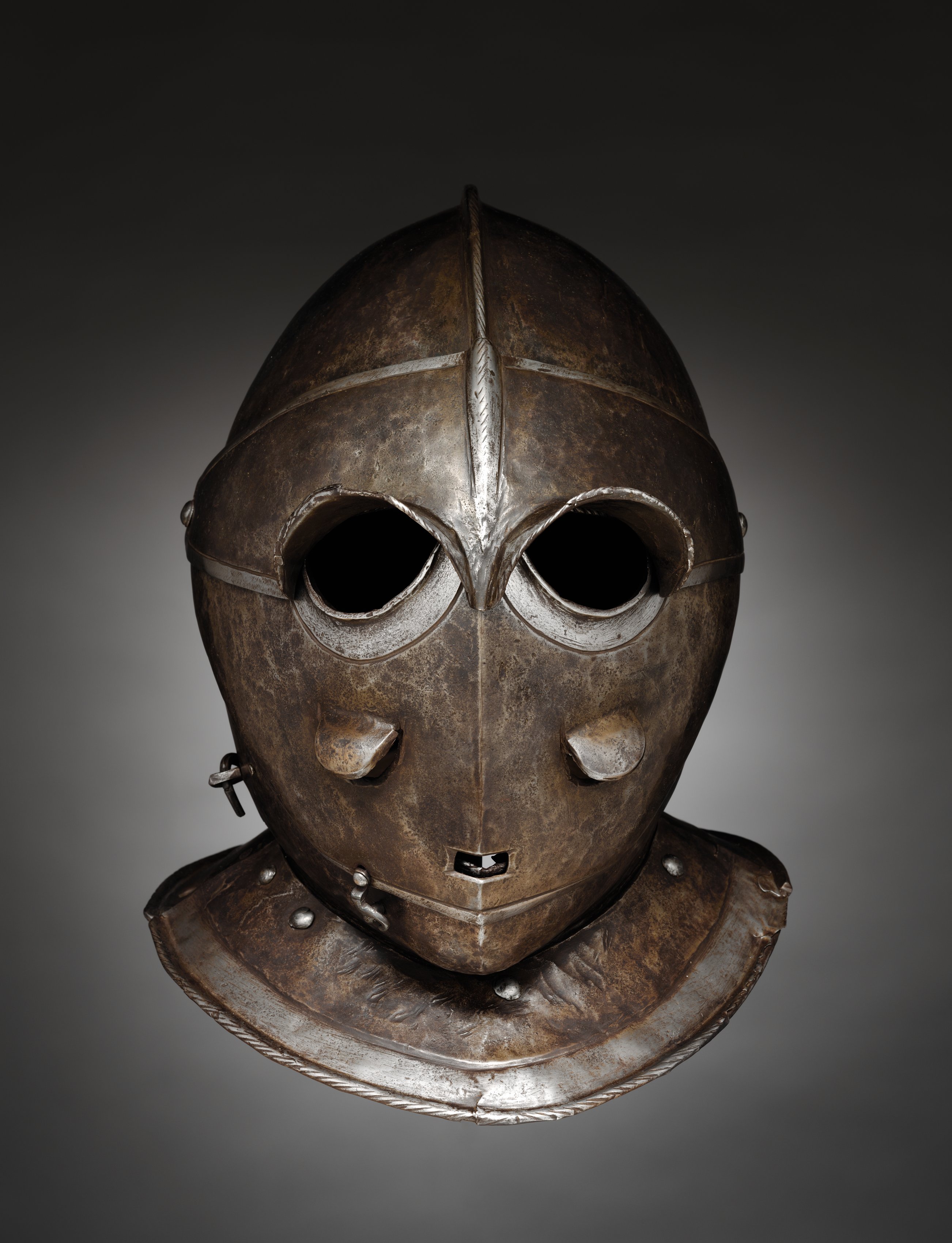
At Zoey Fashion Lab, our mandate is not merely to study historical garments but to interrogate them—to strip away their original context and re-forge their structural DNA into new, provocative forms. The subject of this analysis, the Savoyard Helmet (Todenkopf), presents a uniquely challenging and rewarding paradox. Originating from Italy or Germany in the early 17th century, this piece of blackened steel is ostensibly a tool of war, designed for maximum protection and intimidation. Yet, when viewed through the lens of avant-garde fashion, it transforms into a radical manifesto on volume, negative space, surface treatment, and the psychology of adornment. This analysis will deconstruct the Todenkopf’s technical and aesthetic components, proposing a direct translation from battlefield hardware to couture silhouette.
I. The Todenkopf: A Study in Confrontational Form
The term "Todenkopf" translates to "death's head," a name that immediately signals its intended psychological impact. Unlike the more ornate and ceremonial armors of the same period, the Savoyard helmet is brutally functional. Its defining characteristic is the deep, close-fitting skull piece that extends downward to protect the nape of the neck, coupled with a pronounced, pointed visor that offers a narrow, horizontal viewing slit. This slit is not a decorative flourish; it is a calculated aperture, forcing the wearer to confront the world through a sliver of light, creating an almost insectoid or alien profile.
For the fabric deconstructionist, the helmet’s form is a masterclass in negative space as power. The solid steel mass is not the story; the story is the void—the dark, impenetrable slot where the eyes should be. This absence of the human gaze is more threatening than any painted visage. In fashion, we often fill space with fabric, embellishment, or volume. The Todenkopf suggests a radical inversion: the power of the silhouette can be defined by what it conceals and the aggressive geometry of that concealment. The sharp, downward taper of the skull and the forward projection of the visor create a dynamic, directional line that pulls the eye forward, suggesting motion and intent, even when the wearer is stationary.
II. Materiality and the Alchemy of Blackening
The technical specification—steel, blackened—is critical. This is not a polished, reflective surface meant to dazzle. The blackening process, often achieved through controlled oxidation or oil-quenching, creates a matte, almost velvety finish that absorbs light rather than reflecting it. This is a deliberate act of anti-ornamentation. In the early 17th century, this finish served a dual purpose: it prevented rust and reduced glare on the battlefield, making the wearer less visible to enemies. But aesthetically, it creates a profound sense of monolithic depth.
For Zoey Fashion Lab, this blackened surface is the primary text. It speaks to a desire for materials that do not perform for the viewer but instead demand a closer, more intimate inspection. The matte finish negates the superficiality of shine, replacing it with a tactile, almost porous quality. We translate this into fabric technology by exploring high-density, matte-finish wools, technical nylons treated with a non-reflective coating, or even laser-cut leathers that mimic the micro-texture of oxidized steel. The color is not simply "black"; it is a black that has been earned through a process, carrying the history of fire and chemical reaction. This is the antithesis of the fast-fashion black dye; it is a black with a narrative of transformation.
III. The New DNA Strand: From Armor to Aura
The reference to a "New DNA Strand" in our brief is the key to unlocking the avant-garde potential. We are not interested in replicating the helmet as a literal accessory. Instead, we extract its genetic code—its core principles—and splice them into a contemporary fashion language. The DNA of the Todenkopf can be sequenced into three primary strands:
Strand 1: The Architectural Collar. The helmet’s flared base, which protects the neck, becomes the blueprint for a new kind of collar. We envision a sculptural, high-neck piece constructed from rigid, molded felt or layered, heat-set organza. This collar would not sit flat against the skin but would project outward and upward, framing the face and neck in a protective, yet alien, shell. The interior of this collar would be lined with a soft, blackened silk, creating a stark contrast between the harsh exterior and the intimate, tactile interior—a nod to the padded lining of the original helmet.
Strand 2: The Slit Silhouette. The horizontal vision slit is translated into a series of strategic cuts and apertures in garments. Instead of a full neckline, a jacket might feature a single, razor-thin horizontal opening across the chest or back, revealing a flash of skin or a contrasting, luminous underlay. This is not about exposure for its own sake; it is about creating a focal point of controlled revelation. The slit becomes a "viewing port" for the observer, but it also restricts the wearer’s own visibility, creating a power dynamic that is both seductive and intimidating. In outerwear, this could manifest as a sculpted, asymmetric shoulder that tapers to a sharp point, echoing the helmet’s forward projection.
Strand 3: The Weight of Absence. The helmet’s immense physical weight—a tangible heaviness—is translated not into literal mass, but into visual and psychological weight. We achieve this through exaggerated proportions and the use of dense, heavy drapery. A full-length coat in a double-faced wool, cut with severe, architectural lines, would carry the same sense of gravity and permanence as the steel original. The garment would not move fluidly; it would move with a deliberate, slow purpose, as if armored. This is the opposite of the ethereal, floaty trends; it is a fashion of groundedness, of intention.
IV. Synthesis: The Avant-Garde Manifesto
The Savoyard Helmet, in its original form, is an object of violence and defense. In our deconstruction, it becomes an object of psychological armor for the modern world. The avant-garde collection derived from this analysis does not seek to make the wearer look like a soldier. Instead, it equips them with a new form of confidence—one that is quiet, self-contained, and impermeable.
The final garment is a study in contradictions: brutal yet refined, heavy yet meticulously engineered, opaque yet deeply revealing. It is a suit of armor for the soul, designed not for physical combat but for the battles of perception, identity, and presence. By mining the past, we do not merely revive it; we mutate it. The Todenkopf’s DNA, once sequenced and re-coded, gives birth to a fashion that is not wearable art, but wearable architecture—a structure that defines the space around the wearer and challenges the viewer to look beyond the surface, into the blackened void where true power resides. This is the new strand, and it is forged, not sewn.