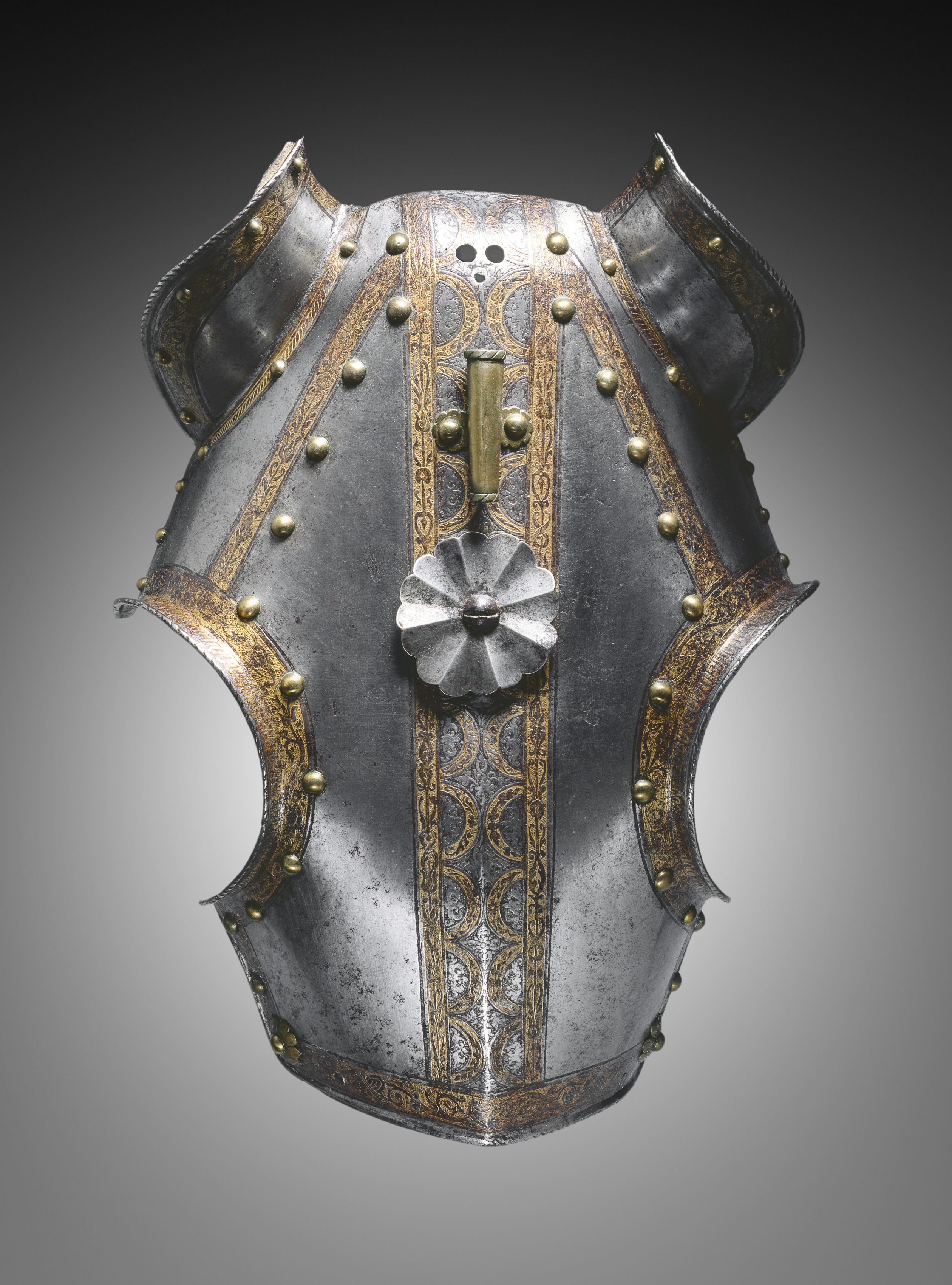
Executive Summary: The Demi-Chanfron as a Foundational Artifact
At Zoey Fashion Lab, our mandate is not merely to observe historical garments but to deconstruct their structural DNA and re-sequence it into contemporary, avant-garde propositions. The subject of this analysis—the Demi-Chanfron from Augsburg, Germany—presents a paradox of materiality and mobility. While originating as a piece of equestrian armor in the 16th century, its technical execution (etched and gilded steel) and its ergonomic logic (a half-mask covering the frontal plane) offer a blueprint for modern, sculptural fashion. This report dissects the artifact’s material, geometric, and functional lexicon, proposing a transference from horse to human silhouette.
I. Provenance and Contextual Displacement
The city of Augsburg, during the Renaissance, was not merely a manufacturing hub; it was a crucible of metallurgical alchemy. The Demi-Chanfron, specifically, was a defensive plate protecting a horse’s forehead and nasal bridge—a half-face shield designed to deflect lance splinters and glancing blows. In our laboratory, we strip this object of its martial context. We do not see a weapon; we see a wearable architecture that predates contemporary body armor by five centuries. The displacement from equine to human form is not a literal translation but a conceptual one. We are interested in the tension between the rigid steel frontal and the implied softness of the leather backing—a dichotomy that resonates deeply with the avant-garde’s obsession with protective fragility.
Technical Deconstruction: Etched and Gilded Steel
The technical specification of this piece is its most radical element. The steel is not merely functional; it is narrative. The etching process—using acid to carve intricate patterns—creates a topographic map on the metal’s surface. In fashion terms, this is the equivalent of negative-space embroidery on a non-yielding substrate. The gilding, or gold-leaf application, introduces a light-reactive quality that alters the piece’s perception based on ambient light and angle. For Zoey Fashion Lab, this dictates a new material hierarchy: steel is the new silk. We propose a textile that mimics this etched depth using laser-cut mylar and thermoformed polyurethane, achieving the same visual complexity without the weight penalty. The gilded elements translate to micro-sequined appliqués that are soldered, not sewn, onto a base of high-tensile nylon mesh.
The Leather Interface: The Hidden Ergonomics
Beneath the metallic shell lies the leather substructure—the interface that mediated between the cold metal and the horse’s sensitive skin. This is the soft-tech layer. In our avant-garde application, this leather is not a lining; it is the exoskeleton’s antagonist. We propose a hybrid construction where the leather is laser-perforated to reduce weight and increase breathability, then bonded to the steel using a high-frequency welding technique. This creates a composite that flexes where the original was rigid. The leather’s natural patina, which develops over time, becomes a living record of wear—a concept we champion as biomorphic fashion. The garment should age, scar, and tan with the wearer, opposing the sterile permanence of fast fashion.
II. The “New DNA Strand” Interpretation
The reference title for this analysis is “New DNA Strand.” This is not a metaphor; it is a directive. The Demi-Chanfron’s genetic code is its symmetrical frontal axis. The piece is designed to be viewed head-on, presenting a monolithic, protective façade. We have isolated this genetic marker and propose a mutation: the asymmetrical demi-mask. By shifting the chanfron’s centerline to one side of the human face, we create a dynamic, off-kilter silhouette that challenges the viewer’s expectation of facial symmetry. This is the core of our avant-garde strategy—de-familiarization through displacement.
Structural Replication: From Horse to Human Torso
To translate the chanfron’s form, we must consider the human body’s own “frontal shield”—the chest and clavicle. We propose a clavicle-cage garment. This piece would feature a single, gilded steel plate that rests on the sternum, extending upward to the throat, with articulated side panels echoing the chanfron’s curved profile. The leather backing is replaced by a compression-fit, moisture-wicking base layer. The etching pattern, traditionally floral or heraldic, is reimagined as a circuit-board fractal—a nod to the digital age’s own form of armor. This is not nostalgia; it is archaeological futurism.
The gilding, in this context, serves a dual purpose. Historically, gold signified status and wealth. In our deconstruction, the gold is a conductive element. We propose integrating thin, flexible LED filaments beneath the etched lines, turning the gilded grooves into illuminated channels. The garment becomes a communication device, its light patterns responding to biometric data (heart rate, adrenaline). The Demi-Chanfron was static; our version is reactive. The DNA strand is thus “new” because it carries the historical code but expresses it through a living, electronic medium.
III. Avant-Garde Styling and Silhouette Propositions
How does one wear this? The avant-garde is not about practicality; it is about propositional posture. We envision three distinct silhouettes:
- The Sentinel: A high-neck, collar-like chanfron that frames the lower face, paired with exaggerated, padded shoulders to mimic the horse’s powerful withers. The steel is left raw, with a brushed finish, contrasting against a fluid, liquid-silk trouser.
- The Reliquary: A back-mounted piece, reversing the chanfron’s frontal logic. The etched steel plate sits between the shoulder blades, visible through a sheer, deconstructed knit. This is armor for the unseen—a protection of the vulnerable spine, gilded with a matte gold to catch light subtly.
- The Centaur’s Grip: A waist-cinching belt structure, where the chanfron’s shape is flattened and extended to wrap the hips. The leather interface becomes the primary visible material, with steel inserts acting as articulated vertebrae. This silhouette emphasizes the pelvis as the center of gravity and power.
Material Ethics and Wearability
We must address the weight and rigidity. The original chanfron is heavy and immobile. Our adaptation uses aerospace-grade titanium for the primary plates, reducing weight by 60% while maintaining tensile strength. The etching is done via CNC milling, allowing for undercuts and three-dimensional relief that acid etching cannot achieve. The leather is replaced with a cactus-based vegan leather, which is both sustainable and possesses a unique, fibrous texture that accepts dye and tooling beautifully. This ensures the piece is not a museum artifact but a functional, wearable sculpture for editorial shoots, performance art, and the most daring of runway presentations.
IV. Conclusion: The Armor of the Future
The Demi-Chanfron from Augsburg is not a relic; it is a premonition. In its fusion of brutal protection and delicate ornamentation, it predicts the modern individual’s need for both psychological armor and expressive individuality. At Zoey Fashion Lab, we have extracted its core principles—frontal dominance, material contrast, and narrative etching—and re-sequenced them into a new DNA strand for the avant-garde. The result is a collection that is simultaneously historical and alien, heavy in concept yet light in execution. We do not copy the past; we re-engineer its instincts. The chanfron’s legacy is not in the battlefield, but on the runway, where the fight is for attention, identity, and the redefinition of the human form.