The Sovereign Silhouette: Deconstructing the Assyrian Crown-Prince for SS26
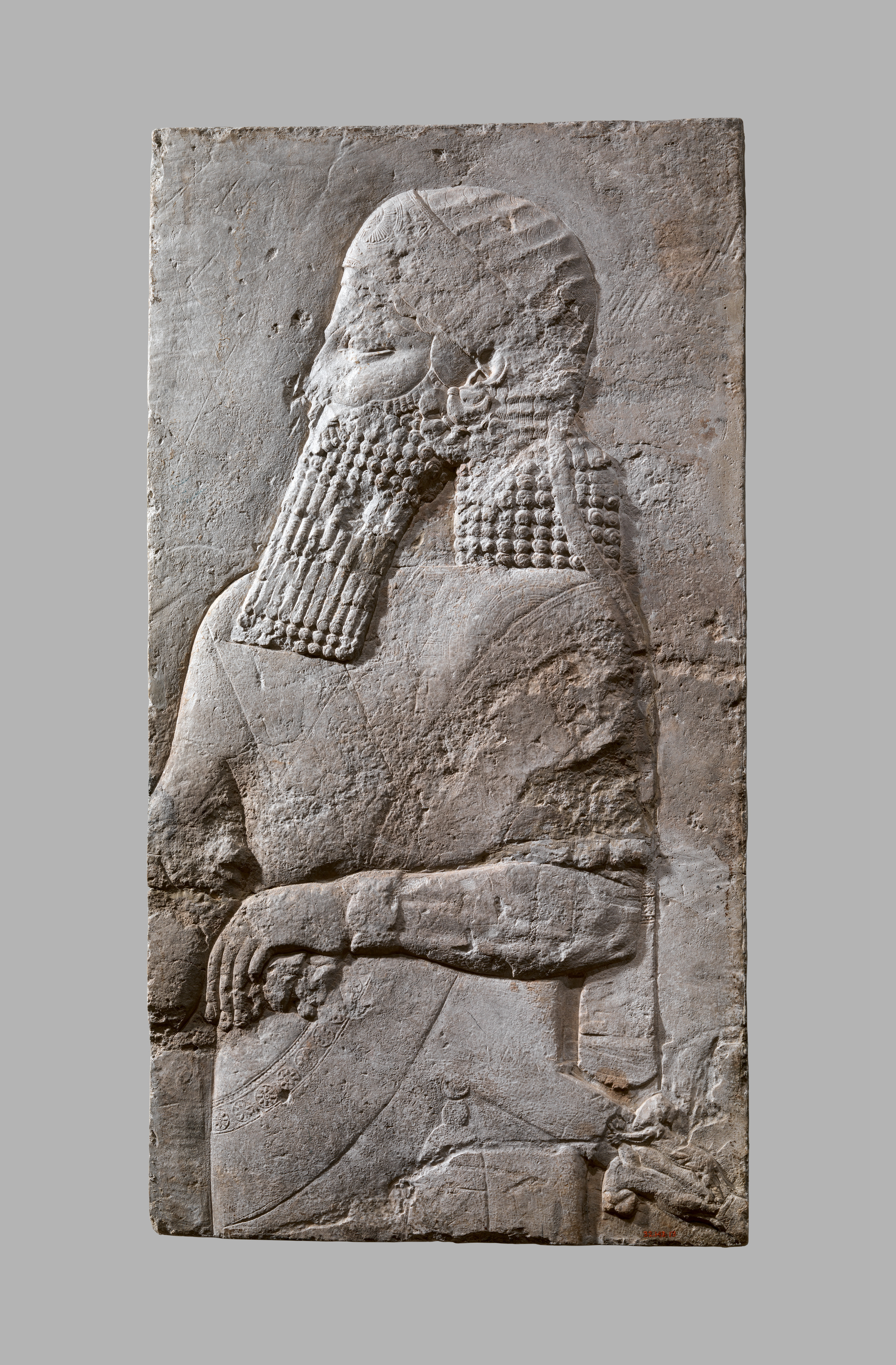
The contemporary fashion landscape is not a linear progression but a palimpsest—layered with the inscriptions of past civilizations, waiting to be excavated by the discerning eye. At Zoey Fashion Laboratory, we do not merely reference history; we perform an archaeological dissection of its power structures, translating them into wearable provocations. Our latest study, the Assyrian Crown-Prince, sourced from a gypsum alabaster relief of the 8th century BCE, serves as the foundational text for our SS26 narrative. This is not a costume drama. This is a blueprint for a new form of regal authority, stripped of its literal ornamentation and rebuilt through the lens of deconstructive futurism.
The original artifact—a bas-relief depicting a beardless prince, his curls meticulously rendered, his hand raised in a gesture of divine acknowledgment—presents a paradox. It is at once rigid and fluid, monumental yet intimate. For SS26, we interrogate this duality. The alabaster’s immaculate whiteness is not a color but a condition—a state of potentiality. Our design thesis posits that the prince’s garments, though lost to time, can be extrapolated from the drapery folds and fringed hems still visible in the stone. We are not reconstructing the garment; we are re-architecting the body politic it once clothed.
Futuristic Silhouettes: The Architecture of Authority
The primary structural innovation for SS26 emerges from the concept of the “Carved Frame.” We have abandoned the soft, draping forms of traditional couture in favor of engineered, load-bearing silhouettes that mimic the verticality and compression of the bas-relief. The shoulder line, typically a site of softness, is reimagined as a cantilevered plinth. Constructed from a hybrid of recycled carbon fiber and bio-resin, the shoulder extends outward and upward, creating a sharp, almost architectural overhang. This is not a shoulder pad; it is a structural corbel, echoing the weight of the king’s palace walls. The silhouette is not worn; it is inhabited. The torso is encased in a sculpted cuirass of laser-sintered gypsum composite, mimicking the alabaster’s texture but rendered in a featherlight, breathable lattice. This piece does not conform to the body; it creates a new, idealized geometry—a torso that exists in a state of permanent, heroic tension.
Below the waist, the silhouette diverges into a radical proposition: the “Fringe-Tectonic” skirt. In the original relief, the prince’s robe terminates in a heavy, knotted fringe. We have abstracted this into a series of articulated, laser-cut panels that hang from a rigid hip yoke. Each panel is a micro-architectural element, hinged to allow for movement while maintaining a severe, columnar line. The effect is one of controlled chaos—a garment that whispers of ancient ritual but moves with the precision of a modern machine. The color palette is intentionally monastic: alabaster white, fossil grey, and a single accent of oxidized copper, referencing the metal fastenings of the original armor. This is not a nostalgic beige; it is a spectral white, a void that allows the structure to speak.
Structural Innovation: The Kinetic Relief
Our most significant technical breakthrough lies in what we term the “Kinetic Relief” system. The bas-relief is, by definition, a static image. Our challenge was to inject temporality into this permanence. The solution is a micro-servo network embedded within the garment’s structural seams. These actuators, powered by flexible photovoltaic films woven into the fabric, respond to the wearer’s biometric data—heart rate, posture, even respiratory rhythm. When the wearer is in a state of repose, the garment’s surface remains smooth, a pristine alabaster plane. As their pulse quickens or their stance shifts, specific panels begin to micro-undulate, creating a rippling effect that mimics the subtle, carved lines of the prince’s curls. This is not mere gimmickry; it is a dialogue between the static authority of the past and the volatile energy of the present. The garment becomes a living relief, perpetually inscribing and erasing its own narrative.
Furthering this, we introduce the “Akkadian Joint”, a modular articulation system replacing conventional sewing. Instead of thread, garments are assembled via interlocking, 3D-printed connectors shaped like cuneiform wedges. This allows for unprecedented flexibility in fit and form. A single silhouette can be reconfigured into three distinct architectures—a full ceremonial robe, a combat-ready tunic, or a minimalist pectoral—without a single stitch. This is a direct response to the modern consumer’s demand for versatility, but it is also a philosophical statement. The Assyrian prince’s power was absolute and static; our SS26 wearer’s power is fluid, adaptive, and self-determined. The garment is no longer a second skin; it is a portable infrastructure for personal sovereignty.
Materiality as Narrative
We cannot ignore the material itself. Gypsum alabaster is soft, almost sedimentary. It is a stone that records pressure. In our SS26 collection, we honor this by developing a proprietary textile called “Alabastron”. This is a multi-layered fabric composed of a cellulose nanofiber base, a layer of mineral-infused silicone, and a final, sacrificial topcoat of crushed gypsum. The result is a material that is supple yet retains a chalky, matte finish. It is designed to scuff, to mark, to bear the patina of experience. Unlike the pristine museum artifact, our garments are meant to be lived in, to become archaeological records of their own wear. This is the ultimate deconstruction: we are not preserving history but creating the conditions for future historians to study us.
The Assyrian Crown-Prince is not a relic to be copied; it is a provocation. For SS26, Zoey Fashion Laboratory proposes a fashion that is not about adornment but about structural authority. It is a collection for the individual who understands that true power is not inherited but engineered. The silhouette is sharp, the materials are intelligent, and the message is unequivocal: the future of couture lies not in the past’s nostalgia, but in its reinterpreted structural DNA. Welcome to the new sovereign age.