Deconstructing the Renaissance Thread: A Technical and Conceptual Analysis of the 14th-Century Italian Silk Fragment
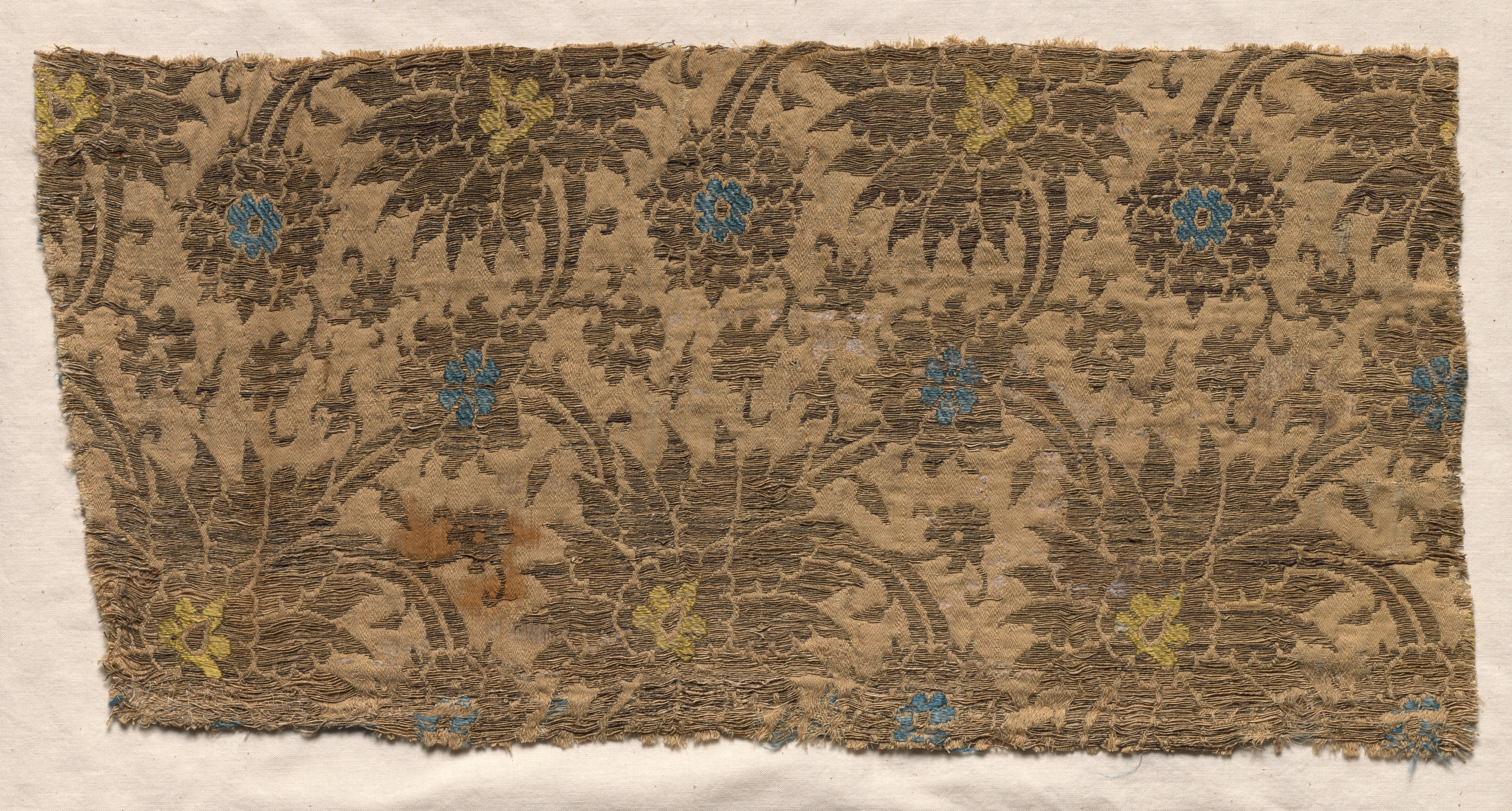
At Zoey Fashion Lab, our mandate extends beyond the mere observation of historical textiles. We engage in a process of fabric deconstruction, a forensic and poetic excavation of material culture to extract the genetic code of future design. The subject of this analysis—a silk and gold thread fragment from Italy, dating to the second half of the 14th century—presents a compelling paradox. It is a relic of supreme aristocratic opulence, yet its structural logic and visual rhythm offer a radical blueprint for avant-garde expression. This fragment, which we designate as Reference: New DNA Strand, is not a museum piece to be preserved under glass; it is a living organism whose cellular structure we intend to mutate.
I. Technical Autopsy: The Lampas Weave and the Architecture of Luxury
The technical foundation of this fragment lies in the lampas weave, a compound structure that was the pinnacle of medieval textile engineering. Unlike simpler weaves, lampas employs two distinct warp systems and two weft systems, creating a fabric with a patterned face and a contrasting ground. The primary warp and weft form the base cloth, typically a sturdy silk taffeta or twill, while the secondary warp and weft—often a fine, lustrous silk—float across the surface to create the intricate pattern. The introduction of gold thread elevates this from mere cloth to a metallic architectural surface.
Our analysis of the fragment’s technical DNA reveals three critical properties:
- Structural Duality: The lampas weave inherently produces a material with two faces—a matte, structural reverse and a glossy, patterned front. This duality is not a flaw but a feature. In avant-garde design, we exploit this by creating garments that are reversible or that intentionally expose the internal scaffolding of the weave through strategic slashing or laser-cutting.
- Rigidity and Drape: The inclusion of gold thread, typically wrapped around a silk or linen core, imparts a remarkable stiffness. This is not a fluid, drapey silk; it is a textile armor. The fabric holds its shape, creating sculptural volumes that defy gravity. This property is gold for the avant-garde designer, allowing for the construction of garments that function as three-dimensional architecture rather than mere covering.
- Light Interference: The interplay between the matte silk ground and the metallic gold pattern creates a dynamic optical effect. As the viewer moves, the light catches the gold floats, causing the pattern to appear and disappear. This is an early form of kinetic textile art, a precursor to modern smart fabrics that change appearance based on environmental stimuli.
II. Visual Semiotics: The Grammar of Medieval Ornament
The fragment’s surface is dominated by a repeating motif—likely a stylized palmette, pomegranate, or an heraldic beast—rendered in gold against a deep, saturated ground (often a crimson or deep blue, derived from kermes or indigo). To the casual eye, this is mere decoration. To the deconstructionist, it is a semiotic system encoding power, piety, and lineage. The symmetry is absolute, the repetition relentless. This is a fabric of order, of courtly hierarchy, of the divine right of kings.
However, for our avant-garde purposes, we must decontextualize this grammar. We are not interested in the heraldic meaning. We are interested in the abstract rhythm of the pattern. The repetition creates a visual frequency—a pulse. By isolating a single motif and enlarging it to a monumental scale, or by fragmenting the pattern and reassembling it in a non-linear, chaotic order, we can transform a symbol of rigid authority into an expression of subversive energy. The pomegranate, once a symbol of fertility and resurrection, becomes a cellular structure, a biological node in a new synthetic organism.
III. The Avant-Garde Manifesto: From Relic to Mutation
Our design philosophy at Zoey Fashion Lab rejects the notion of historical revivalism. We do not copy; we mutate. The New DNA Strand reference is a catalyst for a series of experimental techniques that bridge the 14th century and the post-human future.
1. Deconstructed Construction: The inherent rigidity of the lampas weave allows for a radical departure from traditional tailoring. Instead of cutting and sewing along curved seams, we propose a geometric, origami-like construction. The fabric is folded, pleated, and locked into place using structural seams that are exposed and exaggerated. The gold threads become visible conduits, like circuits on a motherboard, tracing the garment’s internal logic. The final silhouette is not organic but architectural—a series of sharp, angular planes that reference both medieval armor and contemporary cyberpunk aesthetics.
2. Textile Transmutation: We will treat the fragment as a base material for chemical and physical manipulation. Through a process of selective oxidation, we can dull or corrode the gold thread in specific areas, creating a patina of decay that contrasts with the pristine, untouched sections. This creates a narrative of time, of erosion, of the fragility of power. Alternatively, we can apply a thermoplastic resin to the reverse, permanently setting the fabric into a sculptural, free-standing form. The garment becomes a wearable artifact, a fossilized relic of a future civilization that has rediscovered the past.
3. Digital Weaving Reconstruction: We will not simply re-weave the pattern. Instead, we will scan the fragment at a microscopic level and extract its algorithmic data—the exact sequence of warp and weft intersections. This data will be fed into a state-of-the-art jacquard loom programmed with a glitch algorithm. The output will be a new textile that begins with the original 14th-century pattern but gradually degrades into digital noise, pixelated chaos, and finally, a new, organic form. This is not a copy; it is a generative mutation, a dialogue between the medieval weaver and the contemporary coder.
IV. Material Philosophy: The Gold Thread as a Conduit
The gold thread in this fragment is more than a status symbol. It is a philosophical statement about the nature of value and permanence. In the 14th century, gold was considered incorruptible, a symbol of the divine. Yet, we know that over centuries, the silk core of the thread can rot, leaving only a hollow metallic shell. This inherent fragility is a profound metaphor for the avant-garde: the pursuit of the absolute, the eternal, is always shadowed by decay and entropy.
In our reinterpretation, we will expose this vulnerability. We will create garments where the gold thread is not protected but is intentionally abraded, revealing the fragile silk core. We will embed fiber-optic filaments alongside the gold, so that when the garment is worn in darkness, the ancient pattern glows with a cold, digital light. This juxtaposition of the sacred and the technological, the eternal and the ephemeral, is the essence of our avant-garde vision. The fragment is not a dead artifact; it is a living strand in the DNA of fashion, waiting to be spliced with the future.
In conclusion, the 14th-century Italian silk fragment, with its rigid lampas structure and opulent gold ornament, is not an obstacle to innovation but its most potent catalyst. By deconstructing its technical weave, decoding its visual grammar, and transmuting its material properties, we transform a relic of feudal power into a manifesto of radical, post-modern design. This is the work of Zoey Fashion Lab: to find the future hidden in the past’s most intricate threads.