Deconstructing the Golden Field: A Safavid Textile as Proto-Avant-Garde Artifact
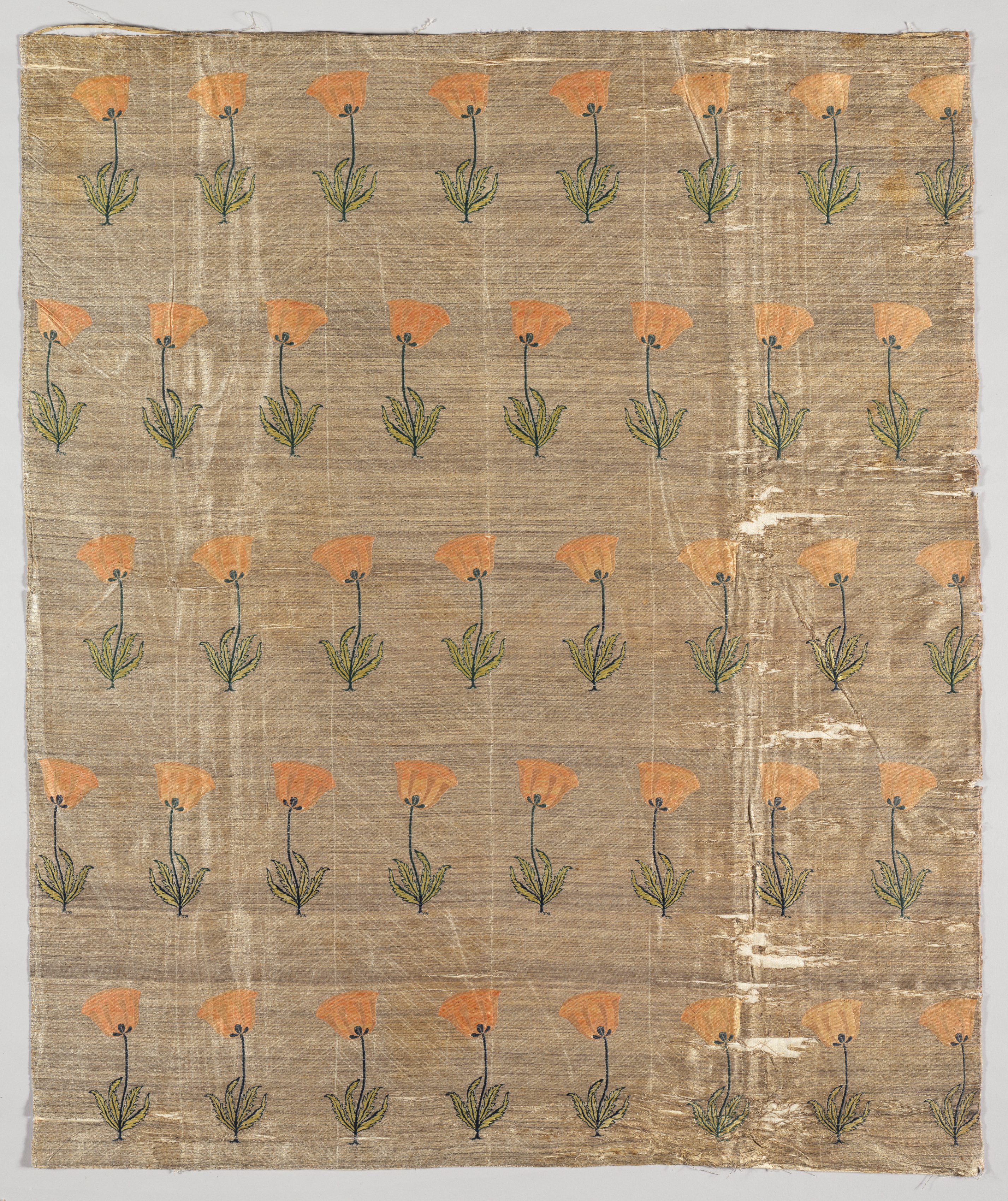
At Zoey Fashion Lab, we do not merely observe historical textiles; we interrogate them. We strip back the layers of veneration and dusty museum glass to expose the radical, often disruptive, core of their materiality. The subject of this analysis—a Safavid Persian textile featuring a field of poppies on a golden ground, woven in silk and gilt-metal thread—is typically categorized as a masterpiece of courtly refinement. But to label it merely as “decorative” is to ignore its profound conceptual violence. This piece, created between 1501 and 1722, is not a passive artifact of a golden age; it is a proto-avant-garde manifesto, a deliberate orchestration of material, pattern, and technique that subverts the very notion of naturalistic representation.
I. The Tyranny of the Ground: Gold as Conceptual Void
The first act of deconstruction begins with the ground. In conventional landscape or botanical representation, the field is a neutral, recessive space—a background against which the subject performs. Here, the Safavid weaver inverts this hierarchy with breathtaking audacity. The golden ground is not a backdrop; it is the primary protagonist. Constructed from gilt-metal thread wrapped around a silk core, this ground is not merely shiny; it is aggressively luminous, a shimmering, reflective surface that actively denies the viewer a stable focal point.
This is not a passive field. It is a stamped, textured plane that catches and fractures light. In avant-garde terms, this functions as a form of optical disruption, predating Op Art by four centuries. The gold does not illuminate the poppies; it competes with them, threatening to swallow their forms in a blaze of material excess. The weaver has effectively created a void that is more present than the object. This is a radical rejection of the Western perspectival tradition, where the ground is subordinate. Here, the ground is a totalizing, immersive environment—a precursor to the monochrome paintings of Yves Klein or Robert Ryman, where the field itself becomes the entire subject.
II. The Poppy: Sedition in Bloom
Enter the poppy. In the botanical lexicon of the Safavid court, the poppy (gol-e khashkhash) was a symbol of ephemerality, intoxication, and often, martyrdom—a complex, melancholic signifier. However, the weaver’s treatment of this motif is anything but sentimental. The poppies are rendered in supplementary weft, a technical choice that lifts them off the ground plane, creating a subtle, almost sculptural relief. They do not sit *in* the field; they hover *over* it, like alien organisms colonizing a metallic host.
Observe the color logic. The silk for the poppies is typically a vivid, arterial red or a deep, narcotic crimson. Against the gold, this red does not harmonize; it shrieks in chromatic dissonance. This is a deliberate act of aesthetic aggression. The red is the color of life, blood, and danger, while the gold is the color of eternity, wealth, and divine stasis. The juxtaposition is not a pastoral scene but a battlefield of opposing temporalities—the fleeting, organic moment versus the immutable, metallic forever.
Furthermore, the poppies are not arranged in a naturalistic, organic scatter. They are organized in a rigorous, repeating pattern—a grid-like, staggered lattice. This is a crucial point. The artificiality of the repetition denies the possibility of a "landscape." This is not a meadow; it is a system. By imposing a rigid, mathematical order onto a symbol of wild, narcotic abandon, the weaver performs a conceptual paradox. This is the same tension that defines the avant-garde: the struggle between the chaotic impulse and the formal constraint. The poppy is tamed, but its inherent wildness bleeds through the pattern, creating a palpable tension that vibrates beneath the surface.
III. Stamped and Twilled: The Violence of Technique
Our analysis must extend to the technical substrate. The use of twill weave with supplementary weft is standard for high-grade Safavid silks, but the specific addition of stamping is the true subversive act. Stamping is a process of physical compression, a forceful indentation that permanently alters the surface. It is, in effect, a controlled act of violence upon the material. In the context of the archive, this stamping serves to create a secondary, tactile texture—a moiré effect that disrupts the already complex play of light.
This technique aligns the textile with the ethos of process art. The artist does not hide the method; they foreground it. The stamped marks are evidence of the hand, the tool, and the pressure applied. This is not the slick, illusionistic surface of a painting. It is a confession of materiality. The fabric does not pretend to be a window into a garden; it announces itself as a constructed object, a slab of woven metal and silk that has been physically beaten into submission. This is a precursor to the deconstructivist fashion of Martin Margiela or Rei Kawakubo, who famously left seams exposed and fabrics distressed, celebrating the construction process as the meaning itself.
IV. Archive Resonance and the Avant-Garde Continuum
The archival note references a resonance—a cultural echo between East and West, a collision of aesthetics. But the true resonance of this textile lies in its radical temporal dislocation. It speaks to us not as a relic, but as a prophecy of modernism. The rejection of narrative depth in favor of surface intensity, the use of pattern as a form of optical disruption, and the brutal honesty of the technique—all of these are pillars of the avant-garde project.
When we at Zoey Fashion Lab look at this Safavid textile, we do not see a courtly luxury good. We see a pre-modern abstraction. The poppies are not flowers; they are glyphs. The gold is not wealth; it is a void. The weave is not craft; it is a system of structural logic. This textile is a challenge to the contemporary designer: to embrace the tension between the organic and the systematic, to use material excess not as decoration but as a conceptual weapon, and to understand that the most radical statement can be woven, thread by thread, in a field of golden silence.
This is not a fabric to be draped. It is a fabric to be deconstructed, analyzed, and re-synthesized into a new form of wearable dissent.