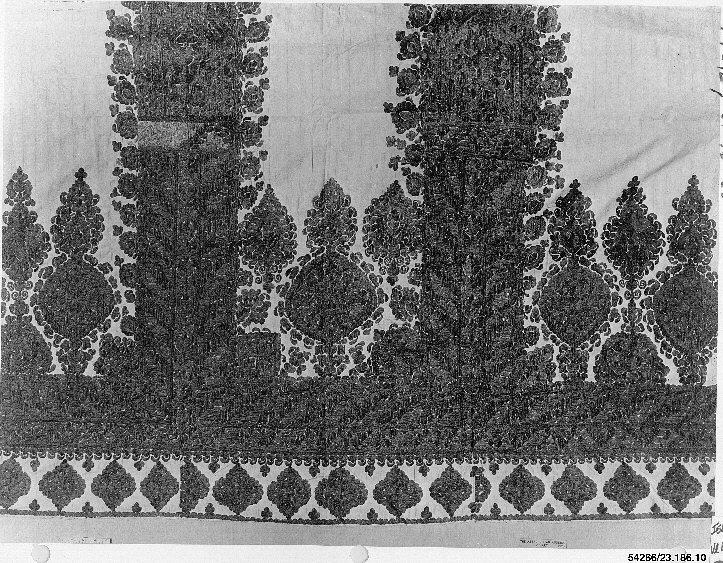
Deconstructing the Gravitational Paradigm: "Hanging" as a Structural Manifesto
Within the lexicon of avant-garde couture, few concepts are as viscerally evocative and structurally defiant as Hanging. For Zoey Fashion Laboratory's SS26 study, this is not a mere descriptor of state but a foundational design philosophy. Originating from the conceptual "Global Frontier"—a non-place of pure ideation beyond geographical and cultural tethers—this collection interrogates the relationship between body, fabric, and the immutable force of gravity. It posits a future where silhouette is not constructed from the ground up, but is instead suspended from a series of deliberate, architectural points of tension. The choice of cotton and silk, transformed through intensive embroidery, serves as a critical dialectic: the humble versus the luxurious, the matte against the luminous, all subjected to the same rigorous structural re-evaluation.
Structural Innovation: The Tensile Architecture of the Body
The core innovation of "Hanging" lies in its rejection of traditional tailoring darts and seams as primary shape-givers. Instead, Zoey Fashion Laboratory engineers garments around a hidden tensile architecture. Imagine silk georgette panels, internally supported by a fine, almost surgical network of embroidered cotton cords. These cords originate from anchor points at the collarbone, shoulder apex, or a single central sternum plate, creating cascading forms that appear to defy their own materiality. The silhouette is a product of calculated drape and counter-tension, resulting in shapes that are simultaneously fluid and rigidly defined. A dress may billow dramatically at the hem yet be cinched taut along the ribcage by an invisible, embroidered harness, creating a kinetic silhouette that evolves with the wearer's movement, a living sculpture in motion.
This approach extends to outerwear and separates, where cotton canvas is treated as a architectural membrane. Jackets are not merely worn; they are suspended from the frame via external armatures that extend from the shoulders, creating a floating shell that exists in deliberate separation from the body. The resulting negative space becomes as critical a component as the garment itself, challenging preconceived notions of fit and function. This is couture as structural engineering, where the body is the site and the fabric is the dynamic load.
Material Dialectics: The Embroidery as Structural Reinforcement
The specified materials—cotton and silk—are deployed not for nostalgia but for their inherent structural and textural properties. Here, embroidery transcends ornamentation to become integral structural reinforcement and a mapping system for tension. Dense, raised cotton-thread embroidery is applied along precise stress trajectories on silk organza, creating reinforced pathways that guide the drape and dictate where the fabric will fold, fall, or resist. This transforms the embroidery from a surface pattern into a three-dimensional skeletal system, visible and tactile, that tells the story of the garment's construction.
Conversely, on heavy cotton twill, embroidery takes on a subtractive quality. Laser-guided threadwork and strategic openwork create perforated zones of calculated weakness, allowing the rigid fabric to collapse and drape in specific, preordained areas. The material dichotomy is stark: the silk, seemingly delicate, is armored by thread; the cotton, ostensibly sturdy, is made to yield. This deliberate contradiction is the essence of the Global Frontier—a synthesis of opposites to forge a new, unresolved whole.
Futuristic Silhouette: The Unresolved Contour
The SS26 silhouette born from "Hanging" is one of dynamic asymmetry and unresolved contour. Hemlines are not uniform; they are algorithmic, responding to the length and pull of their suspension points. A garment may be floor-length on one side and sharply abbreviated on the other, not as a whimsical flourish, but as the logical outcome of its tensile geometry. Sleeves become detached torsos, hanging from cuff connections at the wrist, while bodices may appear to dematerialize into a complex web of straps and embroidered filaments.
This futurism is not cold or robotic; it is profoundly organic in its logic. The silhouettes echo natural systems of suspension—spiderwebs, cascading vines, the gravitational pull on a liquid form. The wearer becomes a walking ecosystem of forces, with the body as the central, grounding element in a constellation of fabric and thread. The result is a powerful, almost ethereal presence that commands space not through volume, but through the implied energy of its suspended state.
Contextualization: A Standalone Study in Avant-Garde Methodology
As a standalone study, "Hanging" operates as a pure exercise in deconstructive aesthetics. It removes the garment from conventional contexts of wearability and commercial aspiration, focusing solely on the philosophical and structural interrogation of its premise. For Zoey Fashion Laboratory, this is essential R&D. The knowledge gained here—on tensile load, material counterplay, and silhouette generation—will inform and permeate future, more accessible collections. It is a manifesto in cloth and thread, asserting that the future of fashion lies not in faster cycles, but in deeper, more radical engagements with fundamental physical laws.
Ultimately, "Hanging" is a collection that makes gravity visible. It charts the invisible forces that act upon us all, rendering them in exquisite, embroidered cotton and silk. It proposes a future where clothing is a dynamic partner to the body's movement in space, a suspended architecture that celebrates the beautiful, constant tension between falling and floating. For SS26, Zoey Fashion Laboratory does not simply design clothes; they design gravitational fields for the human form.