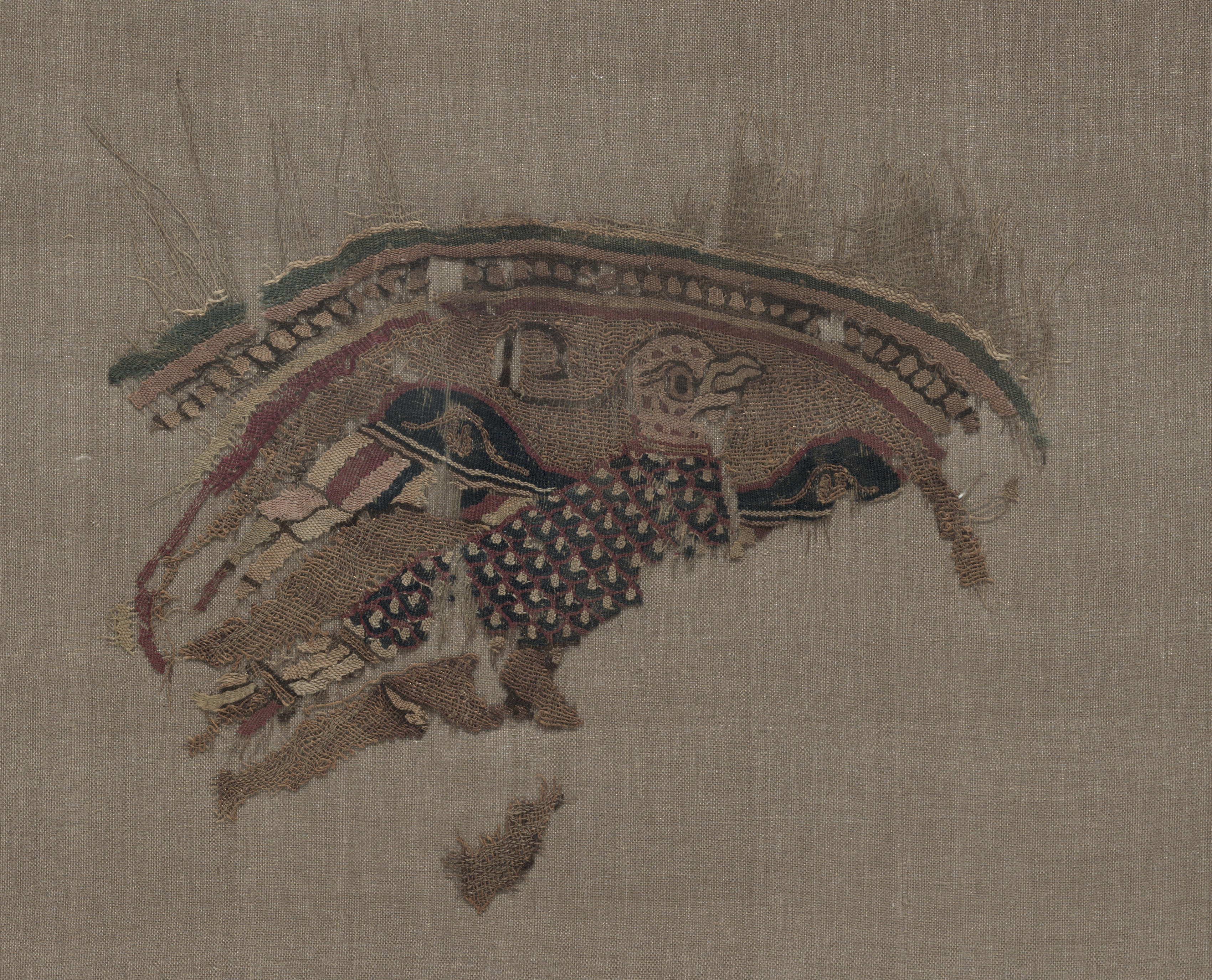
Fragmentary Roundel with Eagle: A Poetic Deconstruction of Power and Precarity
In the hallowed archives of textile history, few artifacts speak with the dual voice of opulence and entropy quite like the Fragmentary roundel with eagle in gold ground from Fatimid Egypt. For Zoey Fashion Lab, this is not merely a relic; it is a manifesto. The piece—composed of linen, silk, and gold filé, executed in plain weave with inwoven tapestry weave—exists in a state of deliberate incompleteness. Its broken edges, frayed warps, and missing segments are not defects but design intelligence. In our avant-garde reinterpretation, we treat the fragment as a structural philosophy: fashion as a palimpsest, where every tear is a sentence, every loose gold thread a whispered rebellion.
Material Alchemy: The Grammar of Gold on Humble Linen
The technical construction of this roundel is a study in hierarchical tension. Linen—the fiber of the earth, of labor, of the Nile’s muddy banks—forms the ground. Upon it, silk, the aristocratic protein filament, weaves its soft, lustrous narrative. And then, gold filé: a metal-wrapped thread, often composed of gilded silver or gold leaf around a silk core, laid upon the surface with a tapestry technique that creates a dense, reflective plane. This is not embroidery; it is inwoven architecture. The gold does not sit atop the fabric; it becomes the fabric’s skin.
In our avant-garde lens, this material hierarchy is inverted. Zoey Fashion Lab proposes a deconstructed gold ground—where the metallic threads are deliberately left raw, unbound, and allowed to oxidize or tarnish unevenly. We imagine a garment where linen is the visible structural skeleton, silk appears as frayed, translucent overlays, and gold filé is applied in discontinuous, broken strokes, mimicking the fragmentary nature of the original. The result is a textile that breathes between luxury and decay, a wearable critique of the fashion industry’s obsession with pristine perfection.
The Eagle: Iconography of Power, Rendered Vulnerable
The central motif—an eagle—is a potent symbol of sovereignty, celestial authority, and martial dominance. In Fatimid art, the eagle often appears as a royal emblem, a guardian of the realm, or a metaphor for the soul’s ascent. Yet here, the eagle is fragmented. Its wing may be missing; its talon may dissolve into unworked ground. This is not a triumphant bird but a wounded sovereign, a ruler whose empire has crumbled into shards of gold and linen.
For our avant-garde collection, we translate this iconography into asymmetrical silhouettes. A tailored jacket, for instance, might feature an eagle’s head embroidered in gold filé on one shoulder, while the opposite side is left as a stark, unadorned linen canvas—an intentional void. The eagle’s body is suggested through negative space, via cutouts, laser-perforated leather, or sheer silk organza panels that reveal the wearer’s skin. This is not decoration; it is a political statement on the fragility of authority, the ephemerality of power, and the beauty of impermanence.
Archive Resonance: Mirror and Stone
The provided reference—Archive Resonance: 一面是光洁银镜上以黄金镶嵌的纷繁棕叶纹,另一面是冰冷石棺板上以浮雕诉说的生命叙事—offers a profound dialectic. On one side, a polished silver mirror inlaid with gold acanthus leaves: a surface of perfect reflection, of vanity, of the present moment captured in metallic splendor. On the other, a cold stone sarcophagus with relief-carved narratives of life: a surface of memory, of death, of permanence carved into immobility. This duality is the core tension of our design philosophy.
The roundel sits between these two poles. It is neither a mirror nor a tombstone; it is a threshold object. Its gold ground reflects light, but its fragmentation prevents full reflection. Its linen base is organic, perishable, yet its tapestry weave is durable, almost monumental. We propose a capsule collection titled "Palimpsest Sovereign" that embodies this resonance:
- Garment 1: "Silver Mirror Shroud" — A floor-length coat in liquid silver lamé, overlaid with detachable panels of gold filé mesh. The panels are cut in acanthus leaf shapes, but deliberately distressed, with torn edges and missing sections. The wearer becomes a moving mirror, but one that is always partially obscured, always in flux.
- Garment 2: "Sarcophagus Gown" — A structured, columnar gown in ivory linen, with relief-like embroidery in silk and gold thread that traces an eagle’s skeletal form. The embroidery is not continuous; it stops abruptly at the waist, as if the narrative is cut off by time. The hem is raw, unhemmed, fraying into loose threads—a metaphor for the body’s eventual dissolution.
- Garment 3: "Fragmentary Cape" — A cape constructed from multiple rectangular panels, each woven in a different technique: plain weave, tapestry, and loose gold filé laid on top. The panels are joined with visible, exposed seams, and some are intentionally left incomplete, with warp threads hanging free. The cape can be worn in multiple configurations, allowing the wearer to curate their own fragmentation.
Avant-Garde Methodology: Weaving as Deconstruction
Our technical approach at Zoey Fashion Lab is not to replicate the roundel but to extract its generative principles. The first principle is interruption: the tapestry weave is not allowed to finish its pattern. We instruct our weavers to cut the weft threads mid-pass, leaving floats and loops on the surface. The second principle is layered transparency: we use gold filé not as a solid ground but as a sparse, linear network, allowing the linen and silk beneath to show through. The third principle is asymmetric composition: the eagle is never centered; it is always displaced, cropped, or partially hidden under a fold or a seam.
This methodology challenges the very notion of luxury. Traditional luxury demands flawlessness; our avant-garde luxury demands narrative honesty. A garment that shows its construction, its wear, its potential for decay, is more honest than one that hides its labor. In a world of fast fashion and disposable trends, the fragmentary roundel teaches us that permanence is an illusion, but craft is a legacy. By embracing the fragment, we honor the whole—the complete eagle, the unbroken gold ground, the pristine mirror—as an ideal that exists only in our imagination, and in the spaces between the threads.
Conclusion: The Fragment as Future
The Fragmentary roundel with eagle in gold ground is not a broken object; it is a complete statement about the nature of time, power, and materiality. For Zoey Fashion Lab, it serves as a blueprint for a new avant-garde—one that rejects sterile perfection in favor of poetic incompleteness. We do not restore; we reinterpret. We do not preserve; we provoke. In our hands, the eagle does not soar; it hovers, suspended between the mirror’s gleam and the sarcophagus’s stillness, forever in the act of becoming—or unbecoming. This is the resonance we archive, the future we weave.