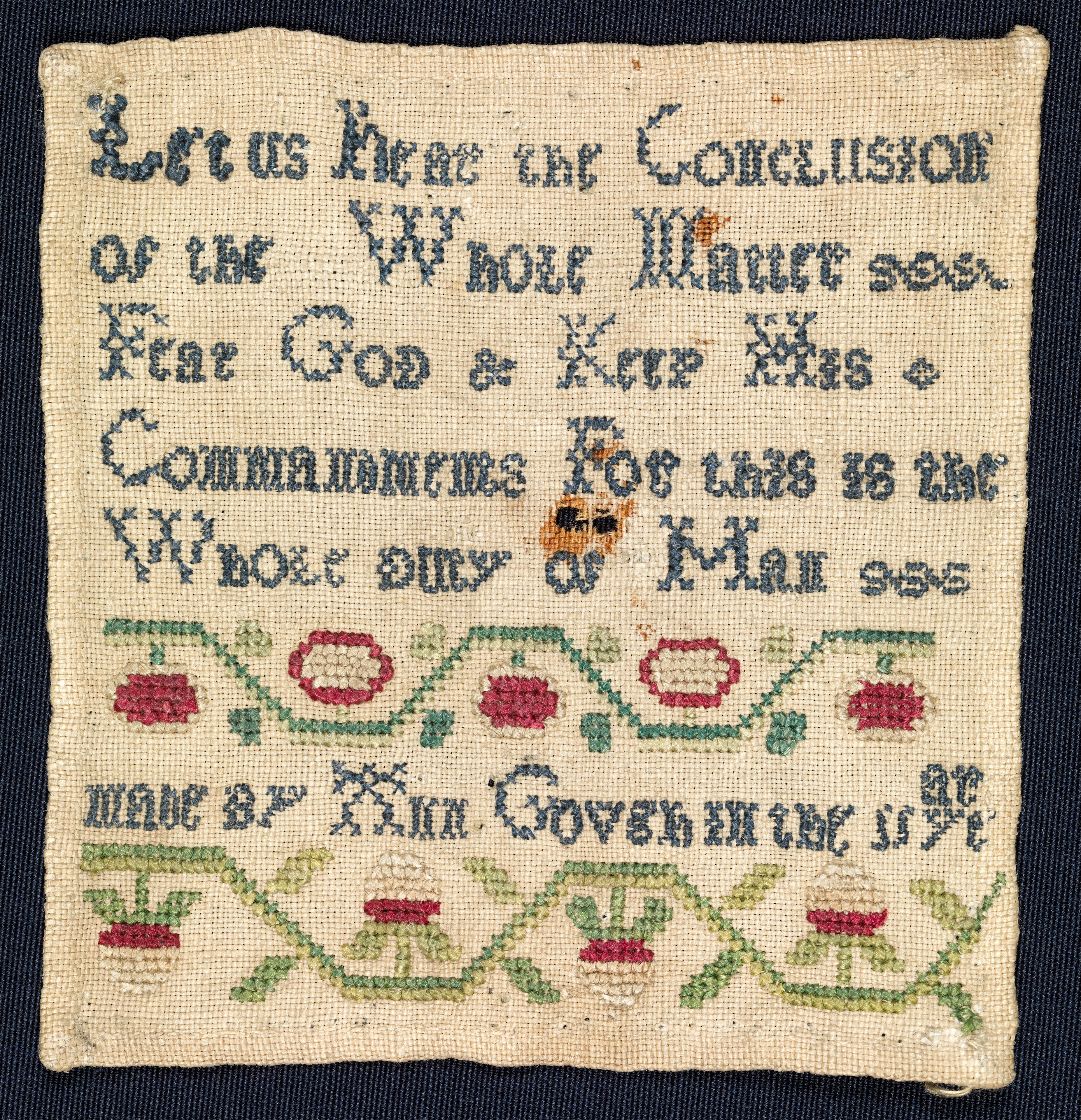
The Sampler Reconfigured: A Blueprint for SS26 Deconstruction
At Zoey Fashion Laboratory, we do not inherit textiles; we interrogate them. The object under our magnifying glass is a sampler—a relic of disciplined childhood, a grid of silk embroidery upon humble linen, born within the austere walls of a charity school on the Global Frontier. To the uninitiated, this is a quaint artifact of moral instruction. To our laboratory, it is a proto-architectural schematic, a coded matrix of tension, repetition, and release that demands a radical reinterpretation for the SS26 season. We are not preserving this sampler; we are weaponizing its structural DNA to forge silhouettes that defy gravity and narrative.
Deconstructing the Grid: From Moral Order to Chaotic Geometry
The charity school sampler is defined by its rigid grid—a Cartesian prison of alphabets, numerals, and pastoral motifs. The silk threads, once laid down by a child’s trembling hand, form a perfect, submissive order. Our first intervention is to violate that grid. We extract the embroidery’s underlying tension—the pull of silk against the passive linen ground—and amplify it into a three-dimensional, load-bearing system. The result is a series of garments that appear to be in a state of perpetual, controlled collapse.
Consider the “Fractured Alphabet” bustier. We laser-cut the linen into a lattice of negative space, leaving only the silk-embroidered characters intact. These letters are then suspended on micro-silicone filaments, allowing them to float a full centimeter off the body’s surface. As the wearer moves, the letters tremble, creating a kinetic typography that dissolves the boundary between garment and communication. This is not nostalgia; it is the extraction of information from a historical artifact, then re-encoding it as a wearable, interactive architecture.
Silk as Structural Steel: The Tension-Compression Paradox
In conventional couture, silk is a symbol of softness, drape, and submission to the body. Our SS26 study inverts this paradigm. We treat the silk embroidery not as decoration, but as pre-stressed reinforcement. By employing a technique we call tension-wefting, we embroider directly onto a heat-set linen substrate that is then collapsed. The silk threads, which are slightly shorter than the final relaxed state of the linen, pull the fabric into sharp, angular folds. This creates a “memory textile” that snaps back into a defined architectural silhouette when released.
Our signature piece from this study is the “Charity Arch” coat. Its silhouette is not cut; it is grown. The shoulders are exaggerated into cantilevered peaks, supported not by padding but by the internal tension of the silk threads themselves. The linen is pleated into a fan that radiates from the spine, mimicking the geometric borders of the original sampler. The coat’s hem is asymmetrical, dipping sharply on one side to reveal a hidden layer of raw, unbleached linen—a nod to the charity school’s austerity, now transformed into a statement of luxurious restraint.
Global Frontier: The Aesthetic of the Improvised Future
The provenance of this sampler—the Global Frontier—is not a geographic location but a conceptual one. It represents the collision of colonial instruction and indigenous resourcefulness. The charity school taught order, but the child’s hand inevitably introduced micro-imperfections: a slightly skewed cross-stitch, a thread that wandered off-grid. These imperfections are our true design gold. We have magnified them 400% to create a new print language for SS26.
This is not a literal reproduction. Instead, we have mapped every error, every tension deviation, into a digital algorithm that generates “glitch-gardens”—a floral motif that appears to be digitally corrupted, with petals that pixelate into sharp triangles. These patterns are then printed onto a bio-based silk organza, creating a garment that is simultaneously futuristic and deeply rooted in handcraft. The narrative is clear: the future of couture is not in sterile perfection, but in the poetic failure of the machine.
Structural Innovation for SS26: The Modular Sampler System
Our most radical proposition is the “Modular Sampler”—a garment system that allows the wearer to become the curator of their own silhouette. The core is a minimal, sleeveless shift dress made of the same linen, but devoid of embroidery. Attached to it are a series of “stitch-modules”: pre-embroidered panels that can be affixed via magnetic micro-clasps. Each module is a fragment of the original sampler—one features the alphabet, another the numeric row, a third the image of a lone tree.
The wearer can assemble these modules to create a high-necked collar, a dramatic peplum, or a sculptural sleeve that wraps around the arm like a rigid exoskeleton. This is a direct challenge to the fixed, hierarchical structure of the charity school. Here, the wearer has total agency. The garment is no longer a finished object but a living archive, endlessly reconfigurable. For SS26, this modularity is not a gimmick; it is a philosophical statement on the fluidity of identity in a post-digital age.
Conclusion: The Sampler as a Time Machine
This study proves that the most avant-garde ideas are not invented from nothing—they are excavated. The charity school sampler, with its humble origins, contains the blueprint for a revolution in structural design. By deconstructing its grid, we have built a new grammar of tension and compression. By amplifying its imperfections, we have created a new digital aesthetic. By modularizing its components, we have given the wearer the keys to their own sartorial destiny.
For SS26, Zoey Fashion Laboratory does not offer clothing. We offer architectural propositions—garments that are arguments, textiles that are theorems. The sampler, once a symbol of obedience, is now a manifesto of radical, structural freedom. This is the frontier of fashion: where history is not a museum, but a laboratory.