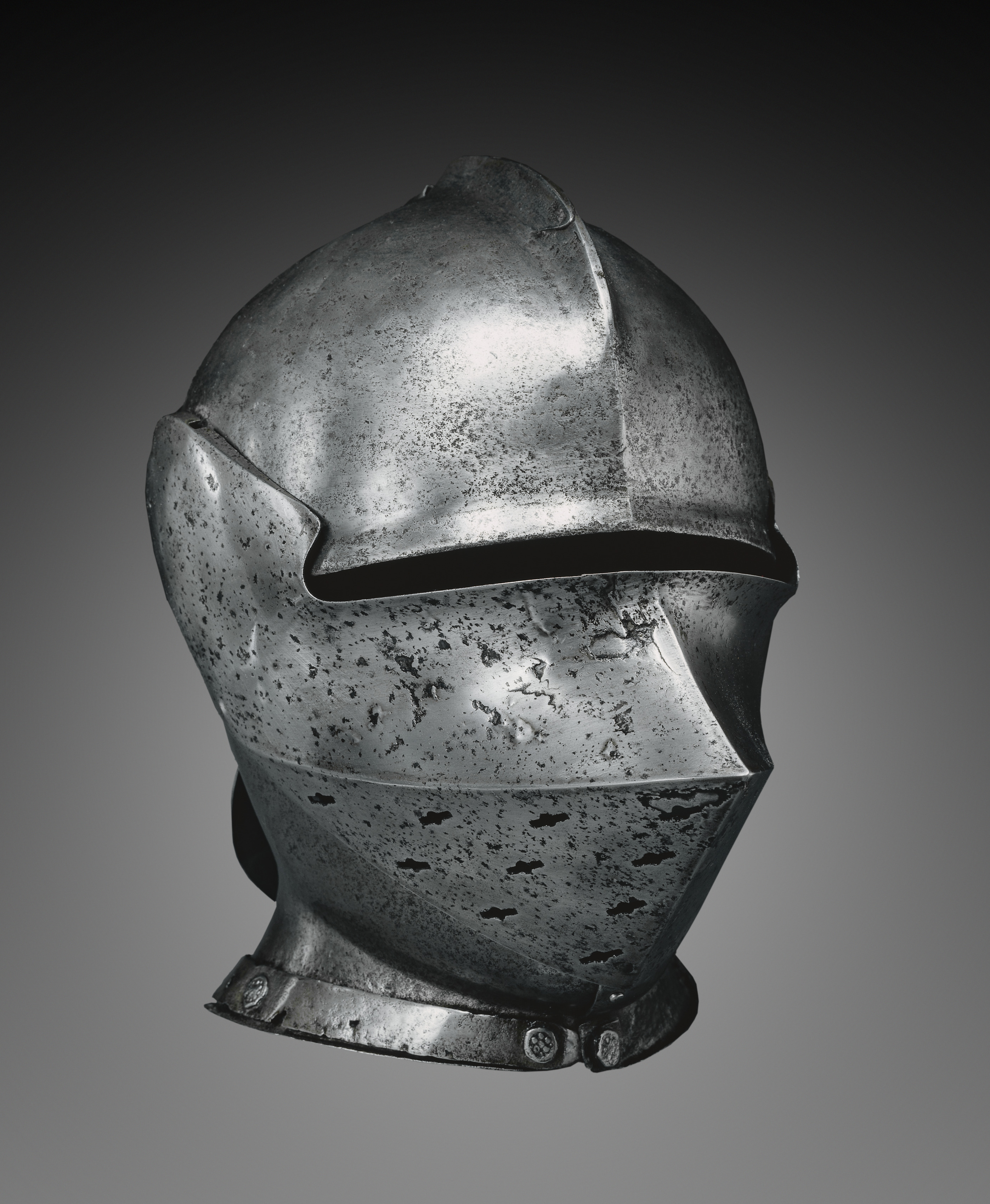
Deconstructing the Armet à Rondelle: A Steel Skeleton for the New DNA Strand
In the hallowed ateliers of Milan, where history is not merely preserved but dissected and re-stitched into the future, Zoey Fashion Lab presents a radical proposition. The object of our latest deconstruction is not a garment, but a relic of martial engineering: the Armet à Rondelle. This 15th-century close-helmet, forged in steel, becomes the primary architectural reference for our upcoming collection, “New DNA Strand.” Our analysis transcends mere historical homage; we treat this piece of armor as a biological blueprint—a skeletal exoskeleton whose every curve, rivet, and articulation encodes a new grammar for avant-garde fashion.
The Armet à Rondelle is a masterclass in controlled mobility and defensive elegance. Unlike its predecessors, the armet was designed to enclose the head and neck completely, offering unprecedented protection while allowing the wearer to turn, tilt, and scan the battlefield with relative ease. Its defining feature—the rondelle, a circular, disc-like plate that protects the rear neck joint—is not an afterthought but a structural keystone. It is this specific element, along with the helmet’s complex multi-plate construction, that forms the core of our new design language.
Anatomy of the Helmet: From Battlefield to Runway
To translate steel into fabric, we must first deconstruct the helmet’s physical components. The Armet à Rondelle is composed of several distinct, yet interdependent, parts:
- The Skull (Calotte): The smooth, domed crown that deflects blows. In our collection, this translates to sculpted, padded shoulders and structured bustiers that create a continuous, unbroken line from neck to shoulder.
- The Cheek Pieces (Gorgets): Two articulated plates that hinge at the temples and close under the chin. This mechanism of overlap and pivot becomes the basis for our multi-layered collars and asymmetrical lapels that can be worn open or cinched tight.
- The Rondelle: The circular disc at the back of the neck. This is our most potent symbol. It represents a protective halo, a technological node, and a point of visual punctuation. We will reimagine it as oversized, circular back-plates, detachable neck shields, and rigid, circular shoulder pads that echo the disc’s geometry.
- The Articulated Joints: The overlapping steel lames that allow movement. These become our primary pattern-cutting challenge, translated into concentric pleats, laser-cut leather scales, and engineered knit panels that stretch and contract with the body’s motion.
This is not a costume. The goal is not to reproduce armor but to extract its functional logic—the logic of protection, articulation, and structural hierarchy—and re-express it through contemporary textiles and construction techniques.
The New DNA Strand: Steel as Genetic Code
The title “New DNA Strand” is deliberate. We view the Armet à Rondelle not as a singular artifact, but as a double helix of two intertwined principles: rigidity and flexibility. The steel provides absolute rigidity, yet the helmet’s genius lies in its flexible joints. This binary opposition—hard/soft, fixed/mobile, ancient/future—is the genetic mutation we wish to propagate across the entire collection.
Our fabric deconstruction will focus on creating textiles that possess a “metallic memory.” We are developing a proprietary treatment for technical wools and bonded nylons that allows them to hold sharp, architectural folds without internal wiring, mimicking the hammered contours of the steel skull. Simultaneously, we are integrating 3D-printed polymer joints into garment construction. These joints, discreetly placed at the shoulders, elbows, and hips, function exactly like the helmet’s lames: they allow a full range of motion while creating a powerful, armored silhouette when the wearer is at rest.
The color palette is derived directly from the patina of aged Milanese steel: oxidized gunmetal, burnished silver, and a deep, almost blackened iron. These are punctuated by a single accent—a flash of interior red, reminiscent of the velvet padding found inside historical helmets. This hidden flash of color will be revealed in linings, under-collars, and the interior of our signature “rondelle” back-panels, offering a moment of intimate warmth against the cold exterior.
Key Garments and Construction Protocols
The Rondelle Overcoat
This is our flagship piece. Constructed from a double-faced technical canvas, the coat features a seamless, circular yoke that extends beyond the shoulders, echoing the helmet’s disc. The back of the coat is engineered with a hidden, articulated gusset system, allowing the wearer to raise their arms without disturbing the rigid, circular line of the shoulder. The closure is not a standard zipper but a series of magnetic steel clasps, designed to snap together with a satisfying, percussive click—a sonic reference to the arming of a helmet.
The Articulated Bodysuit
This piece is a direct translation of the gorget’s overlapping plates. Laser-cut panels of vegetable-tanned leather are mounted on a high-compression knit base. Each leather scale is fixed at a single pivot point, allowing it to slide over the adjacent scale as the body moves. The result is a second skin that ripples like a living exoskeleton. The neckline is a high, mandarin-style collar that closes with a single, central hinge, mirroring the armet’s cheek-piece clasp.
The Deconstructed Skirt
Here, we deconstruct the helmet’s vertical profile. A floor-length skirt is built from multiple, asymmetrical panels that overlap like the lames of the helmet’s tail. Each panel is weighted at the hem with a slim, internal steel chain, causing the fabric to fall with a heavy, deliberate drape. The waistband is a rigid, corseted structure, echoing the helmet’s skull, while the skirt’s panels flare outward like the flared base of the armor’s gorget.
Conclusion: The Future Wears Its Past
The Armet à Rondelle is not a relic to be displayed in a glass case; it is a functional prototype for the future of protective fashion. At Zoey Fashion Lab, we believe that true avant-garde design is not about ignoring history, but about re-sequencing its DNA to create something previously unimaginable. By deconstructing this steel helmet, we have found a new material vocabulary—one that speaks of strength, precision, and the elegant mechanics of the human form.
The “New DNA Strand” collection will not merely dress the body; it will armor it for the complexities of the modern world. It offers a silhouette that is at once imposing and fluid, a paradox resolved through the timeless engineering of a Milanese master. This is not a retrospective. This is a mutation. This is the steel skeleton of tomorrow, wearing the skin of today.