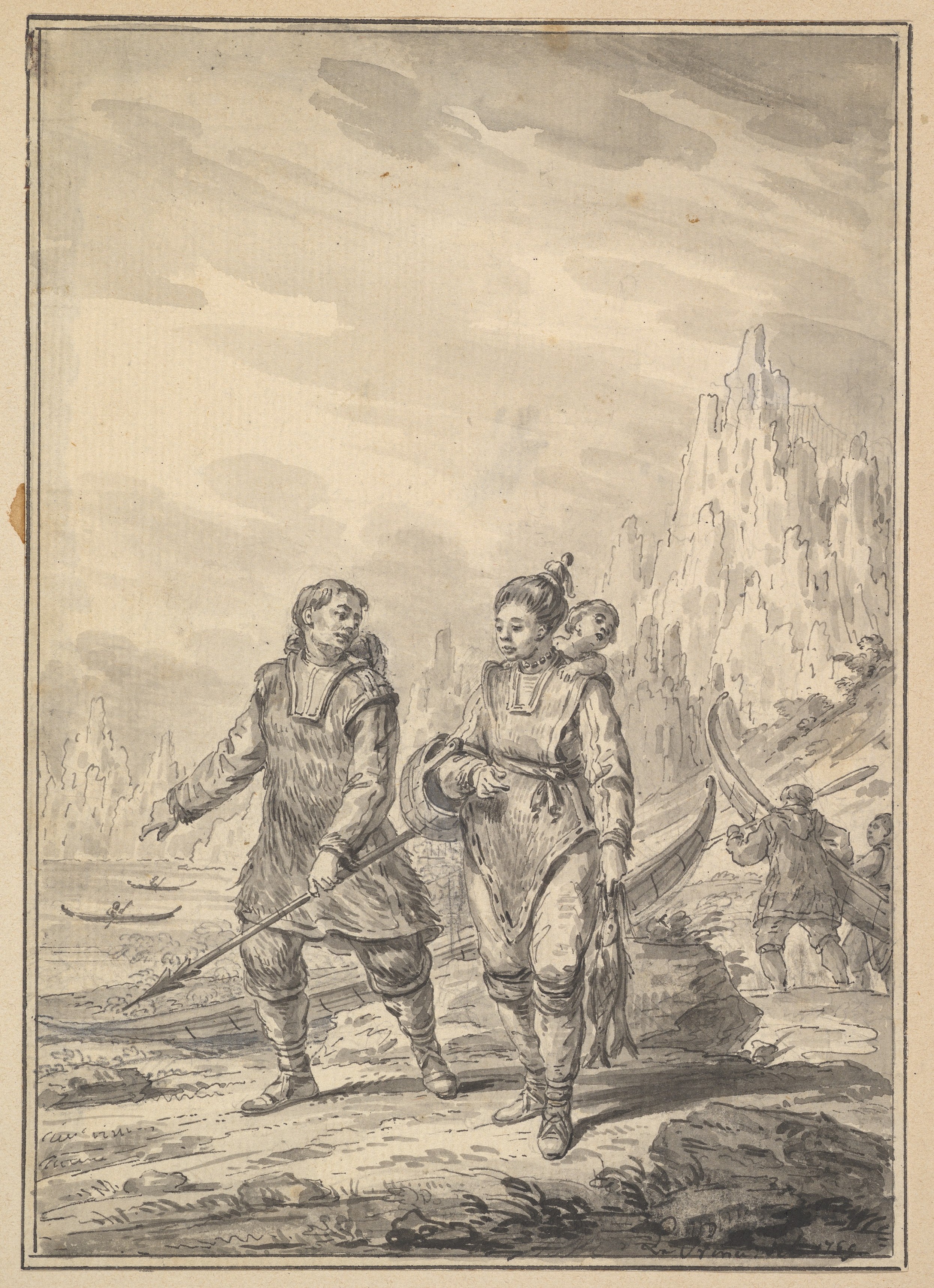
The Arctic Index: Deconstructing Inuit Manner of Dress for a Post-Climate Silhouette
Within the rarefied air of the Zoey Fashion Laboratory, we do not observe tradition; we dissect its survival mechanisms. The Inuit manner of dress, often romanticized as mere folklore, is in fact a masterclass in thermodynamic engineering, a pre-digital algorithm for human endurance. For SS26, we extract its latent futurism, stripping away the ethnography to reveal a pure, structural logic. This is not appropriation; it is an architectural translation of a system designed for the most extreme frontier on Earth, re-calibrated for the coming climate volatility of our own design.
The material genesis of this study—pen and black ink, brush and gray wash, over black chalk, with graphite additions—is crucial. It signals a departure from the soft, seductive draping of conventional couture. The ink provides a stark, unforgiving line, delineating the silhouette with the precision of an engineering blueprint. The gray wash introduces atmospheric depth, suggesting the volumetric layering of air, while the black chalk ground speaks to the primordial darkness of the polar winter. The graphite additions are our speculative annotations, marking where we will sever, extend, and reconstruct. This is a document of analysis, not a sketch of sentiment.
Deconstructing the Parka: From Protective Shell to Wearable Architecture
The central object of our inquiry is the amauti, the monumental woman’s parka. Its defining feature—the oversized hood and the internal pouch for an infant—is frequently misread as mere practicality. In our laboratory, we perceive it as a biomorphic exoskeleton. The pouch is not a pocket; it is a secondary climate zone, a micro-ecosystem that maintains a constant core temperature for two distinct bodies. For SS26, we abstract this concept into a series of modular, inflatable chambers. These are not crude airbags but precision-engineered bladders that can be differentially pressurized.
Imagine a jacket whose internal volume expands at the nape, creating a thermal buffer against wind chill, while the front panel remains taut and sculptural. The silhouette will shift from a sharp, angular profile to a voluminous, almost planetary sphere, controlled by a discreet valve system. This is responsive volume, a garment that breathes and bulges according to environmental stress. The graphite additions on our study indicate where we will insert these chambers, not at the seams, but through the very body of the fabric, creating a quilted topography that references the frozen ridges of sea ice.
The Geometry of the Hood: A Study in Peripheral Vision
The Inuit hood, or amua, is engineered for peripheral awareness. Its ruff of fur (traditionally wolverine or wolf) is not decorative; it creates a still-air pocket that prevents the moisture of breath from freezing on the face. For our avant-garde iteration, we replace fur with a lattice of carbon-fiber filaments, each tipped with a micro-sensor. The hood becomes a data-gathering instrument, its silhouette a dramatic, sweeping halo that frames the face like a satellite dish. The gray wash in our study suggests the soft, blurred edge of this halo, but our construction will be rigid, cantilevered outward from the shoulders.
The result is a hood that is less a covering and more a piece of sculptural headgear, a futuristic cowl that redefines the wearer’s relationship to their environment. It does not merely shield the eyes; it extends them. The visual weight is pushed backward, creating a forward-leaning, predatory stance. This is not a nostalgic nod to a past culture but a projection of a future where our garments must actively mediate between our bodies and an increasingly hostile atmosphere.
Layering as a System: The Logic of the Frictionless Sandwich
Traditional Inuit dress is a three-layer system: a silky inner layer, a dense middle layer, and a windproof outer shell. Our deconstruction reveals this as a thermodynamic sandwich, where each layer has a specific coefficient of friction and moisture-wicking property. For SS26, we re-engineer this hierarchy with high-performance textiles. The inner layer becomes a seamless, knitted biopolymer that hugs the body like a second skin. The middle layer is not a single garment but a series of interchangeable, magnetic panels—each a different thickness and density—that can be swapped based on activity level.
The outer shell, however, is where our innovation peaks. Instead of a woven fabric, we propose a laser-sintered, open-cell mesh that is then coated with a hydrophobic, ceramic-based film. This creates a material that is windproof yet breathable, rigid yet flexible. The seams are not sewn but welded, creating a monolithic surface that is entirely devoid of stitching. This eliminates the primary failure point of all garments: the thread. The silhouette becomes a series of clean, uninterrupted planes, interrupted only by the sharp folds and tucks indicated by our ink lines. This is not tailoring; it is material assembly, a process closer to architecture than dressmaking.
The Futuristic Silhouette: A Cartography of Survival
The final silhouette for this study is not a single garment but a system. We propose a modular exosuit that combines the parka’s volume, the hood’s instrumentality, and the layering’s logic. The base is a sleek, black, second-skin unitard. Over this, we place a series of articulated plates, reminiscent of both armor and the segmented structure of a carapace. These plates are not fixed; they pivot and slide, allowing for a full range of motion while providing targeted insulation over the core, the kidneys, and the back of the neck.
The color palette is stark: the obsidian black of the ink, the glacier gray of the wash, and the chalk-white of the under-drawing. There is no ornamentation, no color for color’s sake. Every line, every fold, every volume is a response to a functional imperative. The trousers are wide and tapered at the ankle, creating a bell-bottom effect that can be cinched with a toggle to create a seal against the elements. The sleeves end in articulated, mitten-like gloves, but with a slit at the index finger for tactile precision.
This is the post-climate uniform, a garment that assumes the world is no longer a benign backdrop but an active adversary. It is a silhouette of preparation, of forward momentum, of a body that is armored yet agile. The Inuit manner of dress, in its original context, was the difference between life and death. In our translation, it becomes a philosophical statement about resilience, adaptability, and the inextricable link between our bodies and the systems we build to protect them. This is not a costume; it is a manifesto, written in ink, chalk, and the immutable logic of survival.