Deconstructing the Velvet Fragment: A Material Dialogue Across Centuries
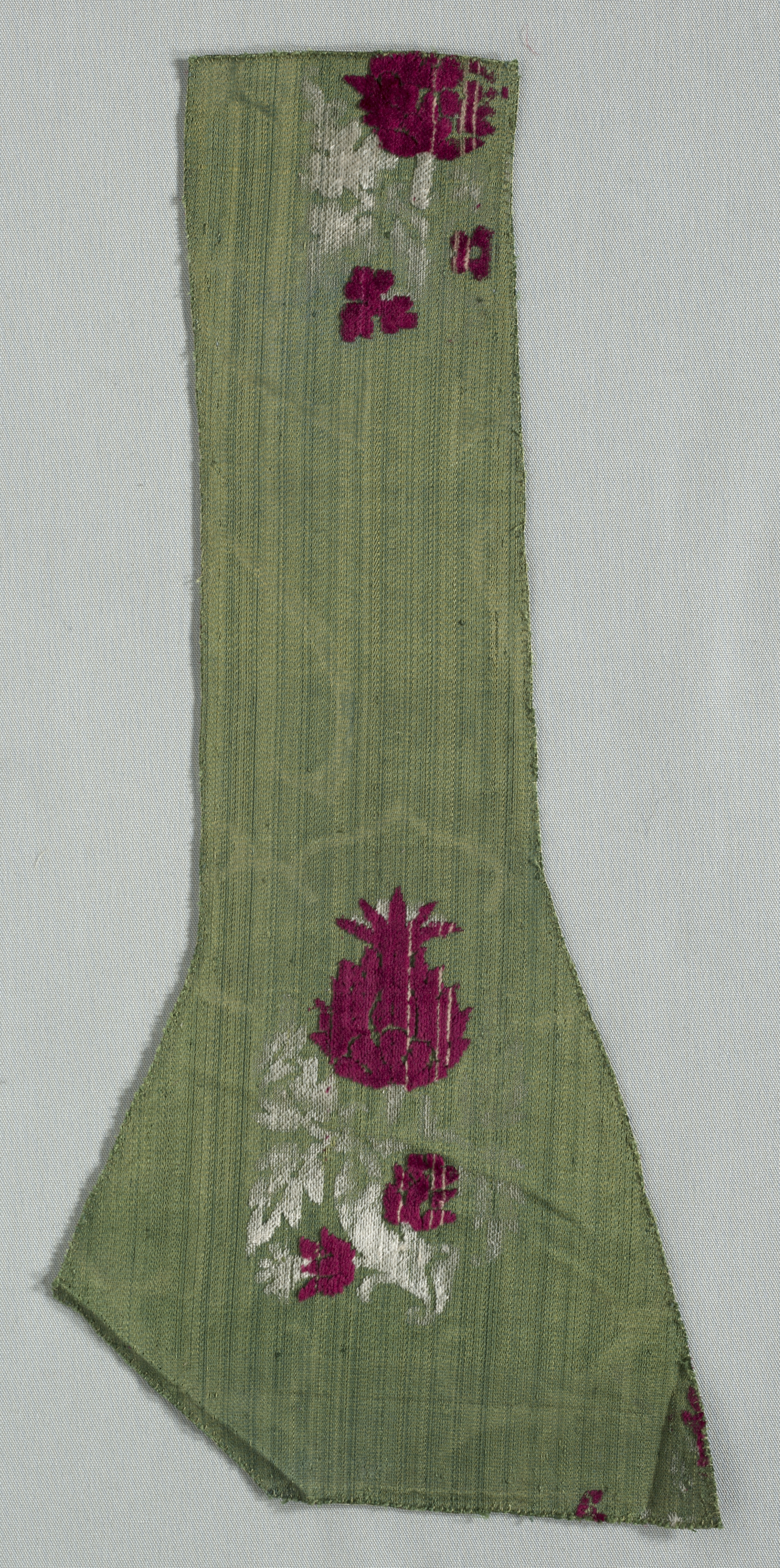
At Zoey Fashion Lab, our mandate extends beyond the mere cataloging of historical textiles. We engage in a process of material interrogation, extracting the latent design intelligence embedded within each fiber. The subject of this analysis—a fragment of cut and voided velvet, originating from mid-15th century Italy—presents a particularly rich case study. Categorized under our internal reference as "New DNA Strand," this artifact is not a relic to be preserved under glass, but a living genetic code to be sequenced, understood, and re-expressed through an avant-garde lens. This document offers a technical and conceptual deconstruction of the fragment, outlining its historical grammar and proposing a radical translation for contemporary fashion.
I. Technical Provenance and Material Architecture
The fragment’s origin in mid-15th century Italy places it within the crucible of the Renaissance, a period when Italian weaving centers—particularly Florence, Venice, and Genoa—dominated European luxury markets. The technical specification is precise: cut and voided velvet, executed in pure silk. This is not a simple pile weave. The term "voided" is critical. It signifies a deliberate, negative-space design where the pile is selectively cut away or suppressed, leaving a ground weave of the same silk to create a contrasting luster and texture. This is a sophisticated manipulation of light and shadow, a proto-chiaroscuro effect achieved through textile architecture.
From a forensic standpoint, the "New DNA Strand" reference is apt. The construction reveals a two-ply warp and a weft that is often heavier, creating a dense, supple hand. The cut pile, which forms the raised pattern, is achieved by weaving over metal rods or wires; the subsequent slicing of these loops creates the characteristic plush surface. The voided areas, by contrast, showcase the flat, satin-like base weave, which often features a subtle twill or plain construction. The result is a fabric of immense structural complexity—a dual-surface system where tactile contrast is the primary aesthetic driver. The silk itself, with its high refractive index, amplifies this effect: the pile absorbs and reflects light differently than the ground, creating a shimmering, almost liquid motion as the fabric moves.
II. Historical Grammar: The Language of Opulence and Power
To deconstruct this fragment is to read a text of social and economic power. In mid-15th century Italy, such velvet was not merely decorative; it was a currency of status. Sumptuary laws regulated its use, restricting it to the aristocracy and high clergy. The pattern, likely a pomegranate or artichoke motif—common in the period—was a symbol of fertility, eternity, and royal lineage. The technical mastery required to produce this fabric was immense; a single loom could produce only a few centimeters per day, and the cost of the silk and the skilled labor made it more valuable than gold by weight.
For the avant-garde designer, this historical grammar is not a constraint but a provocation. The fragment speaks of excess, labor, and exclusivity. It embodies a pre-industrial notion of value where time and skill are the ultimate luxury. The "voided" areas, often overlooked, are in fact the most radical element. They represent a conscious decision to negate, to create emptiness as a design feature. This is a conceptual precursor to modern minimalism—a deliberate absence that gives form to presence. Our analysis must therefore treat the void not as a flaw, but as a generative principle.
III. Avant-Garde Translation: From Artifact to Algorithm
How do we translate this 500-year-old silk into a contemporary avant-garde garment? The answer lies not in replication, but in algorithmic reinterpretation. The "New DNA Strand" label implies a biological, iterative approach. We must extract the core DNA—the dual-surface tension, the interplay of positive and negative space, the luxurious weight—and splice it with modern materials and construction techniques.
1. Material Subversion: The first step is to challenge the material itself. While silk is the historical substrate, the avant-garde imperative demands disruption. We can re-engineer the velvet using recycled technical fibers—such as bio-based nylon or regenerated cellulose—to create a similar pile structure with entirely different properties. Imagine a velvet that is waterproof, breathable, and possesses a subtle, iridescent sheen achieved through nano-coating, not dye. The voided areas could be laser-cut with precision, creating a geometric, pixelated pattern that references the original pomegranate motif but renders it as a digital glitch. This is not a rejection of the original; it is a mutation that honors its structural logic while updating its materiality.
2. Structural Deconstruction: The historical fragment is a flat, two-dimensional surface. The avant-garde translation must liberate it into three dimensions. We propose a garment—a modular, asymmetric coat—where the velvet is not a flat panel but a series of sculptural, bonded panels. The cut pile can be selectively crushed or heat-set to create topographic variations, transforming the surface into a tactile landscape. The voided areas can be physically cut away, not just woven, to create openwork that reveals the body or an under-layer of contrasting material—perhaps a sheer, metallic mesh. This creates a literal "void" that the wearer inhabits, making the negative space a functional, kinetic element.
3. Conceptual Re-framing: The most potent avant-garde act is to subvert the original meaning of the velvet—from a symbol of aristocratic stasis to one of dynamic, post-human fluidity. The 15th-century velvet was rigid in its social coding. Our version must be fluid in its identity. The garment could be designed to be worn in multiple configurations—as a cape, a jacket, or a deconstructed drape—using magnetic closures or modular straps. The weight and density of the velvet, once a sign of immobility and grandeur, can be counteracted with a lightweight, ergonomic lining that allows for unprecedented movement. The wearer is no longer a passive display of wealth, but an active agent who manipulates the garment’s form, echoing the original weaver’s manipulation of the loom.
IV. Conclusion: The Fragment as a Living System
The Italian velvet fragment is not an end point; it is a starting signal. Its technical precision—the cut and voided construction—offers a masterclass in contrast management. Its historical context provides a narrative of power that we can critique and invert. For Zoey Fashion Lab, this fragment represents a "New DNA Strand" precisely because it is not a static object. It is a system of relationships: between pile and ground, light and shadow, luxury and labor, past and future.
Our avant-garde interpretation will not look like a Renaissance gown. It will look like a piece of architecture that moves—a garment that uses the velvet’s inherent duality to create a dialogue between solidity and air, opulence and decay. By deconstructing the technical grammar and re-splicing the conceptual DNA, we transform a historical artifact into a proposition for the future of fashion. The velvet is no longer a memory; it is a living material, re-coded for a new era of experimental, expressive, and critically engaged design. This is the true function of the Fabric Deconstructionist: to see the future already woven, hidden in plain sight, within the threads of the past.