Technical Deconstruction: The Armored Core of "Parade Spear"
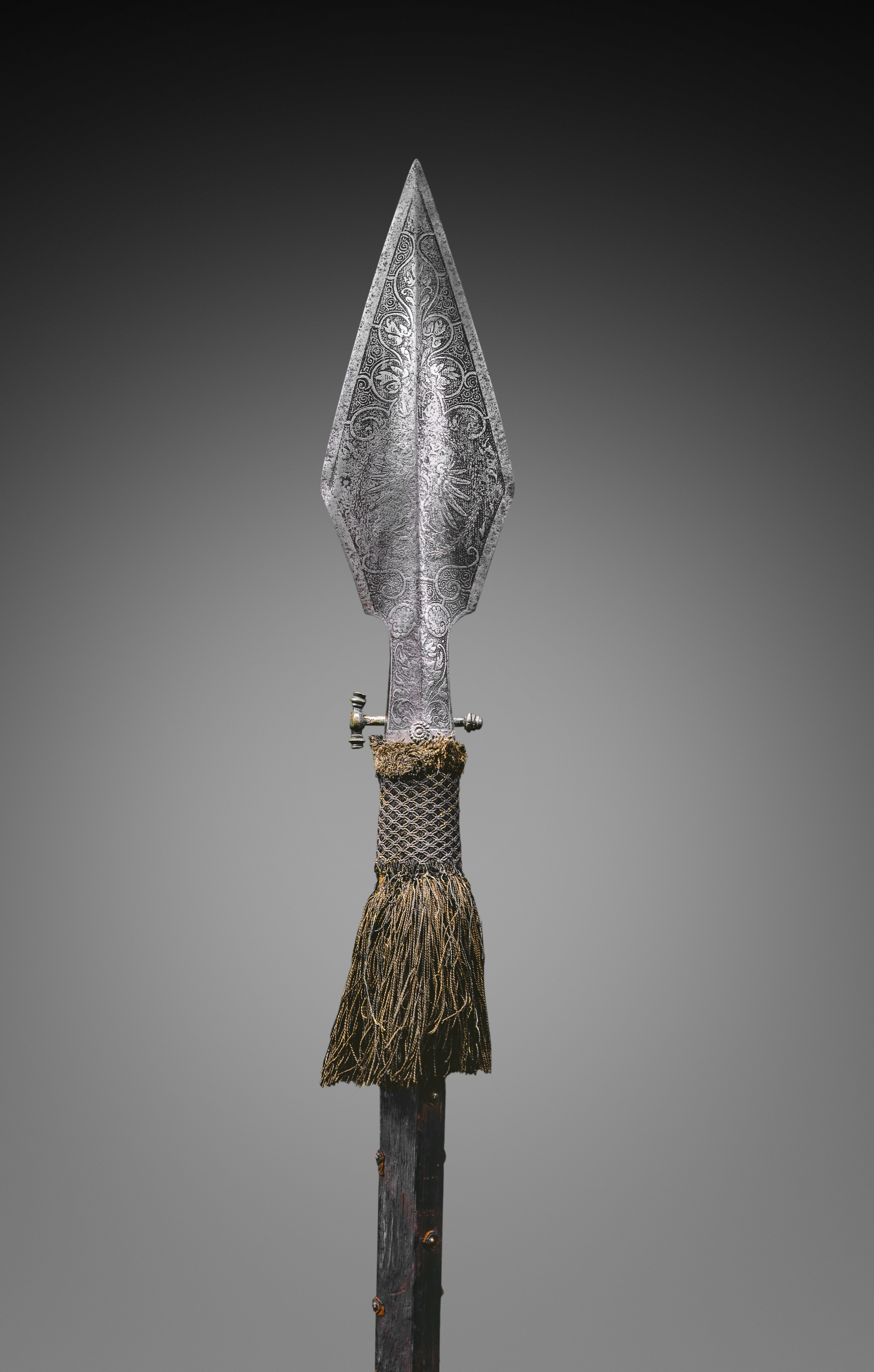
The artifact designated "Parade Spear" presents a foundational paradox: an instrument of war meticulously refined into a symbol of civic pageantry. Our analysis begins with its material truth. The primary substrate is steel, etched. This is not the crude, functional steel of battlefield pikes, but a medium for narrative. The etching—a likely depiction of imperial eagles, mythological scenes, or intricate foliate patterns—transforms a defensive shell into a communicative surface. It speaks of wealth, artistry, and the desire to project ideology even in celebration. The addition of brass lugs is a critical detail. Brass, a softer, more ornamental alloy, functions here as both structural accent and visual highlight. These lugs secure the head to the haft, but their presence in a contrasting, golden metal reveals a design philosophy where every component, even the utilitarian, must contribute to an overall aesthetic of controlled opulence.
Material Dialogue & Structural Tension
The haft—hexagonal wood with leather straps—introduces a dialogue between rigid geometry and organic grip. The hexagon provides a firm, anti-rotational structure, a subtle engineering consideration for a ceremonial object meant to be held static in procession. The leather straps, however, speak to the human interface, to grip and endurance. They are a concession to the body within the spectacle. Finally, the woolen tassel appears as a soft, dynamic counterpoint to the rigid steel and brass. Its purpose is purely kinetic and visual, catching light and movement, a fluttering, ephemeral breath at the spear's stern. This composite construction—steel, brass, wood, leather, wool—establishes a textural vocabulary of power (steel), status (brass), foundation (wood), utility (leather), and flourish (wool).
Conceptual Genesis: From Augsburg Armory to Avant-Garde Atelier
The speculated origin in Augsburg, 16th century, is profoundly generative. Augsburg was a nexus of finance, trade, and crucially, the armorer's craft. This "Parade Spear" is a product of a society where the workshop of a master armorer was also a studio for applied arts. It represents the moment martial technology reaches such a peak of refinement that it transcends its primary function. It is armor for the ego of the city-state or the prince, a weapon that has been semantically shifted from piercing flesh to piercing the spectacle of a parade. The reference to the New DNA Strand provides our transformative key. We interpret this not as a literal genetic code, but as a structural and conceptual helix—two intertwined strands of meaning that form the core identity of the object.
The Double Helix of Function and Spectacle
The first strand is Latent Function: the underlying blueprint of a weapon—the piercing point, the structural integrity, the materials chosen for durability. The second strand is Imposed Spectacle: the etching, the polished brass, the decorative tassel, the very context of a parade. These two strands twist around each other, inseparable. The spectacle is amplified because it is built upon a framework of genuine, lethal potential. The function is made culturally potent because it is cloaked in artistry. This tense co-dependence is the artifact's true DNA.
Reconstruction for Zoey Fashion Lab: The Avant-Garde Manifesto
Translating this analysis into an Avant-garde style requires not replication, but a molecular-level re-sequencing of its identified DNA. We do not create a "spear dress." We create a garment that embodies the structural tension and semantic duality of the original.
Strand 1: Exoskeletal Architecture
The latent function strand manifests as exoskeletal tailoring. Imagine a garment built upon a foundational "haft"—perhaps a severe, hexagonal-line corset or a structured, geometric bodice made from a technical, matte fabric with the visual density of hardened leather or polished steel wool. This is the armor. Seams are exaggerated like etching lines, not decorative, but revealing the inner architecture of the garment. Brass lugs are translated as hardware accents: functional, grommetted closures, asymmetric clasps in burnished metal, or rigid epaulets that secure draped elements. They are unmistakably utilitarian in appearance, serving as both fastening and focal point.
Strand 2: Kinetic Pageantry
The imposed spectacle strand translates into dynamic, soft systems attached to this rigid core. The woolen tassel is reimagined as cascading fringes of raw-cut silk or unraveled technical tape, emerging from the hard seams. The leather straps become integrated harness elements that both bind and release volume—straps that, when fastened, gather vast swathes of fluid fabric (a modern stand-in for the parade's banners) into a precise form, and when released, allow the fabric to billow in a performance of controlled chaos. The palette should mirror the material dialogue: the cool grayscale of steel, the warm, sudden accent of brass, the deep, organic tone of aged leather, and the vivid, declarative hue of the wool tassel, now perhaps a shock of crimson or acidic yellow.
Synthesis: The Garment as Ceremonial Object
The final design is a wearable paradox. It is architectural yet kinetic, restrictive yet liberating, armored yet expressive. The wearer becomes the spear-bearer in a contemporary parade. The garment's rigid core projects authority and a deconstructed modernity, while its soft, kinetic elements engage with space, movement, and air—a spectacle of personal identity. It references the parade ground by transforming the catwalk or the urban landscape into a site of personal pageantry. The "New DNA Strand" is thus re-coded: the double helix now intertwines Structural Integrity and Performative Release. It is a garment that, like the original Parade Spear, declares its purpose not through literal mimicry, but through the profound and avant-garde articulation of its own constructed nature.