The Jabot Recalibrated: An Avant-Garde Autopsy of Lace and Structure for SS26
The jabot—historically a whisper of aristocratic vanity, a froth of lace cascading from a masculine throat—has long been consigned to the amber of costume drama. For Spring/Summer 2026, Zoey Fashion Laboratory seizes this relic and subjects it to a radical, deconstructive vivisection. We do not revive the jabot; we weaponize it. Our study, sourced from the Global Frontier, transmutes the traditional needle lace and Point de Gaze into a speculative architecture of the neck and torso. This is not nostalgia. This is a blueprint for a new epidermal interface, where fragility is engineered into strength and ornament becomes structural load-bearing.
Deconstructing the Historical Syntax
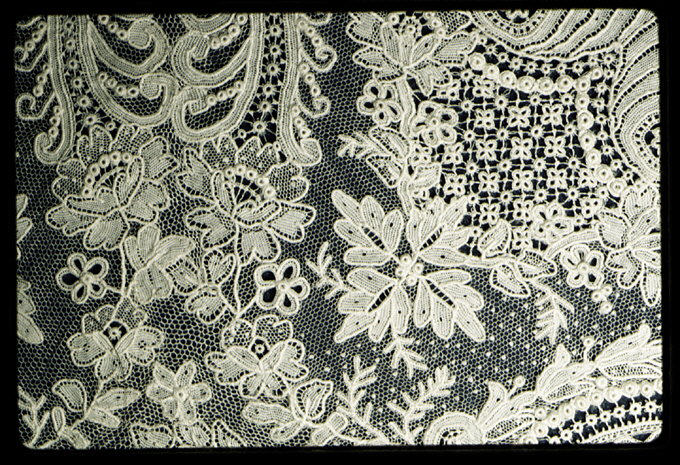
To innovate, one must first dismantle the grammar. The 18th-century jabot was a signifier of leisure, its intricate folds a performative denial of labor. Its material—needle lace, specifically the ethereal Point de Gaze—was prized for its ground net and raised cordonnet, creating a three-dimensional relief that mimicked sculpted frost. Our laboratory rejects the jabot’s passive drape. Instead, we extract its core DNA: the repetitive, cellular logic of the net and the volumetric tension of the raised floral motifs. We treat these not as decorative elements but as a primitive code—a lattice system that can be mathematically re-sequenced for contemporary body architecture.
The Global Frontier context is critical here. It signifies a cultural détente, a dissolution of geographic fashion hierarchies. Our jabot is not French, not Italian, not Japanese. It is a hybridized construct, synthesized from the algorithmic patterns of digital lace-making and the hand-crafted irregularity of artisanal Point de Gaze. The result is a garment that speaks in a universal dialect of structural tension and ethereal release.
From Drape to Deflection: The Silhouette Revolution
For SS26, the jabot abandons its horizontal, gravity-bound orientation. We propose a vertical, cantilevered silhouette. Imagine a high, architectural collar that does not rest on the clavicle but projects forward and upward, like the prow of a futuristic vessel. This is achieved not by internal wiring—a crude solution—but by re-engineering the lace itself. We utilize a technique of differential tension stitching, where the Point de Gaze’s open loops are selectively stiffened with a bio-resin micro-film. This allows the lace to hold a rigid, sculptural curve while retaining its visual porosity. The wearer’s neck becomes a plinth; the jabot becomes a fragile, yet unyielding, exoskeletal fan.
This is a definitive shift from the body-con of previous seasons. The new silhouette is suspended animation. The jabot does not cling; it hovers. We create a micro-climate between the skin and the lace, a negative space that is charged with potential. The garment functions as a personal atmosphere, a translucent shield that deflects both gaze and environment. The futuristic imperative is not about metallic armor but about biomorphic fragility—strength that looks like it could shatter but never will.
Material Alchemy: Needle Lace as Structural Composite
Our material study elevates needle lace beyond its textile classification. We treat it as a composite material. The hand-woven loops of Point de Gaze provide a base matrix of exquisite irregularity—a fingerprint of the artisan. Onto this, we deposit a layer of laser-sintered cellulose nanoparticles, derived from post-industrial flax waste. This process does not coat the lace; it fuses with its molecular structure. The result is a fabric that is 70% air, yet possesses the tensile strength of a carbon-fiber mesh. It can be crushed, folded, and will return to its programmed shape memory without a single crease.
This alchemy enables a new form of garment architecture. We can now create self-supporting ruffles that spiral around the torso like a DNA helix, each flounce a rigid cantilever that casts a distinct shadow. The traditional jabot’s soft, undulating folds are replaced by facetted, angular planes. The lace is no longer a passive surface; it is a topographical map of tension and release. We have developed a proprietary technique called “Lace Volt”, where the needlework is executed in a grid of alternating high and low density. The high-density zones form structural ribs; the low-density zones remain diaphanous, creating a visual rhythm of solid and void.
The SS26 Palate: Chromatic Silence and Bio-Luminescence
Color theory for this study rejects the pastel optimism often associated with spring. Our palette is a study in chromatic silence: bone white, optical grey, and a deep, mineral black. These are not colors but light-modulating surfaces. The white is treated with a micro-prismatic finish that refracts ambient light, making the lace appear to vibrate at the edges. The black is not a void but a dense, light-absorbing matrix that makes the structural ribs appear to float in negative space. For evening, we introduce a bioluminescent undertone—a non-toxic, phosphorescent dye embedded in the cellulose matrix. The jabot does not glow artificially; it emits a soft, organic luminescence, like a deep-sea organism. This is not decoration; it is a functional response to low-light environments, a subtle signal of presence.
Structural Innovation: The Wearable Tensegrity
The ultimate innovation in our jabot study is the application of tensegrity principles—the architectural system where isolated components are held in compression by a continuous network of tension. The needle lace becomes the tension network; the rigid, resin-infused floral motifs become the compression struts. The wearer’s movement is not restricted; it is amplified. When the head turns, the lace does not collapse but redistributes its internal forces, creating a dynamic, ever-shifting silhouette. The garment is a perpetual motion machine of form.
Furthermore, we have integrated a modular attachment system at the sternum. The jabot can be detached, inverted, and reattached to form a secondary, smaller collar—a choker of structural lace. This modularity ensures the piece is not a costume but a transformative system, adaptable from day to night, from a full architectural statement to a minimal, high-impact accent. The closure system is invisible, utilizing magnetic micro-catches embedded within the lace’s raised cordonnet, eliminating any visual disruption.
Conclusion: A Manifesto for the Future of Ornament
The Zoey Fashion Laboratory jabot for SS26 is a definitive statement. It proves that ornament is not the enemy of modernity but its most sophisticated expression. By deconstructing the historical syntax, re-engineering the material matrix, and applying structural principles from architecture and engineering, we have transformed a fragile artifact into a functional, futuristic exoskeleton. This is not a nostalgic echo; it is a projection. The jabot is no longer a whisper of the past; it is a loud, clear signal of a future where fashion, technology, and hand-crafted artistry fuse into a seamless, wearable intelligence. This is the new frontier—where lace becomes load-bearing, and fragility is a form of ultimate strength.