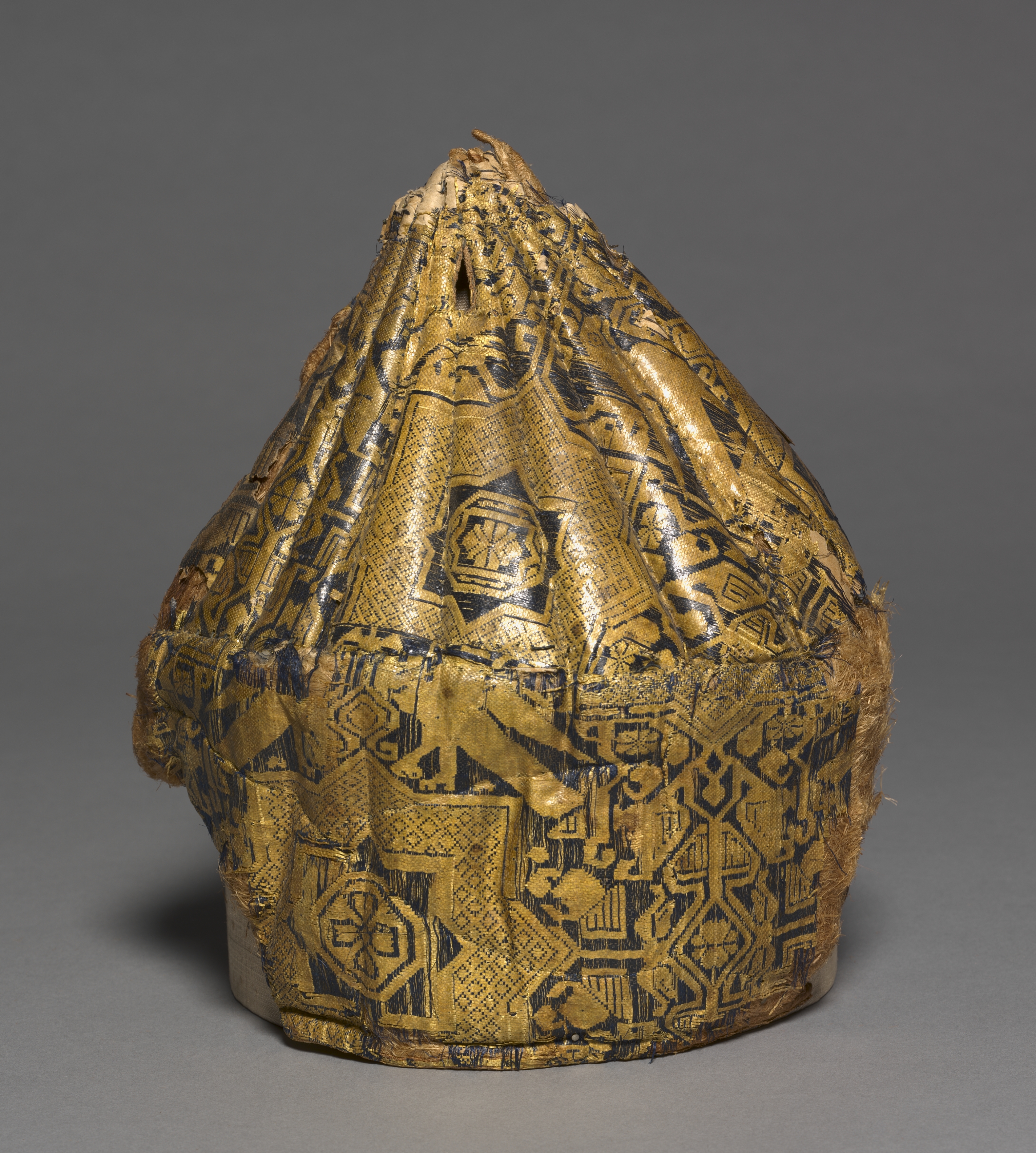
Deconstructing the Celestial Cartography: A Technical and Avant-Garde Analysis of the Buyid-Seljuq Quilted Cap
At Zoey Fashion Lab, our mandate extends beyond the superficial read of garment construction. We engage in fabric deconstruction as a form of historical excavation, unearthing the structural DNA embedded within each weave. The subject of this analysis—a quilted cap originating from the Buyid or Seljuq period of Iran or Iraq, constructed in lampas silk with a star-patterned field—presents a remarkable paradox. It is at once a relic of imperial courtly culture and, in its technical DNA, a precursor to the most radical forms of contemporary avant-garde structuralism. This is not merely a hat; it is a three-dimensional architectural blueprint rendered in textile, a testament to the sophisticated engineering of medieval Islamic looms that resonates profoundly with modern, deconstructivist fashion philosophy.
Technical Provenance: The Lampas Weave as a Structural Skeleton
The foundational element of our analysis is the lampas weave itself. In technical terms, lampas is a compound weave structure where a main warp and weft create a ground fabric, while a supplementary warp and weft are bound into the structure to create the pattern. This is not a simple brocade or embroidery; it is a fully integrated, multi-layered system. For the Buyid and Seljuq weavers, this allowed for the creation of complex, repeating geometric motifs—in this case, the celestial star—without compromising the fabric’s integrity. The supplementary weft floats on the reverse, creating a fabric that is heavier and more substantial than a plain silk tabby. This inherent density was not a flaw but a feature, designed for durability and warmth. In our deconstruction, we identify this as the primary structural skeleton of the cap. The lampas technique provides the tensile strength and the rigid, yet flexible, matrix required to support the subsequent quilting. This is a critical distinction: the lampas is not simply a decorative surface; it is the load-bearing architectural wall of the garment.
The Quilting Matrix: Topographical Relief and Thermal Logic
The act of quilting—stitching through multiple layers of fabric with a batting or interlining—transforms the flat, two-dimensional lampas into a three-dimensional topographical map. The quilting pattern, likely executed in fine silk thread, follows the contours of the star motifs, creating a raised, padded relief. This is where the garment’s functional DNA merges with its aesthetic ambition. The quilting serves a dual purpose: thermal insulation and structural rigidity. In the cold climates of the Iranian plateau, a quilted cap provided essential warmth. However, the specific star-patterned quilting is not random. The stitching lines create a grid of tension and compression, effectively turning the cap into a geodesic dome. The quilted channels act as structural ribs, allowing the silk to hold a specific shape—a tall, conical or rounded form—without collapsing. This is a proto-engineering marvel. The weaver and tailor understood that by manipulating the tension of the stitching, they could control the drape and the silhouette. This is the same principle that underpins modern avant-garde millinery, where rigid fabrics are pleated, folded, and stitched to create sculptural forms that defy gravity.
The Star Pattern: A Celestial Codex in Silk
The star pattern, woven into the lampas ground and echoed in the quilting, is not a mere decorative flourish. In the Buyid and Seljuq cosmological worldview, the star—particularly the eight-pointed star or the rosette—was a symbol of divine order, celestial navigation, and royal authority. The geometric precision required to weave this pattern in lampas is staggering. The repeat must align perfectly across the warp and weft, requiring a mathematical understanding of pattern drafting that predates the computer by a millennium. The stars are likely arranged in a grid or a radiating medallion format, creating a sense of infinite expansion. This is the visual DNA of the piece. In our avant-garde interpretation, we see this as a precursor to the fractal patterns and algorithmic designs used in contemporary digital textile printing. The star is not just a shape; it is a generative module. It suggests a system of infinite reproducibility, a concept that resonates with the avant-garde’s fascination with seriality and modular construction.
Avant-Garde Resonance: The New DNA Strand
When we reference the “New DNA Strand” in our Zoey Fashion Lab analysis, we are referring to the conceptual bridge between this historical artifact and the principles of deconstruction and reconstruction. The avant-garde designer does not see a cap; they see a prototype for a new form of wearable architecture. The quilted cap’s logic can be extrapolated to a full-scale garment. Imagine a coat where the lampas silk forms the outer shell, quilted with a pattern derived from the star geometry, creating a padded, armored silhouette. The historical cap’s function—protection from the elements—is translated into a contemporary language of protection from the social and environmental pressures of modern life.
Furthermore, the lampas weave’s technical complexity—its multiple layers and floats—can be deconstructed and reinterpreted. An avant-garde designer might deliberately expose the supplementary weft floats on the exterior, creating a fringe or a distressed texture, subverting the pristine finish of the original. The quilting could be exaggerated, using high-loft batting to create exaggerated, almost cartoonish volumes, pushing the cap’s structural logic to its extreme. The star pattern could be abstracted, broken apart, and reassembled in a chaotic, non-repeating arrangement, reflecting the fragmentation of contemporary identity. The historical cap is a perfect, ordered microcosm; the avant-garde response is to deliberately introduce disorder, to question the very notion of perfection.
Materiality and Craft: The Hand of the Artisan
Finally, we must address the materiality. The silk itself is a protein fiber, a natural polymer with a unique molecular structure that allows for incredible luster and dye affinity. The colors—likely indigo, madder red, or a rich, undyed ivory—would have been achieved through natural dyes, each with its own chemical complexity. The hand of the artisan is evident in every stitch and every warp thread. In our lab, we measure the thread count, the twist of the silk, the density of the quilting. We find that the precision is not machined but achieved through years of embodied knowledge. This is the intangible DNA of the piece. For the avant-garde, this is a challenge to the sterile perfection of mass production. It is a call to return to a more tactile, process-driven approach to fashion design. The cap is a reminder that true innovation is not about novelty for its own sake, but about a deep, intelligent dialogue with the past.
In conclusion, this Buyid-Seljuq quilted cap is a masterpiece of functional engineering and symbolic art. Its lampas construction and star-patterned quilting provide a rich technical and conceptual foundation for avant-garde exploration. It is not a relic to be preserved under glass but a living document of design intelligence, a strand of DNA that, when re-sequenced through a contemporary lens, yields infinite possibilities for sculptural, structural, and conceptually rigorous fashion.