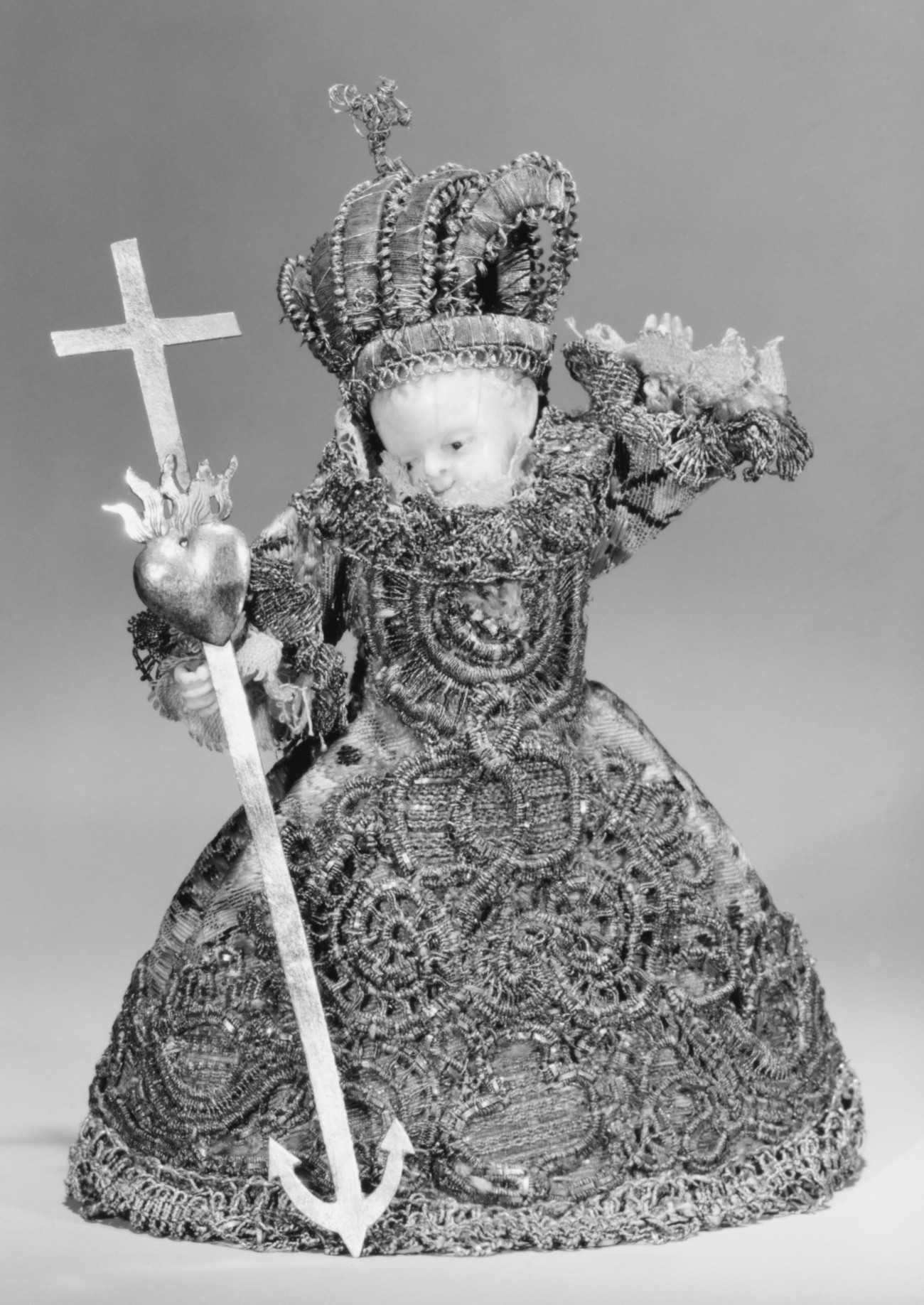
The Neonatal Silhouette: Deconstructing the Infant Christ for SS26
The avant-garde imperative is not to represent, but to re-contextualize. At Zoey Fashion Laboratory, we reject the passive inheritance of iconography. For Spring/Summer 2026, we have taken the most historically burdened figure in Western art—the Infant Christ—and subjected it to a radical process of architectural dissection. This is not a study in piety; it is a study in origin as a structural prototype. The Infant Christ, stripped of its doctrinal weight, emerges as a pure, pre-linguistic form: a nexus of swaddling, fragility, and latent power. Our analysis proposes a new sartorial grammar, one where the swaddle becomes a shell, the halo becomes a visor, and the manger becomes a modular chassis.
Material Alchemy: Ivory as Structural Memory
The material list—ivory, seed pearls, silk, metal thread, lace, parchment, wood, and glass—is not a palette; it is an archaeological strata. We treat ivory not as a nostalgic luxury, but as a bio-composite with inherent tensile memory. In our SS26 construction, ivory is laser-scored and thermo-formed into curved, load-bearing panels that mimic the cranial plates of a neonate. These panels are not decorative; they are the primary exoskeleton. Seed pearls are re-imagined as micro-ball bearings, embedded within the seams to facilitate articulation. They are not sewn on; they are engineered in, allowing the garment to shift and breathe with the wearer’s kinetic signature.
Silk, in its rawest, unweighted form, is treated as a fluid membrane, suspended between the ivory plates. We employ a technique of "wet-draping with metal thread," where the silk is bonded to a lattice of fine-gauge silver wire. This creates a fabric that holds its own sculptural volume—a metallic skin that can be crushed, folded, and set into permanent, geometric creases. The lace is not romantic; it is architectural tracery, laser-cut from parchment and laminated onto the silk. It functions as a structural gusset, distributing tension across the seams, referencing the delicate fontanels of an infant’s skull.
The Swaddle as a Modular Exoskeleton
The traditional swaddle is a symbol of helplessness. In our analysis, it is inverted into a powerful, self-supporting carapace. We propose the "Neonatal Shell," a silhouette that is simultaneously cocoon-like and aggressively futuristic. The garment begins as a compressed, cylindrical volume at the shoulder—a direct reference to the swaddled form—but it expands exponentially towards the lower hemisphere, creating a trapezoidal, anti-gravitational profile. This is achieved through a series of articulated, fan-like ribs made of bent wood and ivory. These ribs are not hidden; they are exposed, functioning as an external skeleton that dictates the garment’s permanent stance.
This silhouette is a study in controlled instability. The wearer does not walk; they glide, as the wooden ribs create a pendulum-like momentum. The lower half of the garment is constructed from overlapping panels of glass and silk—a translucent, fragmented skirt that refracts light like a prism. This is not a dress; it is a mobile architectural environment. The glass is not brittle; it is a borosilicate composite, shatter-resistant and thermo-chromatic, shifting from opaque white to a faint, ethereal blue as the ambient temperature rises.
The Halo as a Visor and Communication Array
We dismantle the halo. It is no longer a passive circle of light, but a functional, wearable technology. Our "Halo-Visor" is a curved, single-piece glass visor, suspended from a headpiece of braided silk and metal thread. It does not sit on the face; it floats in front of it, held by a magnetic field generated by micro-coils embedded in the collar. This visor is not for vision—it is for projection. It displays a live, kinetic feed of the wearer’s biometric data, rendered as abstract, swirling patterns of seed pearls and light. It is a communication device, broadcasting a silent, visual language of the wearer’s internal state.
This transforms the Infant Christ from a symbol of passive reception into an active transmitter. The child is no longer the receiver of adoration; it is the source of information. The visor’s curvature references the Byzantine mandorla, but its function is purely cybernetic. We are proposing a garment that thinks, or at least, perceives and responds. The halo becomes a sensory interface, a membrane between the self and the world, rendered in high-clarity optical glass and fine metal filigree.
Parchment, Wood, and the Manger as Chassis
The final element is the integration of the manger. We do not reference the wooden trough literally. Instead, we abstract its structure into a load-bearing backplate—a "Chassis of Origins." This backplate is made of interlocking, steam-bent wood slats, joined with parchment hinges. It is worn like a secondary spine, extending from the nape of the neck to the lower back. This chassis is not decorative; it is the power source of the entire ensemble. It houses the battery cells and micro-processors that power the Halo-Visor and the thermo-chromatic glass. The wood is not rustic; it is a high-performance composite, treated with a polymer resin for extreme durability and flexibility.
The parchment, traditionally a surface for writing, is here used as a structural membrane that connects the wooden slats. It is printed with a micro-circuitry pattern, using conductive metal thread. The result is a piece that is simultaneously ancient and hyper-modern—a palimpsest of sacred history and digital future. The wearer carries their own origin story, not as a narrative, but as a functional, load-bearing system.
Conclusion: The Infant as a Prototype for the Post-Human
Our analysis concludes that the Infant Christ is not a relic, but a blueprint. Its inherent attributes—vulnerability, dependence, and the potent potential for growth—are the exact qualities required for a new form of avant-garde armor. The SS26 collection is not about clothing the body; it is about building a new body. We are proposing a silhouette that is simultaneously a fortress, a sensor, and a beacon. The swaddle is the exoskeleton. The halo is the interface. The manger is the power core. This is the Infant Christ as a cybernetic origin point, a figure of radical, self-contained power, ready to be deployed into an uncertain future. It is a garment that does not ask for protection; it offers it—a silent, architectural guardian for the age of acceleration.