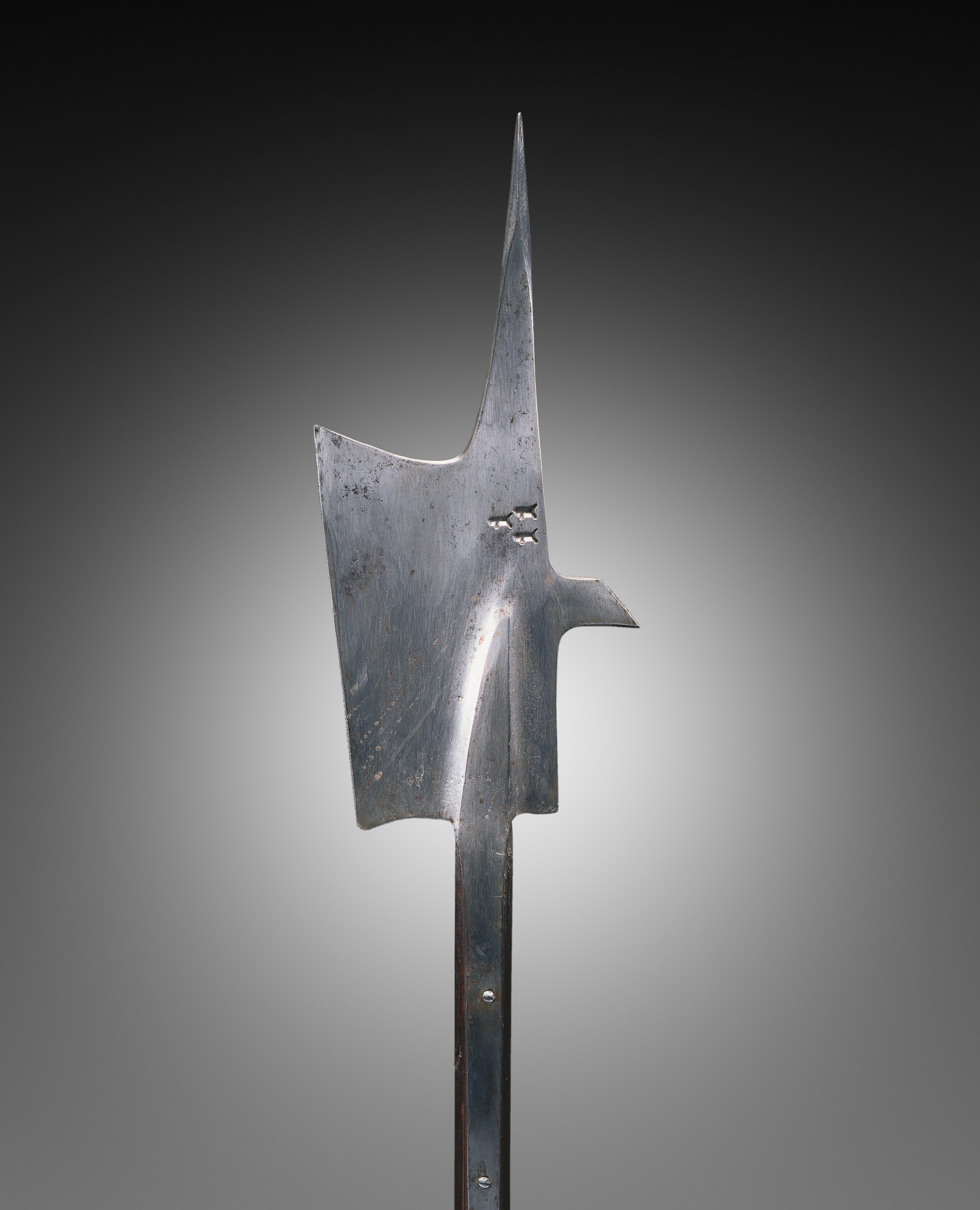
Executive Summary: The Halberd as a Sartorial Archetype
At Zoey Fashion Lab, we do not merely observe historical artifacts; we deconstruct their structural DNA and re-sequence it into wearable provocations. The subject of this analysis—the Swiss Halberd—presents a unique paradox: a weapon of devastating practicality that also functions as a ceremonial object of immense symbolic weight. Its composition, a forged steel head married to a rectangular, planed wooden haft, offers a rich lexicon of material contrasts, geometric tensions, and ergonomic principles that translate powerfully into avant-garde fashion construction.
This report dissects the Halberd’s technical anatomy—its metallic edge, its haft’s angular profile, and its composite joinery—and maps these elements onto a new design framework. We propose a collection that abandons the fluid, organic draping of conventional haute couture in favor of a structural, load-bearing aesthetic. The Halberd is not a source of literal inspiration (no armor, no medieval pastiche); rather, it is a generative algorithm for creating garments that assert posture, define negative space, and challenge the wearer’s relationship with gravity and motion.
Material Deconstruction: Steel and Wood as Textile Proxies
Ferrous Rigidity: The Steel Head as Structural Silhouette
The Halberd’s steel head is a study in asymmetric geometry. Its primary blade is a broad, cleaving arc, while the opposing spike is a sharp, linear counterpoint. The top spike extends vertically, creating a third axis. In our fabric analysis, this translates to a triangulated shoulder architecture. We propose using high-density, resin-coated wool and technical canvas that can be heat-molded into rigid, cantilevered forms. These materials will mimic the cold, unyielding quality of steel while remaining surprisingly lightweight.
The blade’s edge—its most critical functional line—becomes a design motif of laser-cut, bonded seams. Instead of soft curves, our seams will be sharp, beveled, and exposed, functioning as the garment’s “cutting edge.” The surface finish of the steel, characterized by subtle forging marks and a matte, non-reflective patina, is replicated through a brushed, micro-pebbled textile that absorbs light rather than reflecting it. This matte finish is crucial; it signals a rejection of ostentatious shine in favor of a quiet, industrial power.
Arboreal Logic: The Haft as a Framework for Movement
The haft is not a simple cylinder. It is a rectangular prism with planed corners, creating an octagonal cross-section that provides a secure grip and prevents rotation in the wielder’s hands. This is a masterclass in ergonomic engineering. For our garments, this translates into a modular internal skeleton. We will construct a series of articulated panels—rectangular in their primary form, with chamfered edges—that run along the spine, the outer arms, and the front placket.
These panels function like the haft’s corners: they provide torsional stability to the garment. They allow the fabric to twist and flex with the body but return to a prescribed, angular resting state. The wood’s grain, often ash or oak, is represented through a vertical, ribbed jacquard weave that creates a subtle, directional texture. This texture is not decorative; it is a functional guide, directing the eye and the fabric’s drape along a vertical axis, reinforcing the wearer’s stature. The planed corners are echoed in the garment’s seam allowances, which are pressed open and flat, creating crisp, architectural ridges rather than soft, rolled edges.
Structural Grammar: The Halberd’s Joints and Articulations
The Socket and Tongue: A Study in Negative Space
The most technically complex element of the Halberd is the socket—the metal collar that binds the blade to the haft. This junction is not hidden; it is celebrated with rivets and a pronounced flaring of metal. In our design system, this becomes the shoulder yoke and cuff connection. We will create oversized, metallic-grommeted sockets at the shoulder points where the rigid “steel” panels meet the softer, more pliable “wood” body fabric. These are not mere fasteners; they are load-transfer points.
Similarly, the tongue—the flat metal tang that extends down the haft—informs our design of long, integrated pocket flaps and belt loops. These elements will be constructed as separate, stiffened components that are then slotted through slits in the main fabric, appearing to pierce the garment’s surface. This creates a visual and physical layering that mimics the Halberd’s composite construction. The negative space between the tongue and the haft becomes a functional vent, allowing for airflow and a glimpse of an underlayer, adding depth and complexity to the silhouette.
Weight Distribution and Counterbalance
A Halberd is a study in dynamic balance. The heavy steel head is counterbalanced by the length and weight of the wooden haft. This principle directly informs our hem and train design. We propose a weighted, asymmetrical hem that is heavier at the back and left side, mimicking the blade’s forward-heavy bias. This is achieved through internal chain weighting and the use of a denser, felted wool in those specific panels.
The garment’s center of gravity is deliberately low, creating a grounded, authoritative presence. This is a direct antithesis to the ethereal, weightless trends in contemporary fashion. The wearer of a Halberd-derived garment does not float; they plant. Their movement is deliberate, their stance is wide, and their silhouette cuts a sharp, vertical line from shoulder to floor, broken only by the angular interruptions of the socket joints and the planed seams. The overall effect is one of controlled, kinetic potential—a garment that looks as if it could pivot and strike at any moment, even while standing perfectly still.
Avant-Garde Application: The “New DNA Strand” Collection
Silhouette Architecture: From Weapon to Wardrobe
Drawing from the Halberd’s DNA, we define three primary silhouettes for the upcoming season. The first, “The Cleaver,” features a single, dramatically oversized sleeve on the right side, constructed from the rigid steel-proxy material, while the left side remains a streamlined, wood-textured column. This asymmetry is a direct quote from the blade’s single-edged design. The second, “The Spike,” is a full-length, ultra-slim coat with a sharp, triangular collar that extends forward, creating a protective, aggressive visor-like effect. The third, “The Socket,” is a modular jacket with detachable, articulated sleeves that connect via oversized, grommeted flanges, allowing the wearer to alter the garment’s weight and silhouette—a nod to the Halberd’s versatility as both a cutting and thrusting weapon.
Color Palette and Surface Treatment
The palette is deliberately austere: oxidized iron grey, deep charcoal, raw ash blonde, and a single accent of oxidized copper green. This is not a neutral palette; it is a metallurgical palette. Fabrics will be treated with a silicone-based finish to provide a subtle, water-resistant sheen that mimics the oiled patina of a well-maintained weapon. Distressing will not be random; it will be engineered, placed at stress points—the elbows, the underarms, and the hem—to simulate the wear patterns of a historical artifact, giving each garment a pre-forged history.
In conclusion, the Swiss Halberd offers a profound departure from the soft, body-conscious fashion of the past decade. It provides a blueprint for a new kind of wearable armor—not for physical defense, but for psychological and social assertion. By abstracting its technical components—the steel’s rigidity, the wood’s angular ergonomics, and the socket’s structural joinery—Zoey Fashion Lab creates garments that are not merely worn but wielded. This is fashion as a statement of intent, a silent but formidable presence in any room. The Halberd is dead as a weapon; long live the Halberd as a sartorial paradigm.