The Chair Strip Reconfigured: A Blueprint for SS26 Structural Avant-Garde
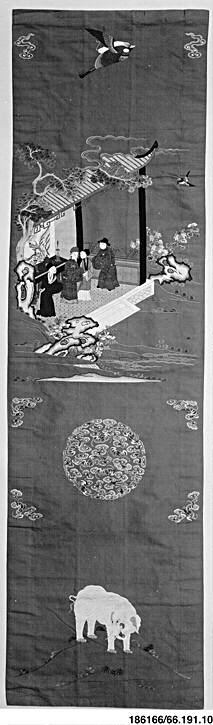
In the rarefied arena of haute couture, where the garment is perpetually in a state of becoming, the mundane object often serves as the most potent catalyst for radical reinvention. Zoey Fashion Laboratory’s latest acquisition—a single, One of a Set of Twelve Chair Strips from China, rendered in lustrous silk and metallic thread—is not a relic of domesticity but a manifesto. This is not a textile to be read literally; it is a coded architectural fragment, a discrete unit of structural intelligence that, when isolated and recontextualized within a standalone avant-garde study, unlocks a new lexicon of futuristic silhouettes for Spring/Summer 2026. The Laboratory’s interrogation of this artifact moves beyond mere inspiration. It is a surgical extraction of principles—tension, repetition, and spatial negation—that will define a season of garment architecture that breathes, suspends, and defies gravity.
Deconstructing the Unit: From Static Support to Kinetic Armature
The chair strip, in its original context, is a slave to orthodoxy—a horizontal band of tension designed to cradle, support, and immobilize. Its materiality, however, betrays a subversive duality. The silk offers fluidity, a liquid drape that speaks of the body's natural movement, while the metallic thread introduces a rigid, conductive skeleton. This dichotomy is the genesis of our SS26 thesis. We are not designing clothing that merely covers; we are constructing wearable armatures that challenge the static relationship between fabric and form. The strip’s repetitive, modular nature—a unit from a set of twelve—suggests a system of assembly. In the Laboratory, we treat this as a parametric module, a singular voxel of textile that can be multiplied, rotated, and articulated to generate an entire garment architecture. The future of couture, as this artifact proves, lies not in the whole cloth but in the intelligent aggregation of discrete, load-bearing components.
Silhouette Innovation: The Suspended Tension System
Our definitive analysis for SS26 pivots on a radical departure from the conventional bustier or corsetry. The chair strip’s intrinsic function—to hold a body in a state of poised suspension—is translated into a new silhouette we term the “Floating Fulcrum.” Imagine a jacket that does not rest on the shoulders but is anchored by a series of these silk-and-metal bands that wrap the torso in a non-linear, diagonal lattice. The metallic thread acts as a structural tendon, creating a rigid exoskeleton that holds the silk away from the epidermis, generating a negative space between garment and body. This is not a silhouette of containment but of projection. The volume is not added; it is suspended. The chair strip’s original purpose—to support a seated figure—is inverted; here, it creates a standing figure that appears to defy the very concept of gravitational pull. The resulting form is a futuristic hybrid: part samurai armor, part architectural model, part digital render made physical.
Textile Logic: The Conductive Silk Matrix
To treat the silk and metallic thread as mere decoration is to miss the point entirely. In our study, this material fusion is a functional composite. The silk provides a mutable, organic base layer that allows for breathability and fluid draping, while the metallic thread is a conductive element, a filament of light and structure. In SS26, we are exploring this as a form of textile circuitry. The metallic threads are not just visual accents; they are the seams of our structural logic, the points of tension that allow the garment to hold its futuristic shape without internal boning. This allows for a new kind of tailoring—one that is both rigid and fluid, structured and alive. The strip’s narrow width becomes a challenge to our pattern-cutting department: How do we build a full silhouette from a single, repeating band? The answer is in the articulation. By joining these strips at their metallic edges, we create a flexible, scale-like armor that moves with the body while retaining a powerful, architectural presence. This is not a print; it is a construction system.
Structural Innovation: The Logic of the Gap
The most avant-garde element of this study is not the material itself but the negative space it creates. The chair strip, when detached from its chair, is a line of tension. When applied to the body in a series of parallel or intersecting vectors, it defines the space around the form as much as the form itself. Our SS26 collection will feature garments where the strip is used as a connective tissue between panels of air. A skirt, for instance, is not a cone of fabric but a series of these strips spiraling down the leg, leaving deliberate gaps that reveal the skin or an under-layer of iridescent technical mesh. This is a silhouette of interruption, a deliberate breaking of the visual field that aligns with the contemporary fascination with the digital glitch. The garment becomes an interface, a system of signals and gaps, rather than a solid object. The future of couture, as defined by this artifact, is one of selective absence, where the designer’s hand is seen in what is left out as much as in what is included.
Conclusion: A Singular Object, a Universal System
This One of a Set of Twelve Chair Strips is far more than a historical curiosity. For Zoey Fashion Laboratory, it is a proof-of-concept for a new era of garment design. The SS26 silhouette will be defined by tension, suspension, and the intelligent use of structural textiles. The chair strip teaches us that support need not be hidden; it can be the very aesthetic of the garment. The metallic thread’s glow offers a futuristic luminosity, a nod to the machine age, while the silk’s organic hand keeps the design deeply rooted in the sensual, tactile world of haute couture. As we move forward, this artifact will remain a cornerstone of our design methodology, a constant reminder that the most radical futures are often hidden in the most prosaic of pasts. The chair is gone; the strip remains, and with it, we build a new body for the 21st century—a body that is not merely dressed, but architecturally defined.