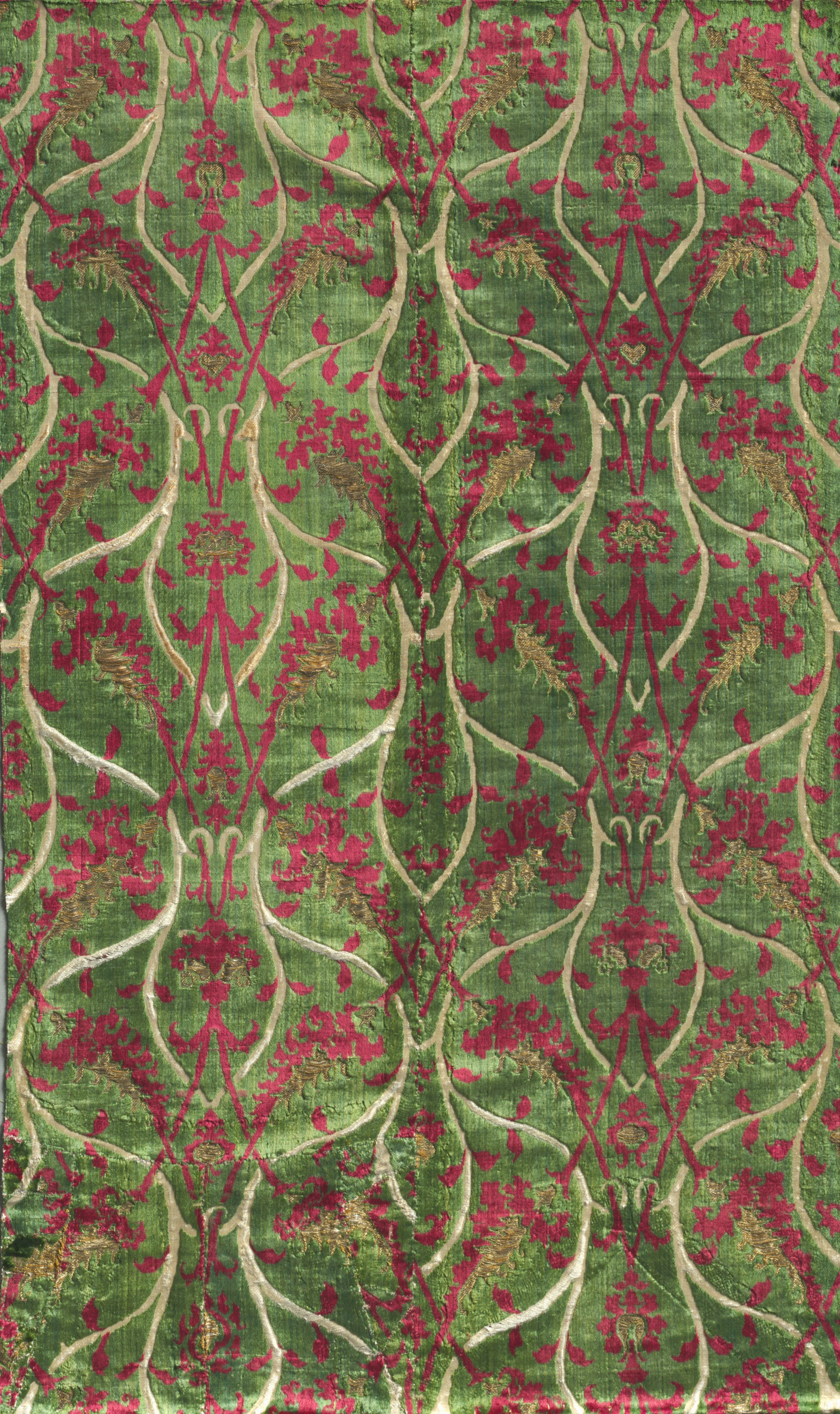
Deconstructing the Archive: The Two-Color Velvet with Gold in Double Curved Lattice
In the hallowed halls of textile history, where threads are not merely fibers but the sinews of cultural memory, Zoey Fashion Lab identifies a singular artifact that transcends its physical form. The subject of this analysis is a fragment of two-color velvet, interwoven with gold, presenting a double curved lattice pattern. Originating from Italy, plausibly Florence, circa the 15th century, this textile is a masterpiece of technical virtuosity. Constructed from silk and gold thread, it employs the complex techniques of polychrome velvet—specifically cut pile, brocaded, and voided—to create a surface that is less a fabric and more a topographic map of opulence. For the avant-garde deconstructionist, this is not a relic to be preserved under glass, but a dynamic algorithm of design principles, waiting to be decoded and re-synthesized into contemporary fashion language.
I. Technical Anatomy: The Loom as a Computational Engine
The 15th-century Florentine loom, particularly the drawloom, operated as a primitive, mechanical computer. The creation of this velvet demanded a sophisticated binary logic: the simultaneous management of warp, weft, and pile warps to achieve the three distinct surface elevations. The cut pile provides a plush, dimensional surface, absorbing light. The voided areas, where the pile is absent, reveal the ground weave, creating a stark, reflective contrast. The brocaded gold thread, often gilded silver wrapped around a silk core, is inserted as a discontinuous supplementary weft, allowing for intricate, localized metallic detailing without compromising the fabric's drape.
This is not mere decoration; it is a structural argument. The double curved lattice, a motif of intersecting ogival arches, is a feat of geometric engineering. The lattice is not printed or embroidered—it is woven, meaning the pattern is intrinsic to the fabric's architecture. For Zoey Fashion Lab, this represents the pinnacle of material logic. The avant-garde designer must recognize that the pattern is not a surface application but a core property. The challenge is to translate this woven logic into a modern context, perhaps through 3D-printed structural textiles or laser-cut leathers that mimic the interplay of void and pile, without resorting to literal reproduction.
II. The Visual Dialectic: Lattice, Light, and the Void
The visual impact of this velvet is predicated on a dialectic between light and shadow, mass and void. The double curved lattice, often derived from Islamic architectural motifs, creates an optical illusion of infinite depth. The eye is invited to trace the intersecting curves, which appear to weave over and under each other in a perpetual, hypnotic dance. The two-color scheme—perhaps a deep crimson or emerald against a contrasting ground—further complicates this optical play. The gold thread acts as the high-frequency signal, catching ambient light and creating a shimmering, celestial network across the fabric’s surface.
This is a fabric that performs. It is not static; it changes character with every movement of the wearer. The voided areas function as negative space, allowing the ground color to breathe, preventing the design from becoming claustrophobic. In an avant-garde context, this principle translates directly to garment construction. Consider a modern silhouette—an asymmetric, sculptural gown—where the "void" is achieved through strategic cutouts, sheer panels, or the deliberate absence of fabric. The lattice pattern, then, is not a printed design but a structural framework for the human body, where skin becomes the ground weave and the garment becomes the pile. The gold, in this reinterpretation, could be a metallic liquid finish applied to specific seams or edges, echoing the brocaded highlights of the original.
III. Cultural Resonance: The Mirror and the Stone
The archival reference provided—"一面是光洁银镜上以黄金镶嵌的纷繁棕叶纹,另一面是冰冷石棺板上以浮雕诉说的生命叙事"—offers a profound poetic key. It juxtaposes the polished silver mirror (reflection, vanity, the ephemeral present) with the cold stone sarcophagus (memory, mortality, the enduring past). The velvet exists precisely at this intersection. Its gold threads are the mirror, reflecting the wealth and status of the owner, while its deep, plush pile and intricate lattice are the stone relief, telling a narrative of cultural exchange, technological prowess, and artistic ambition that outlives its original patron.
For the avant-garde designer, this duality is a conceptual goldmine. The garment must simultaneously be a mirror and a monument. It must reflect the immediate, kinetic reality of the wearer while also evoking a sense of historical weight and gravitas. This can be achieved through material juxtaposition: pairing the heavy, historical resonance of velvet (or its modern equivalent, such as a recycled, high-tech microfibre velvet) with the stark, cold precision of polished metal hardware. The design narrative becomes a dialogue between the fleeting moment of a runway show and the permanent archive of fashion history. The lattice, in this reading, is not just a pattern; it is a visual metaphor for the interconnectedness of time—each curve crossing another, each thread tied to a past and future.
IV. Avant-Garde Synthesis: From Archive to Algorithm
Zoey Fashion Lab's deconstructionist protocol rejects the notion of the museum piece as a final, closed object. Instead, we treat this 15th-century velvet as an open-source code. The avant-garde translation involves several key operations:
- Deformation: The rigid, symmetrical lattice is intentionally warped, stretched, or digitally distorted to create a new, unsettling geometry. This reflects the contemporary, fractured experience of time and space.
- Material Substitution: The silk and gold are replaced with bio-fabricated silks, recycled metallic yarns, or even conductive threads that can interact with the wearer’s environment. The opulence of gold is re-coded as the opulence of innovation and sustainability.
- Scale Manipulation: The lattice is blown up to a monumental scale, becoming an architectural cage around the body, or reduced to a micro-scale, creating a subtle, textural effect that only reveals its complexity upon close inspection.
- Functionality Reversal: The velvet's traditional association with static, ceremonial dress is subverted. The new garment is modular, reversible, and adaptable, allowing the wearer to manipulate the "void" and "pile" in real-time, changing the garment's silhouette and narrative throughout the day.
The final product is not a costume of the past, but a speculative artifact from an alternative present. It is a garment that honors the technical mastery of the Florentine weavers while rejecting the constraints of historical reproduction. It is a wearable argument that the most innovative future of fashion lies not in erasing the past, but in radically, critically, and creatively re-engineering its most profound expressions. The two-color velvet with gold is no longer a relic; it is a blueprint for a new form of sartorial intelligence.