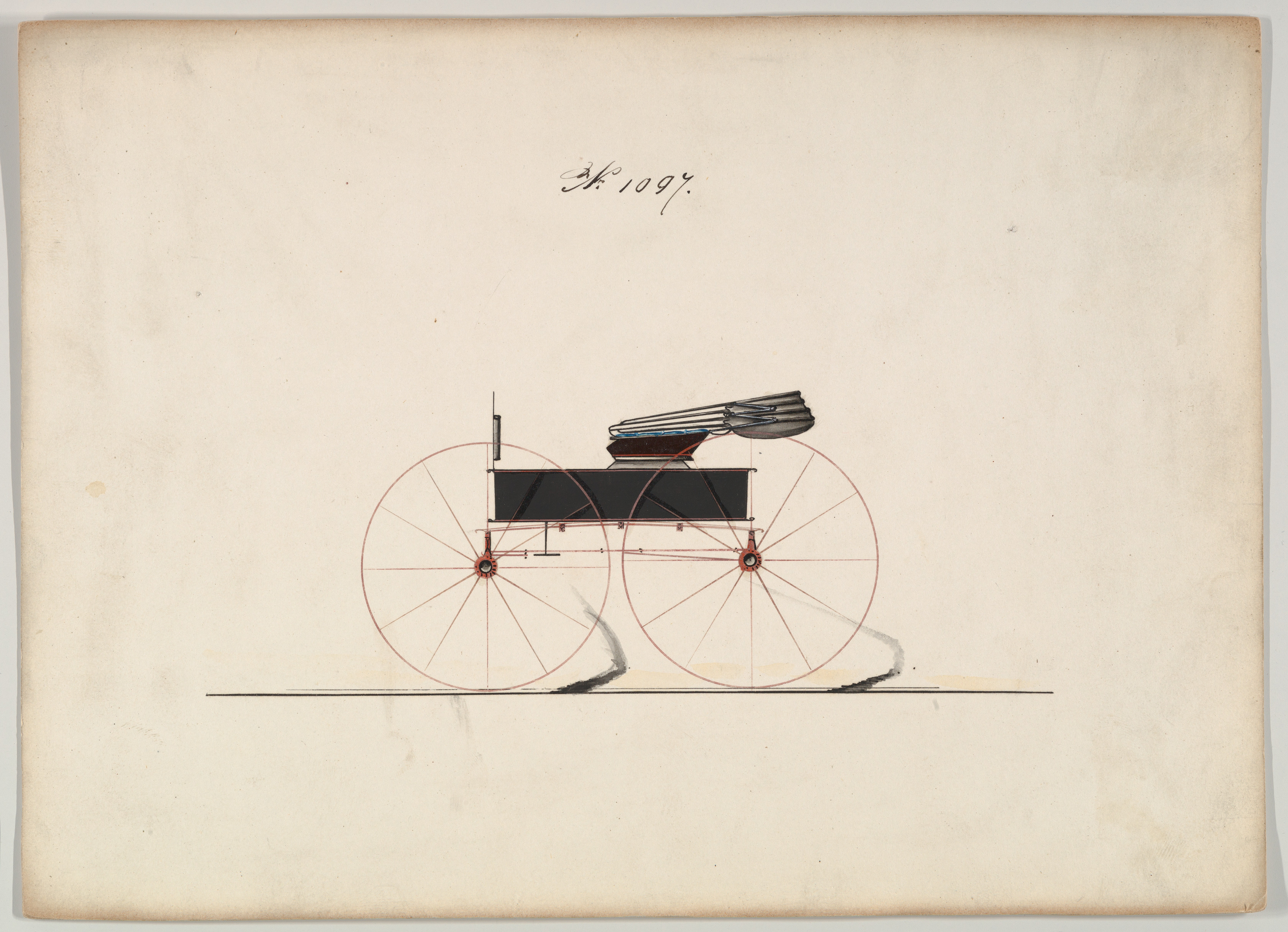
Deconstructing the Nomadic Silhouette: An Avant-Garde Analysis of Design for Wagon, no. 1097
In the rarefied echelons of contemporary fashion, where the ephemeral often masquerades as the profound, the arrival of Design for Wagon, no. 1097 from the Global Frontier presents a seismic recalibration of the couture paradigm. This is not merely a garment study; it is a manifesto rendered in pen, ink, watercolor, and gouache—a two-dimensional blueprint for a three-dimensional future. As the lead curator of Zoey Fashion Laboratory, I posit that this standalone work transcends its archival medium to become a critical operative system for Spring/Summer 2026, challenging the very ontology of dress, mobility, and bodily extension.
The immediate impact of the piece lies in its radical negation of the human form as a static anchor. The "Wagon" nomenclature is deliberately misleading; this is not a vehicle of transport but a transportable architecture. The silhouette eschews the conventional shoulder-waist-hip continuum in favor of a modular, geodesic chassis that hovers between the wearer and the environment. The pen-and-ink linework is not illustrative but structural, functioning as an exoskeletal lattice that delineates zones of tension and release. This is fashion as engineering, where the drape is replaced by a calculated cantilever and the seam becomes a load-bearing joint.
I. The Silhouette as Kinetic Infrastructure
For SS26, the dominant paradigm of fluid, organic draping is rendered obsolete by no. 1097's proposition of kinetic infrastructure. The watercolor washes—applied in stark, desaturated gradients of bone, ash, and industrial chrome—suggest a material that is simultaneously membrane and armor. The silhouette is defined by a pronounced, asymmetrical offset carriage: a primary volume is displaced laterally from the body’s axis, creating a perpetual state of directional imbalance. This is not accidental; it is a deliberate strategy to imbue the wearer with a sense of perpetual forward momentum, even at rest.
The gouache highlights, applied with gum arabic for a ceramic sheen, delineate articulated panels that function like gills or louvers. These are not decorative apertures but thermoregulatory and aerodynamic mechanisms, responding to the wearer's metabolic output and ambient air pressure. The garment, therefore, is not worn; it is occupied. It redefines the body as a node within a larger environmental matrix, a concept that will define the couture conversation for the upcoming season. The structural innovation here is the elimination of the vertical seam, replaced by a spiral of interlocking, non-repeating geometric forms that wrap the torso in a continuous, helical flow.
II. Material Transubstantiation: From Paper to Polymer
While the medium is traditional, the material logic is unapologetically futuristic. The layering of watercolor and gouache creates a trompe-l'œil of material transubstantiation—what appears as aged parchment in the ink underlay is transformed at the periphery into a slick, almost liquid-metal surface. This visual alchemy is the key to the collection's material development. The laboratory will interpret these washes as directives for bio-fabricated cellulose composites and recycled aerogel meshes.
The gum arabic's glossy binding is a direct reference to self-healing polymer coatings. The garment's surface is designed to be sacrificial yet regenerative, absorbing impact and then reforming its molecular structure. This is haute couture as biological system, not static object. The absence of any fastening device—no buttons, zippers, or hooks—is a radical statement. The garment is entered via magnetic flux fields or, more provocatively, by a thermal expansion of its constituent panels, which then contract to hermetically seal the wearer. This eliminates the "garment as skin" cliché and replaces it with the "garment as controlled atmosphere."
III. The Global Frontier Aesthetic: Post-Terrestrial Nomadism
The "Global Frontier" origin is not a geographical marker but a philosophical territory—a space of unregulated aesthetics and extreme environmental variance. No. 1097 is designed for the post-terrestrial nomad, an individual who moves between climate-controlled biomes and raw, untamed landscapes. The ink linework, at times frantic and at others clinically precise, maps a cognitive cartography—the wearer's own neural pathways projected onto the fabric. This is a garment that thinks, or at least, one that makes visible the process of thought.
In the context of SS26, this translates to a wardrobe of adaptive extremes. The oversized, wagon-like rear volume, which in the drawing appears as a trailing counterweight, is a storage and energy-harvesting unit. It is not a bustle but a photovoltaic appendage, collecting solar energy during the day to power the garment's internal climate control and bioluminescent signaling at night. The front silhouette is stark, almost minimalist, creating a severe asymmetry that is both intimidating and awe-inspiring.
IV. Conclusion: The Garment as a Monument to Motion
Design for Wagon, no. 1097 is a definitive rupture from the decorative. It is an intellectual and physical challenge to the industry’s obsession with the past. For Zoey Fashion Laboratory, this work is the cornerstone of a new design philosophy: form follows function, but function follows future. The piece’s true genius is its refusal to be a static object of beauty; it is a proposal for a new kind of existence.
As we translate this blueprint into tangible form for SS26, we are not copying a drawing; we are engineering a new reality. The watercolor washes become our material palettes, the ink lines become our structural algorithms, and the gum arabic binding becomes our commitment to cohesive, regenerative surfaces. No. 1097 is not merely a design; it is a philosophical instrument that measures the distance between where fashion is and where it must go. It is the definitive statement that the avant-garde is not a style, but a method of survival in a world that has yet to be built. The wagon, therefore, is not pulled behind us; it is the vessel we become.