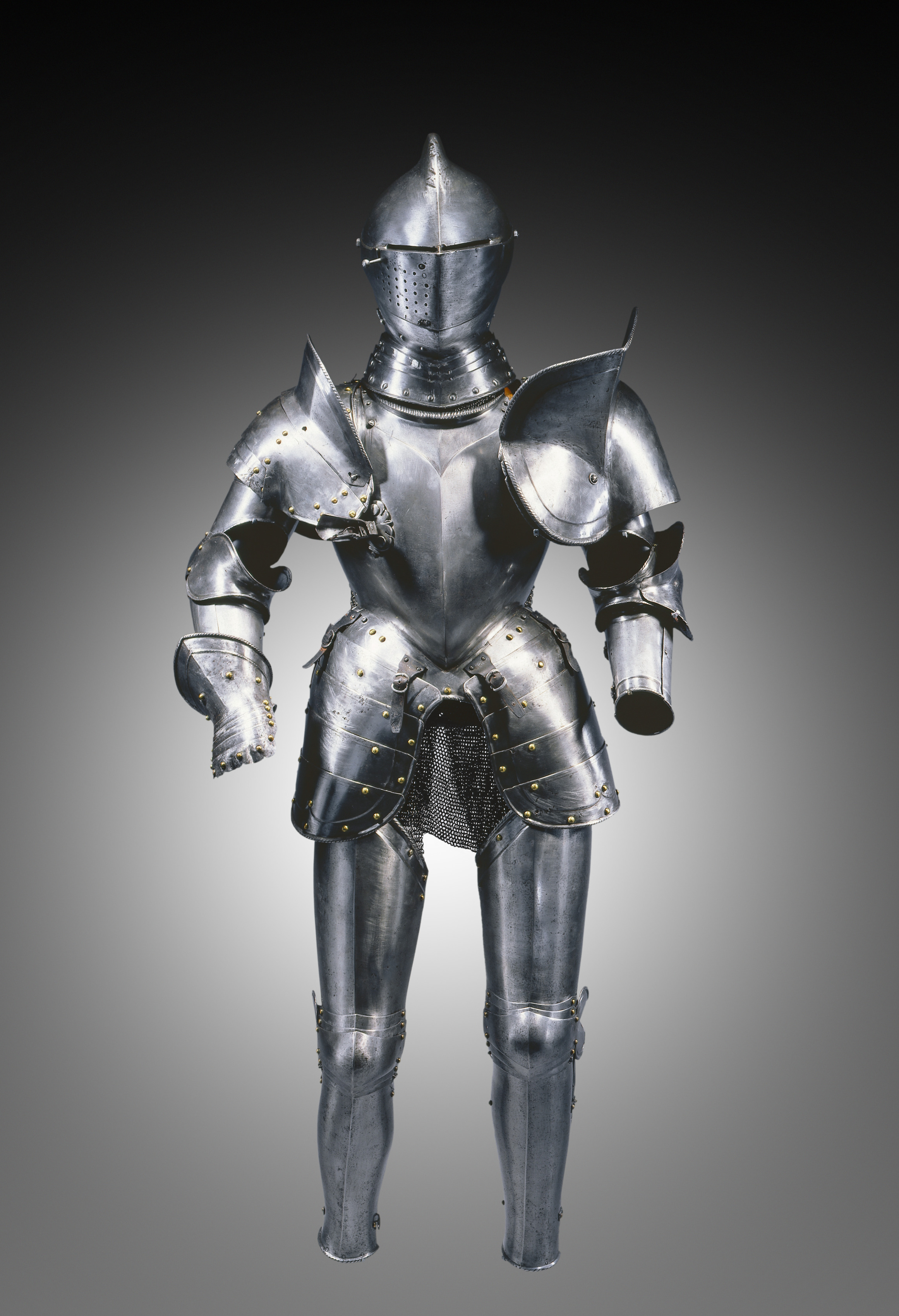
Deconstructing the Tilting Suit: A 16th-Century Blueprint for Avant-Garde Expression
At Zoey Fashion Lab, our mandate is not merely to study garments but to interrogate their structural DNA, extracting the latent codes that can be re-synthesized into future-facing silhouettes. Today, we turn our analytical lens to a singular artifact: the South German Tilting Suit, circa 1550. Composed of hardened steel, vegetable-tanned leather straps, and hand-set brass rivets, this object is often misread as a relic of martial function. We see it as a proto-architectural exoskeleton, a rigid carapace that paradoxically speaks to the most fluid concepts of contemporary avant-garde design. Our reference, the "New DNA Strand," is not a biological metaphor but a design methodology—a way of isolating the suit's core structural principles and recombining them into a new, wearable organism.
I. The Armor as Exoskeleton, Not Defense
The Tilting Suit’s primary function was jousting—a sport of controlled violence. Yet, its construction reveals a deeper logic. The steel plates are not a continuous shell but a series of articulated, overlapping segments, each one a discrete module. This is the suit’s first and most critical genetic marker: modular segmentation. Unlike a tailored cloth garment that drapes and folds, the suit creates volume through rigid, positive geometry. Each pauldron, cuirass, and tasset is a self-contained architectural unit, connected by the leather straps and brass rivets—the suit’s "ligaments and joints."
For the avant-garde designer, this is a radical departure from the soft, drape-centric traditions of haute couture. The suit proposes a silhouette where the body is not the primary form; instead, the body is a chassis upon which a secondary, constructed landscape is mounted. We extract this principle as a design directive: build volume from the outside in. The New DNA Strand encourages us to design garments as prefabricated components—a shoulder capsule, a hip cage—that are assembled on the wearer, creating a new, exaggerated human topology that challenges the natural form.
II. The Material Triad: Steel, Leather, and Brass as a Textural Symphony
The material palette of the Tilting Suit is deceptively simple, yet its textural and tactile complexity is profound. The steel offers a mirror-polished or blued surface, a cold, hard, and reflective plane. The leather straps, often left undyed, provide a warm, fibrous, and flexible counterpoint. The brass rivets act as tiny, golden punctuation marks, catching light and creating a rhythmic visual beat across the metal expanse.
This triad is not arbitrary. It is a study in oppositional tension—hard versus soft, reflective versus absorbent, cool versus warm. In our deconstruction, we translate this into a material strategy for the avant-garde: reject monochromatic, single-fiber thinking. Instead, we propose a garment that layers a high-polish, liquid-metal finish (perhaps a technical PVC or coated nylon) with raw, unrefined leather edges and exposed, oversized metallic fasteners. The result is a textural dissonance that is both aggressive and alluring. The New DNA Strand dictates that every material must serve a structural or sensory purpose, creating a dialogue between the rigid and the pliable, the mechanical and the organic.
III. The Line of Articulation: Engineering Movement in Stasis
Perhaps the most sophisticated element of the Tilting Suit is its articulation system. The leather straps and rivets are not simply holding the plates together; they are creating engineered pivot points. The suit allows for a specific, restricted range of motion—the forward lunge of the lance, the twist of the torso. This is not freedom of movement; it is directed movement. The garment dictates the choreography of the body.
This concept is revolutionary for contemporary fashion, which often prioritizes unrestricted comfort. We invert this logic. The avant-garde garment, following the suit’s blueprint, should choreograph the wearer. By placing rigid panels at the hip or shoulder with strategic, visible hinge mechanisms, we create a silhouette that moves with a mechanical, almost robotic precision. The wearer becomes a performer, their gait and posture altered by the garment’s architecture. The New DNA Strand captures this as "kinetic sculpture." The garment is not static; it is a piece of wearable machinery that comes alive only when the body activates its joints, creating a dynamic, ever-shifting visual profile.
IV. The Aesthetic of the Incomplete: The "Composed" State
The designation "(composed)" in our reference is crucial. It implies that the suit is not a singular, monolithic object but an assembly—a system of parts that can theoretically be reconfigured. This aligns perfectly with the avant-garde’s fascination with the unfinished, the deconstructed, and the modular. We reject the notion of a "finished" garment. Instead, we propose a design that is intentionally left open for interpretation.
Consider a jacket inspired by this suit: it might feature a fully articulated steel-like sleeve on one arm, while the other side dissolves into a flowing, asymmetrical drape of leather and mesh. The brass rivets might be left exposed, not as a fastening, but as a decorative structural scar. The leather straps could be functional, allowing the wearer to cinch or release the garment’s volume, actively participating in its final form. This is the ultimate expression of the New DNA Strand: the garment is a kit of parts, a conversation between the designer’s initial intent and the wearer’s final manipulation. It is fashion as an open-source system, a direct challenge to the static, mass-produced norm.
V. Synthesis: The Tilting Suit as a Provocation
The South German Tilting Suit is not a costume; it is a manifesto in steel. It declares that clothing can be protective, aggressive, and sculptural—a second skin that is not a mimicry of the body but a superstructure imposed upon it. For Zoey Fashion Lab, it serves as a profound source of inspiration, not for its historical accuracy, but for its radical structural logic.
By isolating its core principles—modular segmentation, oppositional materiality, engineered articulation, and an unfinished aesthetic—we have developed a new design grammar. The New DNA Strand is our translation of this 16th-century engineering into a 21st-century sartorial language. The result is a collection that is not merely clothing but a series of wearable provocations, challenging the wearer to reconsider their relationship with volume, movement, and material. The Tilting Suit asked, "What can a body do within a rigid framework?" We answer, "It can become a living monument." This is the future of fashion: not to clothe the body, but to re-architect it.