The Ephemeral Architecture of Myth: Deconstructing the Burmese Kalaga for SS26
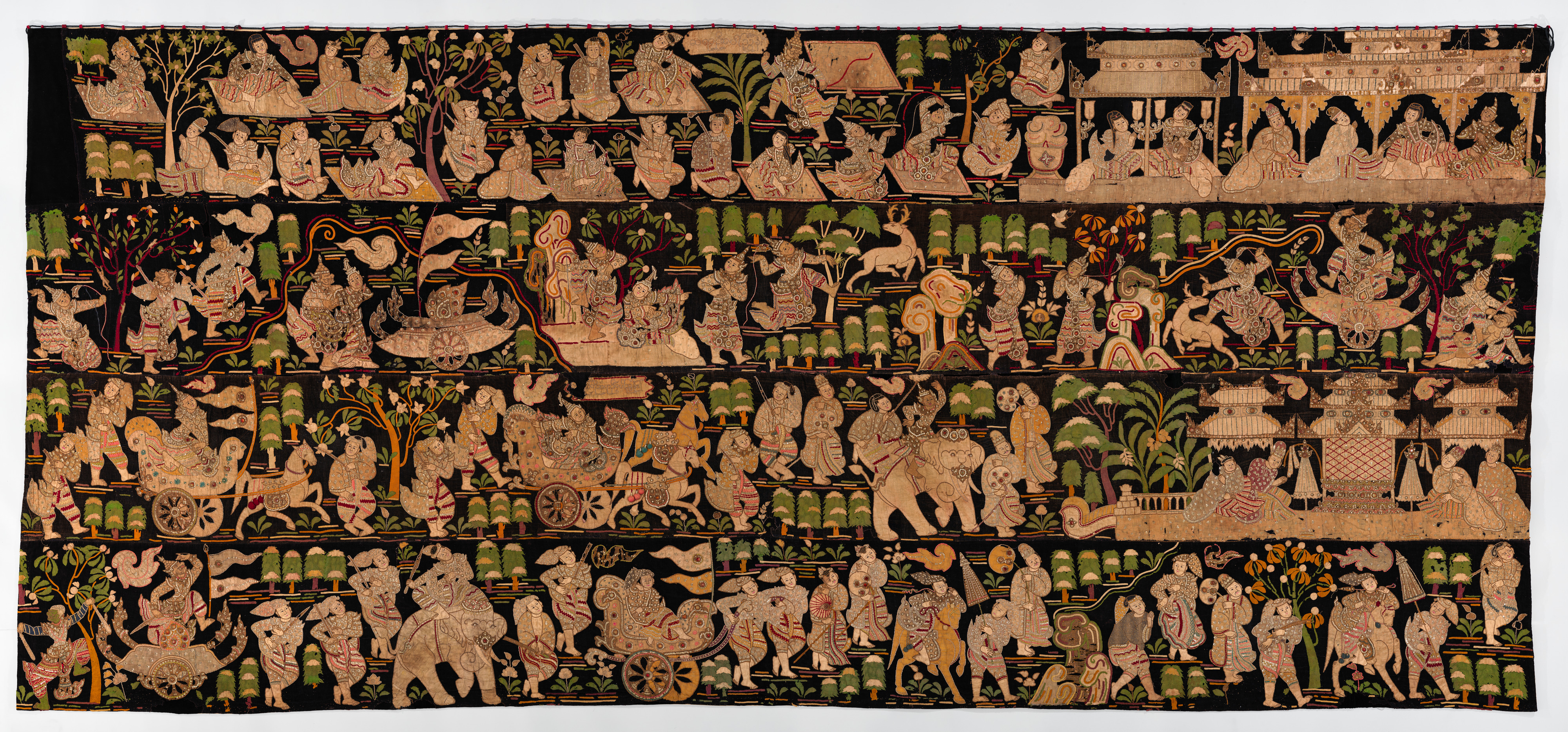
The contemporary fashion imagination is often seduced by the sterile futurism of synthetic fabrics and the cold precision of digital fabrication. Yet, the most radical propositions for the coming season lie not in the unseen, but in the re-reading of the ancestral. Zoey Fashion Laboratory’s latest avant-garde study turns its gaze to the Thiri Rama, the Burmese adaptation of the Ramayana, as manifested in the exquisite medium of the kalaga—a pictorial textile hanging from Yangon and Mandalay. This is not a mere exercise in cultural appropriation, but a deep excavation of structural logic, a translation of mythological narrative into the language of deconstructive couture. The kalaga, with its dense appliqué, its shimmering metal threads, and its velvet ground, is not a flat picture; it is a relief map of a cosmic battle, a three-dimensional topography of tension, movement, and divine power. For SS26, we extrapolate this into a new silhouette language—one that is less about the body and more about the space the body commands.
Deconstructing the Ground: From Velvet to Biomorphic Shell
The foundational element of the kalaga is its velvet ground—a deep, absorbent darkness that absorbs light before reflecting it back in muted, luxurious tones. In our SS26 proposition, this ground is not discarded but inverted. We propose a series of biomorphic shell jackets constructed from a new generation of recycled micro-velvet, bonded with a thermo-reactive film. The silhouette is not tailored to the human form; rather, it is sculpted away from it, creating a negative space that suggests an exoskeleton. The garments are engineered to stand independently, their internal structure reinforced with a lattice of recycled carbon fiber, echoing the kalaga’s own internal tension between the heavy ground and the applied relief. The ‘ground’ becomes the ‘armature’—a hard, yet pliable, shell that hovers around the collarbone and flares asymmetrically over the hips, a futuristic nod to the Burmese htamein’s wrapped volume, but rendered in a rigid, architectural form. This is the first principle: the background is no longer passive; it is the primary structural agent.
The Appliqué as Armor: Layering Myth and Material
The essence of the kalaga lies in its appliqué—intricately cut shapes of silk and metallic cloth, layered to create the figures of Rama, Sita, and the demon king Ravana. Each piece is a discrete unit, yet it is subsumed into a larger narrative whole. Our SS26 strategy translates this into a modular system of detachable, high-relief panels. Imagine a series of cuirasses and pauldrons that are not sewn flat, but are attached via a system of magnetic clasps and articulated hinges, allowing the wearer to reconfigure the garment’s narrative throughout the day. These panels are not pictorial, but abstracted—shards of gold-gilt leather, embossed with a topographic pattern derived from the folds of the original hanging, are overlaid with sections of sheer, laser-cut technical tulle that mimic the effect of glass seed pearls. The result is a fragmented silhouette, where the body is seen in pieces, as if caught between moments of transformation. This is the second principle: the garment is a living document, perpetually in a state of assembly and disassembly.
Luminous Threads: The Reinterpretation of Metalwork
The kalaga’s most arresting feature is its use of gold-gilt and silver-gilt metal thread, which catches the candlelight and transforms the textile into a shimmering, celestial map. In our studio, this is reimagined not as embroidery, but as structural wiring. We are developing a series of ‘circuit-braided’ cords—fine, flexible filaments of recycled brass and silver, woven with photovoltaic fibers. These cords are used to connect the modular panels, creating an external, visible network of tension that holds the garment together. The cords are not hidden; they are celebrated, trailing from the shoulder to the wrist, from the hip to the hem, like the radiant energy lines of a mythological being. The effect is a cyber-physical aura, a garment that appears to be powered by its own internal mythology. This is not decoration; it is the garment’s nervous system, the visible articulation of its structural integrity. The ‘thread’ is now a conduit, both literal and metaphorical, for the transmission of power.
Sequins and Seed Pearls: Pixelated Narrative
The surface embellishment of the kalaga—the dense fields of sequins and seed pearls—is often perceived as the epitome of ornamentation. Our analysis reframes this as an early form of pixelation. Each sequin is a single data point, each pearl a unit of light. For SS26, this translates into a new technique we call ‘Tactile Projection’. Using a proprietary digital embroidery process, we apply thousands of micro-discs of iridescent bio-resin onto sheer, architectural organza. These discs are not placed in a floral or decorative pattern, but are algorithmically distributed to create a moiré effect that shifts as the wearer moves. The pattern is derived from the battle scenes of the Thiri Rama, but abstracted to the point of illegibility, becoming a shimmering, kinetic field of energy. The garment is no longer depicting a story; it is generating a visual frequency, a modern-day enchantment that draws the eye without resorting to literal representation.
The Silhouette of Power: Asymmetry and Theatrical Volume
The traditional kalaga is a symmetrical rectangle, but its internal composition is often violently asymmetrical—figures lunge, arms extend, and demons twist. We have extracted this dynamic imbalance to break the tyranny of the symmetrical fashion silhouette. The SS26 collection features asymmetric, one-shoulder capes that sweep diagonally across the body, anchored by a single, exaggerated sleeve that flares into a wing-like structure, referencing the vahana (mounts) of the gods. Trousers are replaced with wrapped, high-waisted culottes that are pleated to mimic the folds of the hanging’s velvet, but are cut with a sharp, geometric precision that feels distinctly of the future. The overall effect is a theatrical, commanding presence—a silhouette that does not conform to the body, but rather creates a new, heroic proportion. This is the ultimate goal: to dress the modern individual not as a consumer, but as a protagonist in their own epic.
Conclusion: A New Mythology for the Modern Body
The Thiri Rama kalaga is not a relic; it is a repository of structural intelligence. By deconstructing its materials, its layering, and its dynamic composition, Zoey Fashion Laboratory has unearthed a blueprint for a new kind of avant-garde couture. This is not about recreating the past, but about harnessing its latent energy to propel fashion into a future where garments are not merely worn, but inhabited. The SS26 proposition is a synthesis of the ancestral and the algorithmic, the hand-stitched and the digitally engineered. It is a testament to the idea that the most radical innovation often comes from looking backward with a futuristic lens, finding in the sacred textiles of Myanmar a profound, wearable philosophy for the coming season. The result is a wardrobe for a new epoch—one where the body is a stage, and the garment is a living, luminous myth.