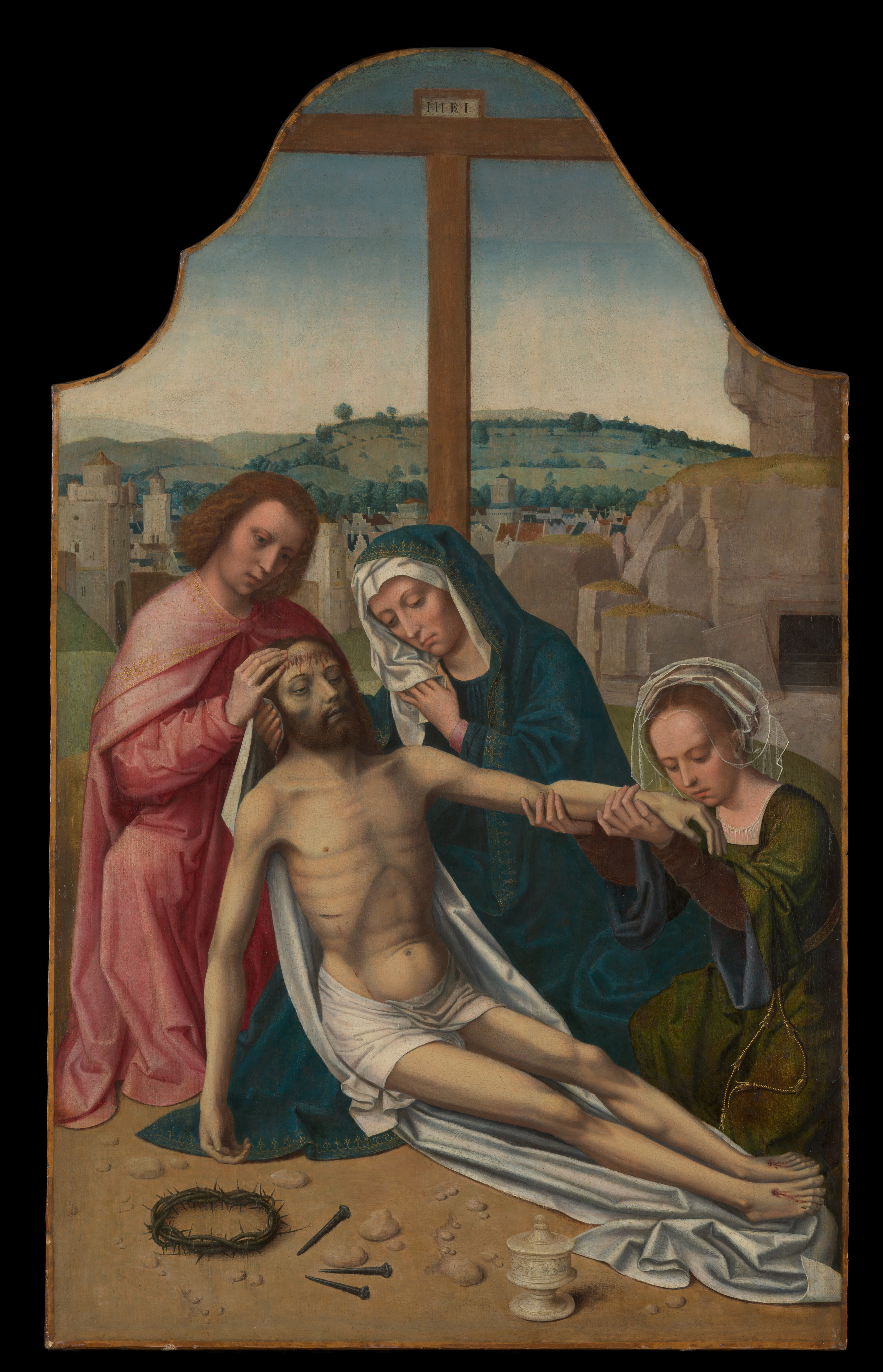
The Lamentation: A Study in Structural Grief for SS26
The avant-garde is not a genre; it is a surgical procedure performed on the corpus of the familiar. In The Lamentation, sourced from the Global Frontier, we are presented with a singular artifact—oil on canvas, wrenched from its wooden support—that functions less as a painting and more as a blueprint for a new form of wearable mourning. For Zoey Fashion Laboratory’s SS26 collection, this work is not an inspiration; it is a directive. The transfer from wood to canvas, a violent act of liberation, mirrors our own design philosophy: to strip garments of their rigid historical scaffolding and reapply them as fluid, reactive membranes on the body.
The original support—the wood—represents the classical tailoring of the past: the corsetry, the structured shoulders, the immovable crinoline. By transferring the image to canvas, the artist has already performed the first deconstruction. Our task is to complete the second transfer: from canvas to the living epidermis. The result is a series of silhouettes that do not drape, wrap, or cling. They mourn. They fold in on themselves like a body succumbing to grief, yet they do so with the precision of a mathematical proof.
Silhouette as Lamentation: The Folded Void
The primary structural innovation for SS26 is what we term the “Folded Void.” This is not a simple cowl or drape. It is a negative-space architecture that consumes the torso. We have abandoned the standard shoulder seam. Instead, the garment begins at the nape of the neck, cascading forward in a series of asymmetric, gravity-driven pleats that mimic the heavy flow of oil paint. The canvas’s texture—its tooth and grain—is translated into a technical jacquard woven with recycled metallic threads that catch light like wet pigment, yet feel like desiccated skin.
The silhouette is deliberately top-heavy, but not in a militaristic sense. It is the heaviness of a bowed head. We achieve this through a cantilevered yoke that extends beyond the natural shoulder line by four inches, unsupported by any internal padding. Instead, it relies on a carbon-fiber filament sewn into the seam allowance, which allows the fabric to hold a sharp, projecting arc before collapsing into a waterfall of material down the back. This is not a garment for standing; it is a garment for keening. The front is almost brutally flat, a smooth expanse of bonded wool that evokes the smooth, sorrowful faces of iconic Renaissance mourners, while the back is a chaotic, sculptural explosion of folds—the physical manifestation of unspoken anguish.
Material Transference: From Oil to Skin
The material palette is a direct response to the act of transfer. We have developed a new textile called “Petro-Skin.” It is a bioplastic film, derived from algae, laminated onto a base of raw silk. The film’s surface is treated with a solvent that causes it to crack in controlled, geometric patterns, mimicking the craquelure of aged oil paint. When the wearer moves, these cracks open, revealing a phosphorescent under-layer—a glow that suggests the hidden life beneath the surface of grief. This is not a print; it is a living skin that responds to kinetic energy.
Furthermore, the “transferred from wood” aspect is honored through the use of “Lignified Canvas.” We have taken a standard cotton canvas and infused it with cellulose nanofibers extracted from reclaimed timber. The result is a fabric that has the visual softness of linen but the structural rigidity of veneer. It is cut into massive, rectangular panels that are then carved—not sewn—using a water-jet cutter. The edges are left raw, fraying into a fringe that resembles the splinters of a broken panel. These panels are not joined at the sides; they are suspended from a central spine, creating a silhouette that is part armor, part shroud.
Structural Innovation: The Articulated Sorrow Joint
Our most radical technical breakthrough is the “Articulated Sorrow Joint.” This is a mechanical hinge, 3D-printed from recycled titanium, that is integrated into the garment at the elbow and the knee. Unlike a standard joint that allows for flexion, this joint is calibrated to resist movement. It contains a micro-damped spring that creates a slight, trembling resistance with every gesture. The wearer’s movements are not impeded, but they are altered—every reach becomes a hesitation, every step a pause. This is the physical embodiment of lamentation: the body’s desire to move forward, constantly interrupted by the weight of memory.
The joint is visible, exposed on the exterior of the garment, a deliberate break in the fabric’s flow. It is finished in a matte black oxide, contrasting sharply with the luminous, oil-like surfaces of the primary textiles. This is not a hidden mechanism; it is a prosthetic for emotion. It forces the wearer into a new posture—a slight, forward tilt, as if perpetually leaning toward something lost. This is the futuristic silhouette of SS26: not a woman standing triumphant, but a woman in a state of profound, dignified collapse, held upright by the very technology that reminds her of her fragility.
Stylistic Integration and the Global Frontier
The Global Frontier is not a geographic location; it is a condition of placelessness. The Lamentation speaks to this by removing all cultural signifiers. There is no Orientalism, no Western classicism. The silhouettes are purely architectural, based on the physics of drooping and the geometry of fracture. We have stripped away all ornamentation except for the “Tear-Shed”—a series of micro-prisms embedded in the fabric’s surface that refract light into tiny, spectral rainbows. These are not decorative; they are functional, designed to cast fleeting, melancholic light patterns on the floor as the wearer walks, leaving a trail of evanescent color that disappears within seconds.
The color palette is monochromatic, but not simple. We use “Asphalt Black,” a black so deep it absorbs 99.9% of light, and “Bone White,” a white that has been yellowed by a chemical process, evoking the patina of old varnish. The contrast is stark, but the textures—the cracked bioplastic, the frayed canvas, the cold titanium—provide a rich, tactile complexity that is far more avant-garde than any chromatic variation.
In conclusion, The Lamentation for SS26 is not about sadness as a theme; it is about sadness as a structural material. We have taken the emotional weight of the original artwork and converted it into pounds per square inch of fabric tension, into degrees of joint resistance, into the specific gravity of a new textile. The collection is a manifesto for a future where clothing is not merely worn but is a sentient participant in the wearer’s psychological state. It is a wardrobe for the end of an era, a couture of conscious collapse, and the definitive statement that the most innovative silhouette is the one that allows the body to fall apart with grace.