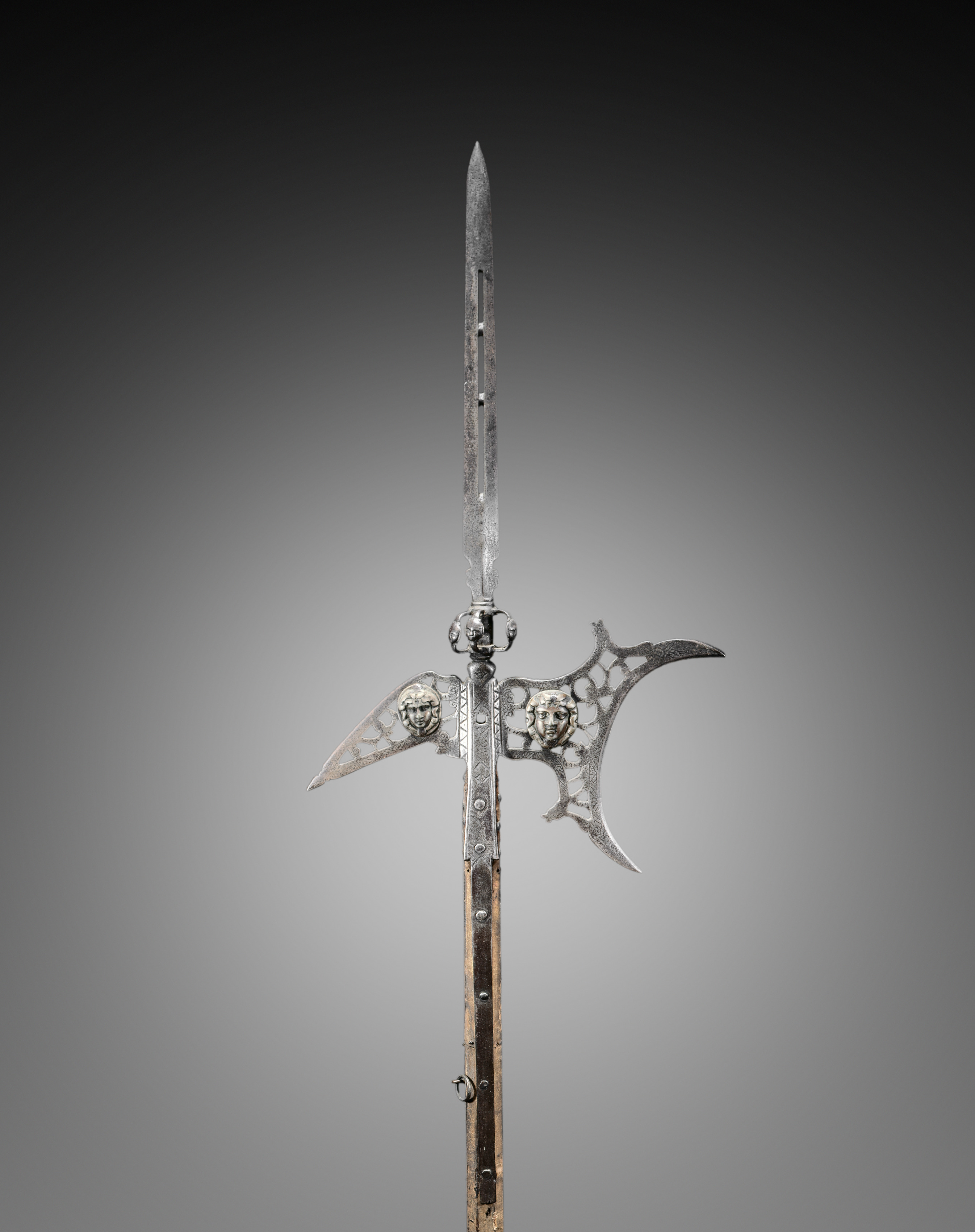
Deconstructing the Halberd: A Study in Anachronistic Armament for the Avant-Garde
At Zoey Fashion Lab, our mandate extends beyond the mere examination of textile and silhouette. We engage in the archaeological excavation of form, function, and cultural memory, unearthing objects from the annals of history to interrogate their latent potential for contemporary expression. In this analysis, we turn our gaze to a singular artifact: the French Halberd of the early 17th century. This is not a weapon of war in the conventional sense, but a complex signifier—a sculptural statement of authority, technical mastery, and impending obsolescence. Its deconstruction reveals a blueprint for a new DNA strand in avant-garde fashion, one that privileges structural tension, metallic adornment, and the deliberate subversion of historical utility.
I. The Object as Text: Materiality and Historical Resonance
The halberd, in its original context, was a weapon of transition. By the early 17th century, the pike and the firearm were rendering the halberdier’s role increasingly ceremonial. This particular specimen, however, defies simple categorization as a relic. Its construction speaks to a sophisticated dialogue between brute force and refined artistry. The primary shaft is an octagonal haft of seasoned wood, a geometric choice that provides ergonomic grip and structural rigidity. This is not a passive support; it is the architectural spine of the piece. The deliberate inclusion of studs and leather straps transforms the haft from a simple pole into a tactile, armored surface. These elements prefigure the modern obsession with hardware and bondage detailing, suggesting a garment that is not merely worn but assembled and secured.
The steel head is the focal point, yet its execution is one of deliberate paradox. The blade is pierced, a technique that lightens the weapon while simultaneously creating a negative-space pattern. This is an act of dematerialization, a denial of the solid mass one expects from a cutting instrument. The piercing is not random; it is a controlled, rhythmic interruption of the metal’s surface, creating a lattice of light and shadow. This technique finds a direct corollary in avant-garde fashion’s use of cutouts, laser-etched leather, and perforated textiles. The garment becomes a filter, a screen through which the body is partially revealed, its presence felt as much through absence as through form. The appliqué masks in brass further this theatricality. These are not functional additions; they are symbolic guardians, faces that gaze out from the weapon’s core. Their placement suggests a hidden narrative, a protective spirit or a vanquished foe, turning the halberd into a totemic object.
II. The New DNA Strand: Translating Armament into Attire
To translate this object into a fashion language, we must isolate its core genetic markers: Structural Rigidity, Metallic Accretion, Negative Space, and Anachronistic Hardware. These are the nucleotides of our new strand, and their combination yields a design philosophy that is unapologetically avant-garde.
Structural Rigidity: The octagonal haft becomes the inspiration for a new silhouette. We envision a jacket or a bustier constructed from bonded wool or technical canvas, with seams that echo the haft’s eight facets. This is not a soft, draping garment. It is an exoskeleton, a piece of architecture that stands independent of the body, creating a powerful, imposing shoulder line. The internal structure would be reinforced with a corsetry-like boning, but one that is visible, becoming a design feature rather than a hidden support. The leather straps, far from being utilitarian, are reimagined as wide, buckled belts that cinch the waist, creating a deliberate tension between the rigid torso and the flowing lower half.
Metallic Accretion: The brass appliqués are translated into a system of metallic embellishment. We eschew simple embroidery for a more sculptural approach. Small, cast-brass masks or abstract geometric forms would be riveted or woven directly onto the fabric. These are not delicate trims; they are weighted, tactile objects that clink and shift with movement. The placement would be strategic: clustered at the shoulder, running down the spine, or framing the neckline. This approach treats the garment as a canvas for a metallic mosaic, echoing the halberd’s fusion of steel and brass. The effect is one of armored glamour, a nod to historical pageantry that is simultaneously futuristic and alien.
III. Piercing the Silhouette: The Language of Absence
The most compelling genetic marker is the pierced steel. This is not a simple decorative cutout. It is a systematic removal of material to create a new visual rhythm. In our translation, this manifests as a technique of strategic perforation on leather or dense felt. We would employ a die-cutting process to create a repeating pattern of slits and apertures across the garment’s surface. This serves multiple functions. First, it creates a breathable, dynamic surface that plays with the skin beneath. Second, it introduces a level of transparency that is both provocative and architectural. Third, it creates a unique textural interplay, where the edges of the cuts are finished with a contrasting material—perhaps a raw, burnt edge or a thin piping of a metallic thread—to mimic the sharp, deliberate edge of the steel pierce.
This technique can be further developed through a process of layering. A sheer, perforated organza could be placed over a solid, opaque base, creating an optical illusion of depth. The pattern of the upper layer would distort the view of the lower, producing a moiré effect that changes with the wearer’s movement. This is a dynamic form of camouflage, one that conceals and reveals in equal measure, forcing the observer to engage with the garment on a purely visual and intellectual level.
IV. Synthesis and Conclusion: The Ceremonial Body
The halberd, stripped of its martial function, becomes a pure object of contemplation. Our deconstruction reveals that its true purpose was always as much about display as it was about combat. The early 17th-century French court was a theater of power, and the halberd was a prop in that performance. By re-contextualizing its elements, Zoey Fashion Lab proposes a new form of ceremonial dress for the contemporary world. The garments we envision are not for the battlefield, but for the urban arena—for the gallery opening, the avant-garde performance, the high-fashion runway.
The final design is a synthesis: a sharply tailored, octagonal-shouldered coat in a deep, oxidized black. The surface is punctuated by a pattern of laser-cut slits, revealing a flash of iridescent lining. At the collar and cuffs, a series of small, brass, mask-like clasps hold the garment closed, their faces turned inward as if guarding the wearer. A wide leather belt, studded with the same brass elements, cinches the waist. The entire piece is an homage to the halberd’s paradoxical nature—its combination of brutal function and delicate artistry, its historical weight and its timeless, unsettling beauty. It is a garment that does not merely clothe the body; it redefines it as a monument, a living sculpture that carries the memory of a weapon into a future of pure style. This is the new DNA strand, a genetic code for fashion that is intellectually rigorous, visually stunning, and unapologetically avant-garde.