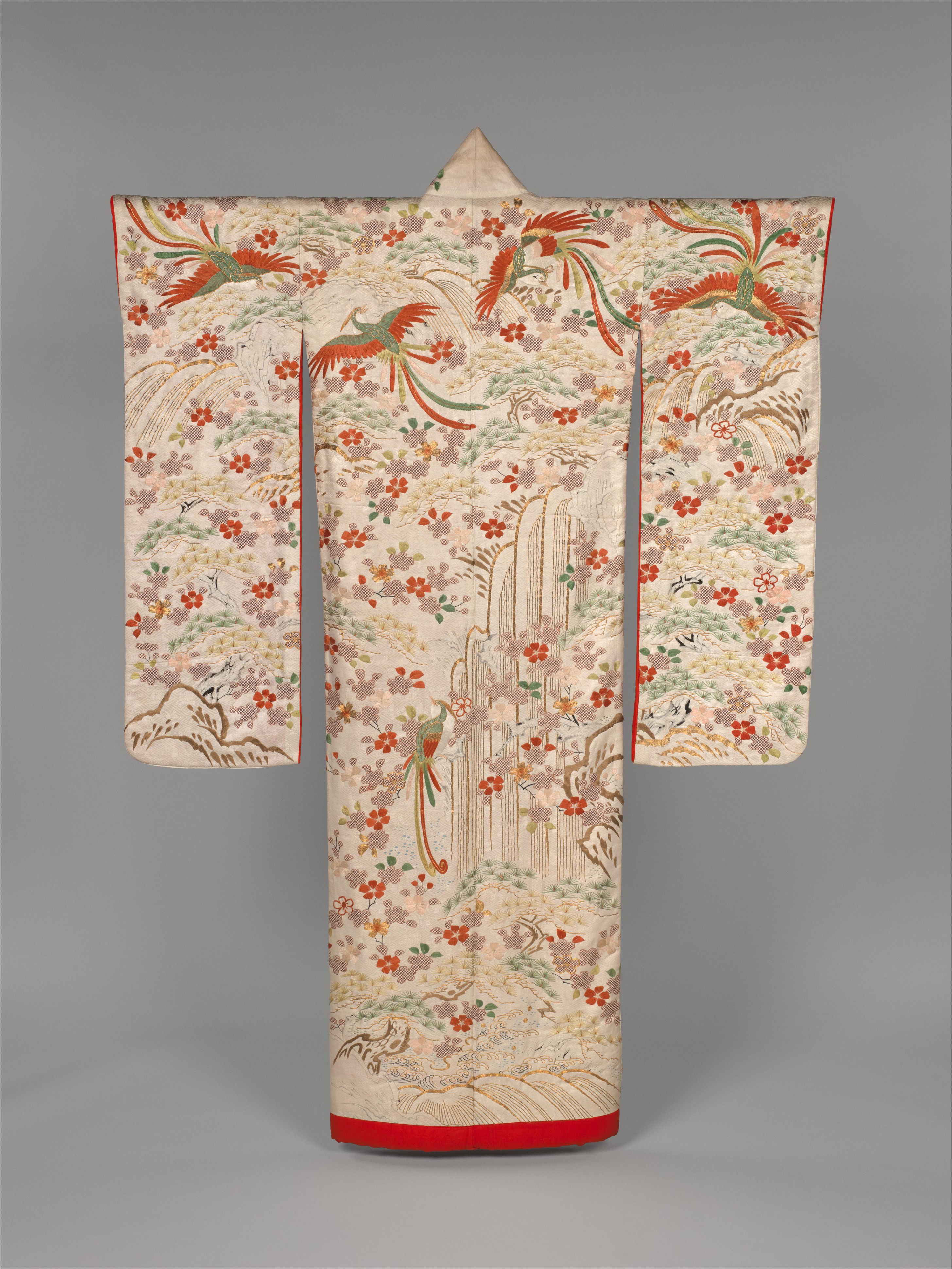
Deconstructing the Uchikake: Temporal Collisions and the Architecture of Flight
The Uchikake, a garment historically reserved for the immutable ritual of matrimony, presents a paradox to the contemporary eye. It is a relic of stillness, a monument to the bride’s passage into a fixed social order. Yet, within its opulent weight and its meticulously rendered landscape of long-tailed birds, Zoey Fashion Laboratory identifies not a conclusion, but a launchpad. For SS26, this Japanese over-robe is not an artifact to be preserved; it is a blueprint to be exploded. Our analysis severs the garment from its ceremonial past, extracting its core structural DNA—the horizontal expanse, the volumetric sleeve, the deliberate drag of fabric—and re-engineering it for a future defined by kinetic grace and architectural defiance. This is not a study in historical homage; it is a dissection of silhouette, a re-calibration of movement, and a manifesto for a new era of garment construction.
I. The Silhouette of Suspension: Beyond the T-shaped Plane
The traditional Uchikake is defined by its flat, T-shaped planarity. It hangs, a rectangular canvas, from shoulder to floor. Our avant-garde intervention begins with the rejection of this passive gravity. We propose a silhouette of suspension, where the ground is not the terminus but a point of tension. The original’s trailing hem, designed to be dragged, is reimagined as a negative-space architecture. Instead of a solid sweep, the SS26 iteration features laser-cut fissures that ascend from the hemline, creating a series of articulated, ribbon-like trains that mimic the exaggerated tail feathers of the depicted birds. These are not mere slits; they are engineered hinges, allowing the fabric to bifurcate and reconfigure with each stride. The silhouette thus shifts from a static monolith to a dynamic, multi-planar sculpture, where the wearer’s movement activates the garment’s latent energy.
Further, the colossal sode (sleeves) are no longer appendages but become primary structural volumes. In our deconstruction, the sleeve is detached at the shoulder and re-attached via a system of articulated, brushed-aluminum joints, inspired by biomechanical prosthetics. This allows the sleeve to swing freely, forward and back, creating a wind-capture profile. The effect is a futuristic, avian silhouette—a human form equipped with wings of silk and metal, poised for take-off rather than static display. The horizontal line of the shoulder is thus broken, replaced by a dynamic, asymmetrical sweep that challenges the very notion of a front and back.
II. Material Alchemy: The Permanence of Paste-Resist and the Ephemeral Metal
The materiality of the original—silk satin damask with stencil paste-resist dyeing and metallic-thread embroidery—is a testament to laborious permanence. For our futurist lens, this permanence is a starting point for a dialogue with the ephemeral. The stencil paste-resist technique, which historically created crisp, defined boundaries between dye and ground, is subverted. We propose a deconstructed resist, where the paste is applied with a deliberate irregularity, allowing the dye to bleed and pool in uncontrolled rivulets. This creates a topographic map of color, a chaotic nebula upon the silk, erasing the idyllic landscape in favor of a post-pastoral abstraction. The long-tailed birds are no longer rendered as literal figures but as ghostly impressions—their forms suggested by the negative space left by the resist, their flight paths traced by the bleeding dye.
Simultaneously, the metallic-thread embroidery is re-contextualized. No longer a flat, decorative overlay, the threads are liberated from the fabric’s surface. They are woven into free-standing, three-dimensional lattices that hover above the silk, attached at specific stress points. These metallic exoskeletons serve a dual purpose: they provide a subtle, internal armature that supports the new, gravity-defying silhouette, and they function as a light-reactive skin. As the wearer moves, the threads catch and refract light, creating a shimmering, holographic aura that obscures and reveals the garment’s internal structure. This is not ornamentation; it is functional engineering, a move from the decorative to the performative.
III. Structural Innovation for SS26: The Kinetic Kimono
The core innovation for SS26 is the transformation of the Uchikake from a garment of static presence to one of kinetic responsiveness. The original’s construction, based on straight seams and rectangular panels, is replaced with a pattern-cutting system based on the Fibonacci spiral. This allows the fabric to be shaped into three-dimensional, curved panels that wrap the body in a continuous, fluid line, rather than hanging from it. The result is a silhouette that is simultaneously sculptural and organic, echoing the natural curvature of the spine while projecting a futuristic, exoskeletal profile.
We introduce a modular fastening system in lieu of the traditional obi (sash). This system, composed of interlocking carbon-fiber clips and magnetic closures, allows the wearer to reconfigure the garment’s volume in real-time. The robe can be worn fully closed, creating a severe, columnar form; partially open, revealing a flash of the under-layer; or completely deconstructed, with the sleeves detached and worn as separate, winged capes. This transformative capability is the ultimate luxury—not the luxury of material alone, but the luxury of control over one’s own architectural environment.
Finally, the internal structure is re-engineered. Where the original relied on the stiffness of its silk damask to hold its shape, the SS26 version incorporates a hidden network of shape-memory alloys, woven into the seams. These alloys are programmed to respond to body heat, causing the fabric to gently curl and furl at the edges. The effect is a garment that is perpetually in flux, its hemline rising and falling, its sleeves subtly undulating. The Uchikake is no longer a static object of beauty; it is a living, breathing organism, a sentinel of a future where clothing is not worn but inhabited. This is the definitive avant-garde statement: to take a symbol of finality and transform it into an instrument of infinite possibility.