Executive Analysis: The Crossbow as a Catalyst for Deconstructionist Design
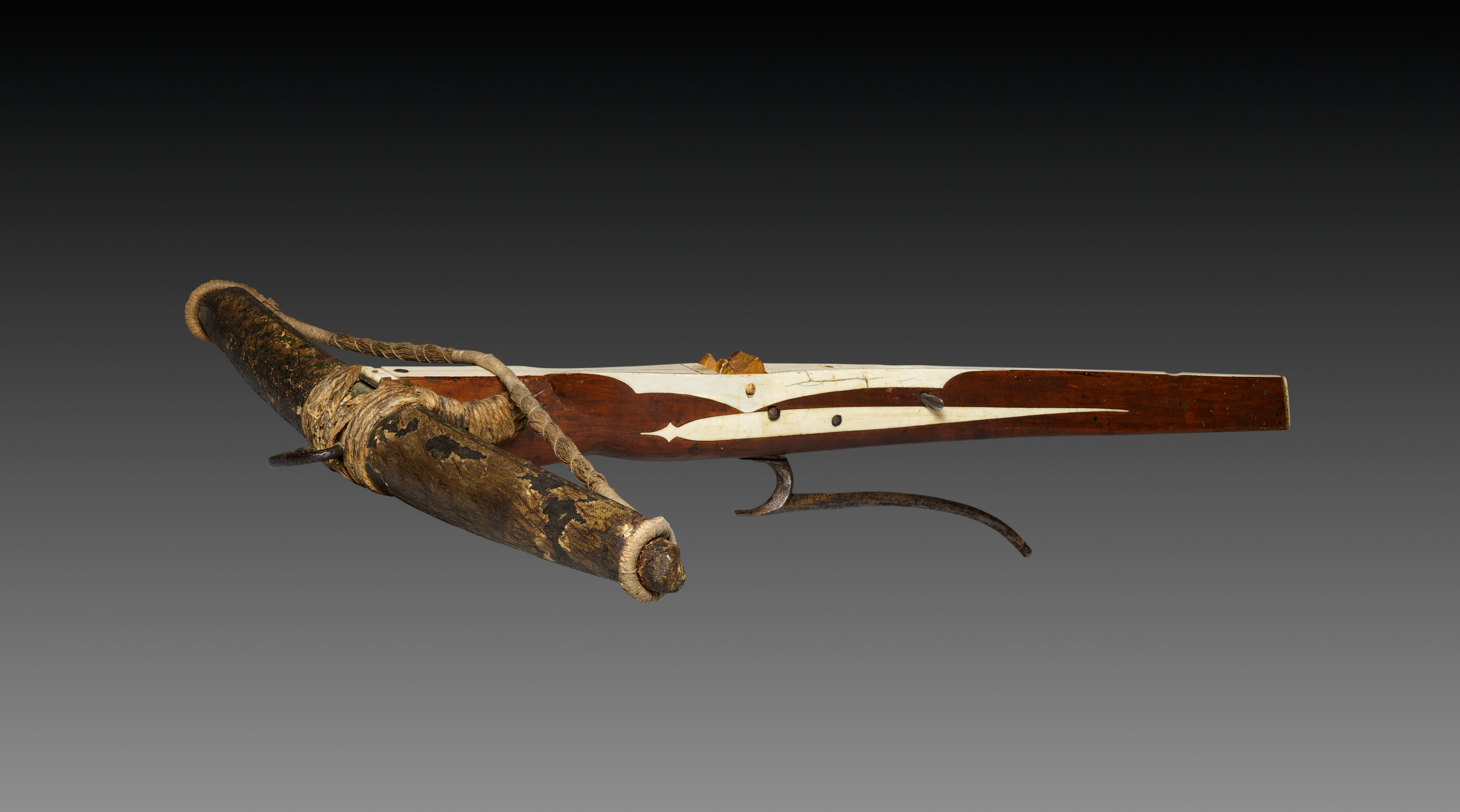
At Zoey Fashion Lab, our mandate is not merely to observe historical artifacts but to dissect their material and conceptual DNA, extracting the elemental codes that can be re-sequenced into avant-garde fashion narratives. The subject of this analysis—a German crossbow, circa late 16th to early 17th century—presents a formidable paradox. It is an object of lethal precision, yet its construction is a testament to organic luxury and meticulous craftsmanship. Constructed from walnut (likely Juglans regia), inlaid with bone, reinforced with horn and parchment, and fitted with iron and steel mechanisms, this weapon is a composite marvel. For our design laboratory, it is not a tool of war; it is a blueprint for structural tension, textural juxtaposition, and the deconstruction of form versus function.
Material Autopsy: The Organic Skeleton
The foundational element of the crossbow is its stock, traditionally carved from walnut. In the context of our design philosophy, walnut is not merely wood; it is a dense, dark, and richly grained substrate that offers a counterpoint to the pale, calcified inlays. The bone inlays—often depicting hunting scenes or mythological motifs—serve as a literal embedding of narrative within structure. For Zoey Fashion Lab, this translates into a call for surface archaeology: garments that feature embedded panels, laser-cut bone-like filigree, or resin-cast "inlays" that interrupt the flow of a primary fabric. We envision a tailored coat where the lapels are not sewn but "inlaid" with a contrasting material—perhaps a matte ivory silicone or a rigid, bone-colored jacquard—creating a visual and tactile seam that mimics the original joinery.
The use of horn and parchment in the composite bow (the prod) is particularly significant. This is not a monolithic material; it is a laminate of organic proteins, compressed and shaped under tension. This technical detail directly informs our avant-garde approach to layered tension. We propose garments that utilize bias-cut parchment-finished leathers or heat-molded horn veneers, not as decoration, but as structural elements that hold the garment's shape—akin to the bow's prod. The tension between the rigid horn (the belly) and the resilient parchment (the back) is a metaphor for the human body's own interplay between skeletal rigidity and muscular flexibility. Our designs will echo this by using internal boning not hidden in channels, but exposed as an exoskeletal feature, referencing the bow's external mechanics.
Mechanical Poetics: Iron, Steel, and the Trigger of Time
The iron and steel lock mechanism—the crossbow's technological heart—is where the object's latent aggression meets its mechanical precision. The trigger, the nut, and the spanning lever are all components of a system designed for instantaneous release. In deconstructionist fashion, this translates to a fascination with visible fastening systems. We reject the hidden zipper in favor of exposed ratchets, articulated metal joints, and magnetic closures that mimic the action of a sear. A Zoey Fashion Lab garment inspired by this piece would feature a "trigger" mechanism at the cuff or collar—a functional, metallic element that allows the wearer to adjust tension, effectively "spanning" the fabric across the body.
Furthermore, the iron elements were often blued or burnished, creating a spectrum from gunmetal grey to polished silver. This chromatic range offers a sophisticated palette for our textile development. We propose a series of technical fabrics with a metallic sheen gradient, where the weave density changes across the garment to simulate the patina of aged iron. This is not a literal print; it is a structural dye technique where the yarns themselves shift from matte black to high-luster steel, creating a three-dimensional play of light that echoes the crossbow's metalwork.
Deconstructing the Silhouette: The "Span" and "Release"
The crossbow's operational cycle—spanning (drawing back) and releasing—provides a dynamic, kinetic model for our silhouette construction. Traditional fashion is static; our avant-garde approach seeks to embed a sense of latent energy into the garment. We propose a "Spanning Jacket" where the shoulders are constructed with articulated panels that can be physically pulled forward and locked into place using a horn-tipped toggle, mimicking the act of drawing the bowstring. When released, the panels would relax, creating a dramatic shift in the garment's architecture from a tight, aggressive profile to a flowing, expansive one.
This kinetic element is reinforced by the composite nature of the bow itself. The layering of horn and parchment suggests a deconstructed sleeve—one that is not a single tube but a series of overlapping, curved panels that wrap around the arm. Each panel would be cut on a different grain or bias, allowing for independent movement while maintaining a unified visual form. The bone inlays, in this context, become the "stitching"—visible, rigid, and decorative, acting as both functional connectors and ornamental markers of the garment's internal logic.
The "New DNA Strand" Reference: A Conceptual Re-Sequencing
The reference to a "New DNA Strand" is critical to our interpretation. We are not recreating a crossbow; we are extracting its genetic code—its material hierarchy (wood as base, bone as narrative, horn as tension, metal as function)—and re-sequencing it into a contemporary fashion language. The DNA strand metaphor implies a double helix: one strand being the organic, artisanal history (wood, bone, horn), and the other being the industrial, mechanical future (iron, steel, precision engineering). Our designs must intertwine these two strands, creating a hybrid that is neither purely historical nor purely futuristic.
This manifests in our choice of fabrics: a base of bio-engineered cellulose (echoing the wood) overlaid with a lattice of 3D-printed, biodegradable polymers (echoing the bone). The horn is replaced by a thermoplastic that can be molded to the body's contours, while the parchment is reimagined as a translucent, high-tenacity silk organza. The iron and steel are translated into titanium hardware, anodized in organic hues to blur the line between the natural and the manufactured.
Conclusion: The Crossbow as a Wearable Contradiction
In conclusion, the German crossbow is not an anachronism for Zoey Fashion Lab; it is a prescient model of functional deconstruction. It demonstrates that the most advanced technology often relies on the most primal materials. Our avant-garde collection will not feature crossbows as accessories. Instead, it will internalize the weapon's principles: the tension of a composite structure, the narrative weight of inlaid materials, and the exposed precision of mechanical joints. The result is a garment that is both armor and sculpture, a wearable contradiction that celebrates the beauty of violent precision through the language of haute couture. This analysis serves as the foundational blueprint for our forthcoming "Ballista" capsule, a line that redefines the intersection of historical weaponry and contemporary fashion.