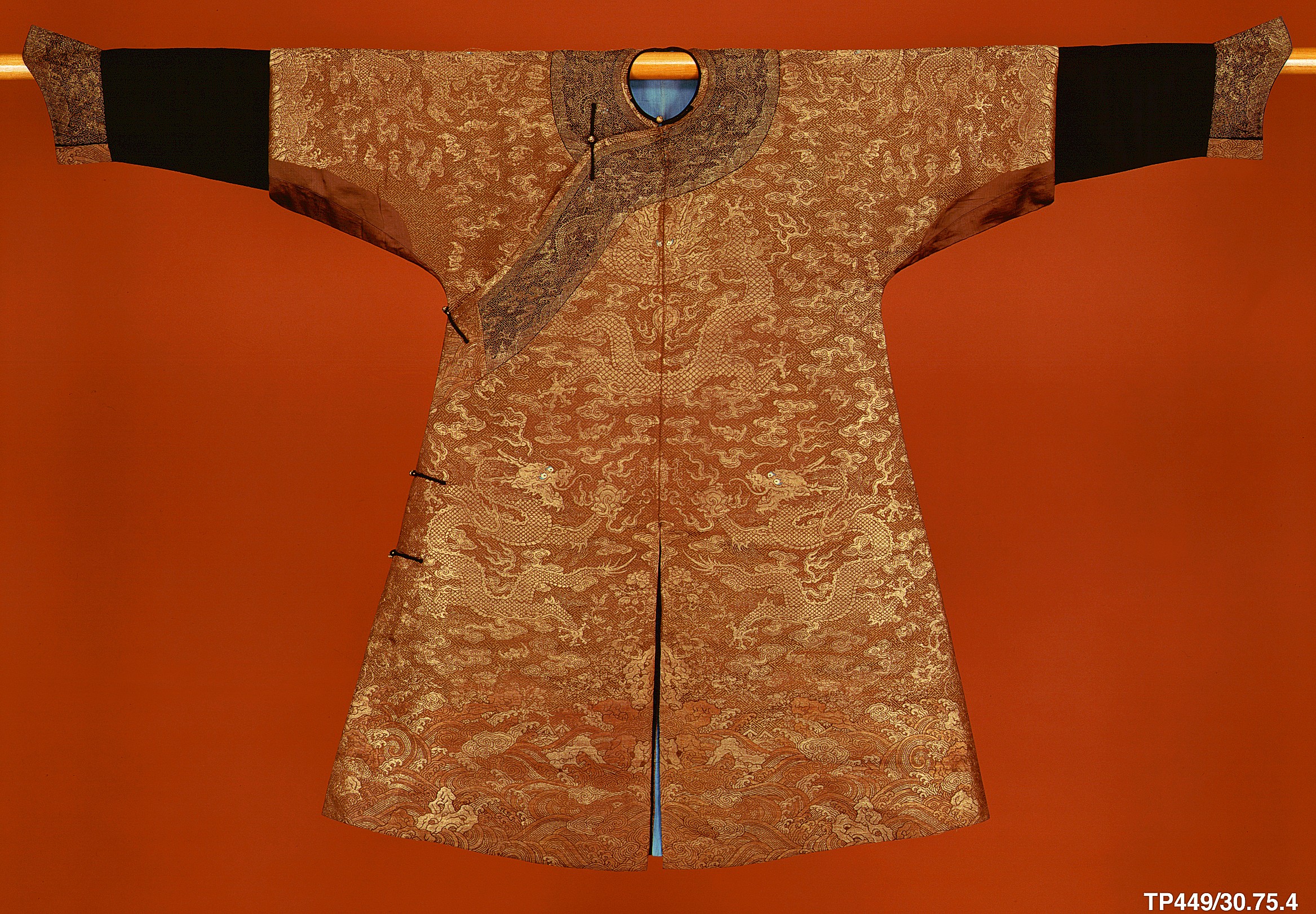
The Imperial Court Robe: A Temporal Dislocation for SS26
The imperial court robe of China, with its voluminous sleeves, rigidly structured collar, and cascading layers of silk and metallic thread, is not a relic. It is a blueprint. For Zoey Fashion Laboratory’s SS26 proposition, we strip this ceremonial garment of its historical reverence and re-engineer it as a vector for futuristic silhouette. The robe’s intrinsic architecture—its gravity-defying shoulder line, its cylindrical torso, its sweeping train—offers a radical departure from the body-conscious minimalism that has dominated recent runways. We do not reproduce; we dissect. We treat the original not as a costume but as a chassis, a skeletal framework upon which to mount new volumes, new tensions, and a new temporal identity.
Deconstructing the Architectural Shell
The traditional court robe operates on a principle of concealed structure. Its grandeur derives from internal padding, layered interfacing, and the sheer tensile strength of its metallic weft. In our SS26 analysis, we invert this logic. The robe’s silhouette is externalized—the internal boning becomes an exoskeleton, the lining becomes the surface. We propose a series of garments where the original robe’s rigid, barrel-shaped torso is sliced along its vertical seams and re-articulated with air gaps. The result is a negative-space architecture: the wearer’s body is no longer wrapped in fabric but framed by it. The sleeves, traditionally voluminous and pendulous, are re-cut into asymmetrical, cantilevered panels that jut forward like aerodynamic fins. This is not a nostalgic echo; it is a structural mutation, a futurist re-reading of ceremonial gravity.
Material Alchemy: Silk and Metallic Thread as Digital Fabric
The material palette of the original—silk and metallic thread—is often misread as opulent or static. For our avant-garde study, we treat these materials as conductive substrates. The silk’s natural drape is a problem; we solve it through heat-set pleating and resin-bonded folds that lock the fabric into permanent, angular creases. The metallic thread, traditionally used for embroidered dragons or cloud motifs, is re-purposed as a linear, circuit-like tracer. We propose a technique where the thread is not woven but applied as a raised, fused filament across the silk’s surface, creating a topographic map of the garment’s stress points. This metallic application is not decorative; it is functional, acting as a visual and physical stiffener that directs the fabric’s fall. The result is a fabric that behaves like a composite—flexible in one axis, unyielding in another—enabling silhouettes that appear frozen mid-motion, as if captured by a high-speed camera.
Futuristic Silhouette: The Robe as a Wearable Environment
Our SS26 vision for the court robe abandons the human form as the primary reference. Instead, we propose the robe as a wearable environment, a micro-architecture that the body inhabits. The traditional front-opening closure—the crossed lapels and tied sash—is replaced by a magnetic, seamless seam that runs diagonally from shoulder to hip, allowing the garment to be donned without disturbing its engineered volume. The train, once a symbol of imperial procession, is re-imagined as a detachable, inflatable module. When deployed, it expands into a rigid, air-filled shell that creates a three-meter radius of personal space. When deflated, it folds into a compact, origami-like pouch at the lower back. This is not mere spectacle; it is a commentary on the future of social distance, of ceremonial presence in a post-physical world.
The collar, traditionally a high, circular band framing the face, is re-engineered as a kinetic visor. Constructed from layered segments of silk and metallic mesh, it can be raised to obscure the lower face, creating an anonymous, almost robotic profile, or lowered to reveal a sculptural neckline that mimics the original’s mandarin curve. The sleeves, in our most radical gesture, are bifurcated. The upper arm is encased in a fitted, metallic-thread sleeve, while the lower arm is enveloped in a detached, oversized silk balloon that floats independently, tethered only by a thin cable of braided thread. This creates a visual disjunction—the body appears to be assembling and disassembling itself in real time.
Structural Innovation: From Ceremony to Cyborg
The greatest innovation lies in the robe’s internal skeleton. We propose a shape-memory alloy lattice sandwiched between two layers of silk. This lattice, when heated by body temperature, slowly expands, pushing the garment from a flat, collapsed state into a full, domed silhouette over a period of ten minutes. The wearer, and the audience, witness the robe’s transformation in real time—a slow, deliberate bloom of volume. This is a direct subversion of the static, pre-arranged grandeur of the imperial court robe. Here, the garment is not a fixed object but a process, a performance of becoming. The metallic thread, in this context, serves as the conductive conduit for the heat activation, turning the robe’s embroidery into a functional heating circuit, invisible to the eye but essential to the form.
Finally, we address the robe’s relationship to the body’s movement. The original court robe restricted motion, enforcing a regal, deliberate gait. Our SS26 version liberates the lower body entirely. The skirt is split into multiple, overlapping panels that can be individually raised and locked at different heights, allowing for asymmetric hemlines that range from floor-sweeping to mid-thigh. This modularity transforms the robe from a single, monolithic statement into a customizable system of dress, a kit of parts that responds to the wearer’s environment and intent. The imperial robe’s authority is no longer derived from its fixed, unchanging form, but from its ability to adapt, to morph, to anticipate. This is the future of couture: not a garment that commands reverence through stasis, but one that earns it through dynamic, intelligent evolution. The silk and metallic thread remain, but they are no longer historical materials. They are the raw data of a new, speculative body—a body that wears its history not as a weight, but as a launchpad.