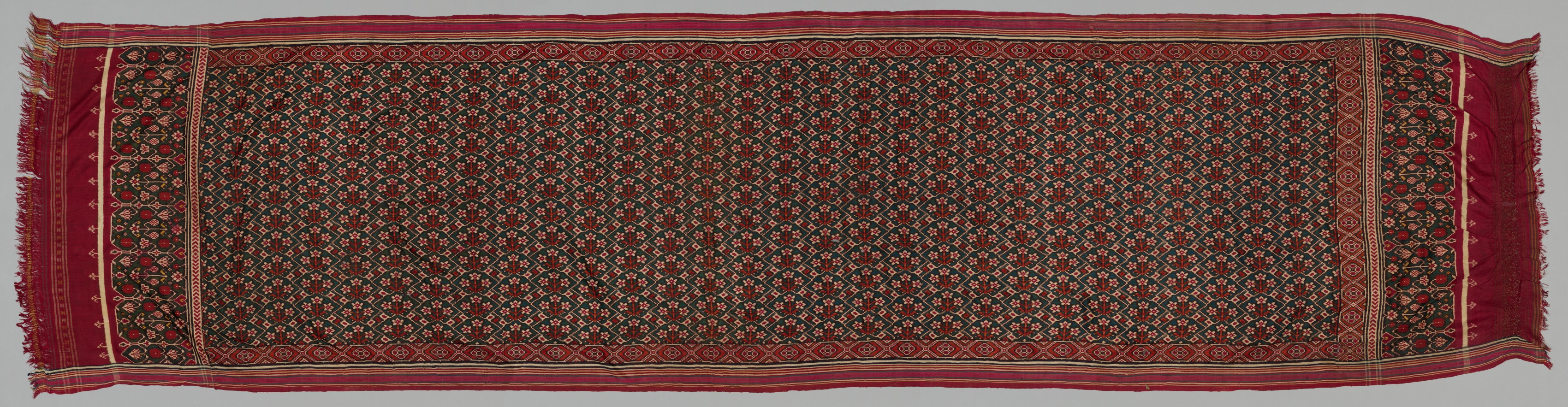
Deconstructing the Silk Patolu Sari: A Genetic Blueprint for Avant-Garde Fashion
At Zoey Fashion Lab, our mandate transcends the mere replication of historical garments. We engage in a process of fabric deconstruction—a forensic and poetic dissection of textile DNA to extract the latent codes that can inform radical, contemporary design. This analysis focuses on the Silk Patolu Sari, a 19th-century masterpiece from Gujarat, India. This is not a relic to be preserved under glass; it is a living organism, a double-helix of cultural memory and technical genius that we intend to re-sequence for the avant-garde. By examining its structural, chromatic, and symbolic strands, we identify a new design vocabulary—what we term a “New DNA Strand”—that disrupts conventional fashion paradigms.
I. The Structural Genome: Tabby Weave and Double Ikat
The foundational architecture of the Patolu is its tabby weave, the simplest and oldest of weaving structures. In a conventional context, this plain weave (over-one, under-one) is a baseline of utilitarian fabric. However, in the Patolu, the tabby weave becomes a taut, minimalist canvas that does not mask its own construction. For the avant-garde, this presents a critical lesson: complexity does not require structural ornamentation. The power lies in the tension between the grid of the warp and weft and the explosive imagery they carry.
The true genetic mutation is the double ikat technique. This process demands that both the warp and weft threads are resist-dyed *before* weaving, with the pattern meticulously calculated to align at the intersection points. The margin for error is microscopic—a single millimeter of miscalculation results in a blur, a ghost of a line. This is not merely a craft; it is a pre-computational algorithm executed with human precision. In our deconstruction, we view the Patolu’s double ikat as an early form of pixelated data. The design is not painted on the surface; it is embedded in the very sinew of the threads. This challenges the contemporary designer to consider material-integrated intelligence—where the pattern is not a print or an embroidery, but a core property of the fiber itself.
Deconstructive Application: The “Genomic Grid”
For Zoey Fashion Lab, we propose a series of garments that expose this structural genome. The avant-garde silhouette would be asymmetric, deconstructed tailoring where the seams deliberately misalign, echoing the imperfect alignment of ikat threads. We would use a raw, un-finished tabby silk in its natural ecru state, but treat the surface with laser-etched lines that mimic the resist-dye boundaries. The garment becomes a diagram of its own making—a jacket where the lapel is cut on the bias to reveal the warp’s tension, and the interior lining is a digitally printed, magnified micrograph of the ikat’s thread-count. This is not about recreating a sari; it is about extracting the logic of patience and translating it into a language of sharp, architectural precision.
II. Chromatic and Symbolic Mutations: The Language of the Border
The 19th-century Patolu is renowned for its vibrant reds, deep maroons, and indigo blues, derived from natural madder and indigo dyes. These colors are not arbitrary; they are a symbolic lexicon. Red signifies auspiciousness and fertility; the pallu (the end piece) often features motifs of the phoenix, elephant, or flowering vine, representing cosmic order and prosperity. The border, or kinar, is a rigid frame of geometric repetition, acting as a boundary between the sacred (the central field) and the profane (the outside world).
In our avant-garde deconstruction, we rupture this symbolic hierarchy. We propose to invert the relationship between border and field. The traditional, orderly border becomes a chaotic, bleeding smear of digital glitch-art, printed over the silk. The central field, traditionally a space for narrative motifs, is rendered as a stark, monochromatic void—perhaps a deep charcoal or a sterile white. This inversion speaks to a contemporary anxiety: the breakdown of rigid social structures and the erosion of traditional narratives. The Phoenix motif, once a symbol of rebirth, is now abstracted into a fragmented, cubist form, its wings broken into geometric shards that float across the fabric like debris in a digital stream.
The “Anti-Pallu” Silhouette
We translate this into a modular, multi-piece ensemble. The central fabric (the “field”) is cut into a severe, minimalist column dress with a high, architectural neckline. The pallu is not draped but detached, re-engineered as a transformable cape that can be worn as a hood, a train, or a sculptural shoulder piece. The border is not a hem but a separate, detachable belt or harness, made of rigid, laser-cut leather that is heat-pressed onto the silk. This harness, bearing the glitch-print, physically constrains the dress, creating a tension between the fluidity of the drape and the rigidity of the frame. The wearer becomes a living sculpture, embodying the conflict between tradition and disruption.
III. The “New DNA Strand”: Hybridity and Temporal Dislocation
The reference to a “New DNA Strand” in our brief is crucial. The Patolu’s DNA is not a closed loop; it is a sequence that can be spliced. Our analysis reveals three core genetic markers to be recombined:
1. The Marker of Time: The 19th-century Patolu represents hundreds of hours of human labor. In our contemporary context, we must interrogate this. We propose a hybrid material: a base of peace silk (where the silkworm is allowed to emerge) blended with a bio-fabricated cellulose derived from agricultural waste. This creates a fabric that has the same drape and sheen as the original but with a radically different ecological footprint. The “time” of the garment is no longer solely human; it is also the time of the laboratory, the growth of bacteria, and the decomposition of waste.
2. The Marker of Place: Gujarat is a specific geography. To dislocate this, we introduce a kinetic component. The silk is treated with a micro-encapsulated thermochromic dye. When the wearer’s body heat rises, the deep reds of the traditional palette shift to a stark, electric cyan. The garment becomes a real-time map of the wearer’s physiological state, a living document of anxiety, excitement, or calm. This is not a static heritage piece; it is a responsive organism.
3. The Marker of Pattern: The traditional ikat pattern is a product of human error and correction. We digitize the pattern, then intentionally introduce algorithmic noise—a series of random, glitch-induced distortions. The final motif is a hybrid: a recognizable echo of the phoenix, but corrupted by a machine that has learned to hallucinate. This is the “New DNA Strand”—a symbiosis of ancient hand-skills and contemporary computational aesthetics.
IV. Conclusion: From Preservation to Provocation
The Silk Patolu Sari is not a museum specimen; it is a provocation. For Zoey Fashion Lab, the act of deconstruction is an act of respect—we honor the Patolu by not treating it as a sacred cow to be worshipped, but as a technical and conceptual springboard. The avant-garde garment we envision does not look like a sari. It is a sharp, tailored suit with a detachable, glitch-printed harness; a column dress that changes color with the wearer’s pulse; a cape that disintegrates into a train of laser-cut silk scraps. It is a garment that asks questions about labor, ecology, and the dissolution of cultural boundaries.
By splicing the Patolu’s DNA with bio-fabrication, thermochromic technology, and algorithmic glitch, we do not dilute its heritage. We amplify its relevance. We prove that the most radical future of fashion lies not in the invention of new materials alone, but in the fearless re-reading of our textile past. The Patolu is not the end of a story; it is the opening sequence of a new genome, one that we at Zoey Fashion Lab are committed to sequencing, testing, and wearing into the unknown.