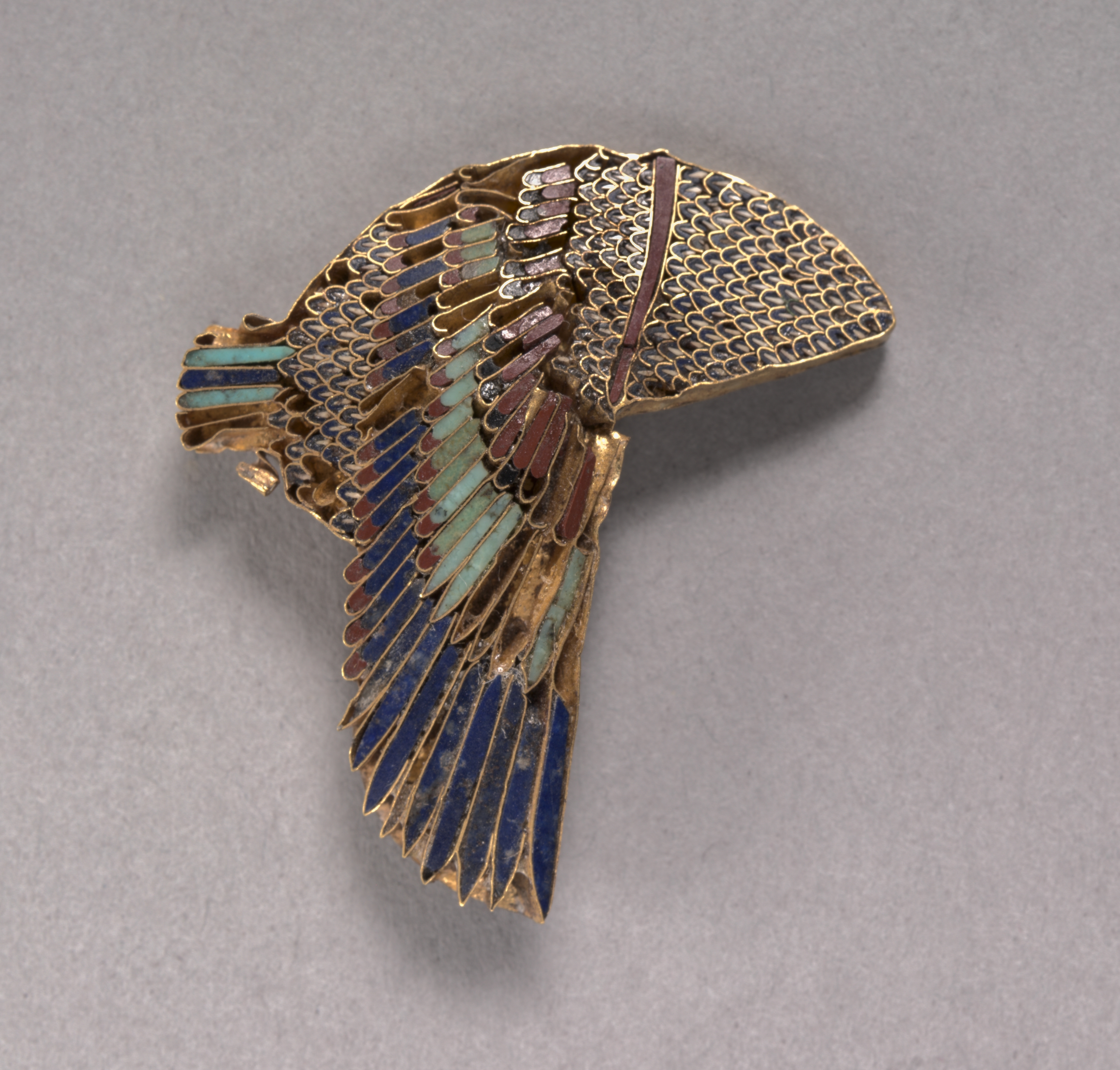
Deconstructing the Sacred: The Vulture Headdress Inlay as Avant-Garde Catalyst
At Zoey Fashion Lab, our mandate transcends the mere replication of historical artifacts. We engage in a process of deconstruction and re-synthesis, extracting the conceptual DNA of ancient objects to fuel contemporary, avant-garde silhouettes. This analysis focuses on a singular artifact: the Vulture Headdress Inlay from Egypt’s Greco-Roman period, specifically the Ptolemaic dynasty (305–30 BCE). Crafted from gold and semi-precious stones, this object is not merely a funerary ornament; it is a complex technological and symbolic matrix. Our reference—the archival resonance of a gilded silver mirror with split-leaf motifs juxtaposed against a cold stone sarcophagus relief—provides the critical lens for this exploration. We will dissect the headdress’s materiality, its iconographic weight, and its structural logic to propose a new paradigm for wearable art.
Material Alchemy: The Politics of Gold and Stone
The Ptolemaic period was a crucible of cultural fusion, where Hellenistic naturalism met Pharaonic monumentalism. The Vulture Headdress Inlay epitomizes this synthesis through its material choices. Gold, in ancient Egyptian cosmology, was the flesh of the gods, an incorruptible metal signifying eternal solar radiance. Its use here is not decorative but substantive. In our avant-garde translation, gold is not a surface treatment but a structural principle. We propose a fabric that integrates metallic weft threads—not as shimmering accents, but as load-bearing elements that dictate the garment’s drape and tension. This is a metallurgic couture, where the garment’s form is determined by the rigidity and flow of its golden skeleton.
The semi-precious stones—likely carnelian, lapis lazuli, and turquoise—were selected for their chromatic intensity and protective properties. Carnelian, the color of life and blood, was placed to invigorate; lapis, the deep blue of the night sky, to invoke the heavens. In our deconstruction, these stones are not inlaid but embedded as micro-engineered components. We imagine a textile with laser-cut apertures, where polished stone cabochons are set into silicone or resin matrices, creating a flexible yet armored surface. This juxtaposition of hard, mineral elements against a soft, pliable base echoes the artifact’s own tension: the permanence of stone against the transience of the flesh it adorned.
Iconographic Dissonance: The Vulture and the Mirror
The vulture is a dual symbol. It is the scavenger, the agent of decay, yet also the mother goddess Nekhbet, protector of Upper Egypt and the pharaoh. This inherent contradiction—death and rebirth, filth and royalty—is the conceptual core of our collection. The headdress’s inlay typically depicts the vulture’s outstretched wings, a gesture of shelter and menace. We translate this into a garment’s silhouette: a cape or bolero that extends from the shoulders like folded wings, but constructed with asymmetrical, razor-sharp panels that suggest both flight and predation.
Our archival reference—the silver mirror with split-leaf motifs—introduces a critical dialogue. The mirror is a tool of self-reflection, of vanity, and of the ephemeral present. The sarcophagus relief, in contrast, is a narrative of permanence, a story carved for eternity. The Vulture Headdress Inlay sits between these poles. It is a decorative object meant for the tomb, yet it is crafted with the precision of a mirror. We exploit this dissonance. Our avant-garde approach will create a garment that is bifunctional: one side is a polished, reflective surface (the mirror), and the reverse is a textured, narrative relief (the sarcophagus). This is achieved through a double-faced fabric—one layer of liquid metallic jersey, the other of sculpted, quilted leather with embossed patterns derived from the vulture’s feather structure.
Structural Grammar: From Inlay to Modular Assembly
The technical execution of the original inlay involved cloisonné or cell construction, where thin gold strips formed compartments for the stones. This is a meticulous, grid-based logic. For Zoey Fashion Lab, we adapt this into a modular design system. The garment is not sewn but assembled from discrete, interlocking units. Each unit is a "cell" of fabric—perhaps a hexagonal panel of metallic mesh—that can be connected via magnetic or mechanical fasteners, mimicking the gold cell walls. This allows for reconfigurability; the wearer can alter the garment’s structure, just as the priest would assemble the headdress for a specific ritual.
This modularity also addresses the concept of archival resonance. The split-leaf motif from the mirror suggests fragmentation and growth. We incorporate this by designing the modular cells with organic, leaf-like edges that overlap like scales. The garment becomes a living archive, where each cell can be added or removed, creating a unique configuration for each presentation. This is a radical departure from the fixed, sacred geometry of the original artifact, yet it honors its underlying principle: the careful arrangement of precious components to achieve a unified, powerful whole.
Chromatic Strategy: A Palette of Power and Decay
The color palette is derived directly from the inlay’s stones, but with a subversive twist. We do not use the stones’ pristine hues. Instead, we evoke their patina and weathering. The gold is not bright yellow but a tarnished, antique bronze. The lapis is not vivid blue but a deep, bruised indigo. The carnelian is not fiery red but a desaturated, blood-rust tone. This is a palette of archaeological decay, reflecting the passage of time and the artifact’s journey from tomb to museum. It aligns with the "cold stone sarcophagus" reference—a sense of chill, of petrification, yet imbued with the latent energy of the original gold.
We employ gradient dyeing and laser-etching to create a surface that appears to be eroding, revealing layers beneath. The garment’s surface will seem to flake, exposing a brighter, more saturated layer underneath—a metaphor for the archaeological dig, or the moment of revelation when the tomb is opened. This is not a nostalgic recreation but a critical engagement with the artifact’s material history.
Silhouette and Movement: The Weight of Eternity
The final element is the silhouette. The Vulture Headdress Inlay is static, fixed in death. Our garment must be dynamic, alive. We propose a silhouette that is architectonically heavy—broad shoulders, a rigid, sculpted bodice—but with a fluid, trailing lower half. This creates a tension between the armored, protective upper body (the vulture’s wings) and the flowing, vulnerable lower body (the earthly realm). The movement is not free but weighted, as if the wearer is carrying the burden of history. This is achieved through the strategic placement of the modular cells: dense and heavy at the shoulders, sparse and light at the hem.
In conclusion, the Vulture Headdress Inlay is not a relic to be copied but a blueprint for radical innovation. By deconstructing its materials, iconography, and structure, Zoey Fashion Lab transforms a funerary object into a living, breathing statement of avant-garde design. The garment we envision is a contradiction: a mirror and a sarcophagus, a symbol of death and a tool for rebirth. It is a wearable artifact that challenges the wearer to embody the vulture’s duality—to be both the scavenger and the queen, the destroyer and the protector. This is the essence of our practice: not fashion, but material philosophy.