Technical Analysis & Material Provenance
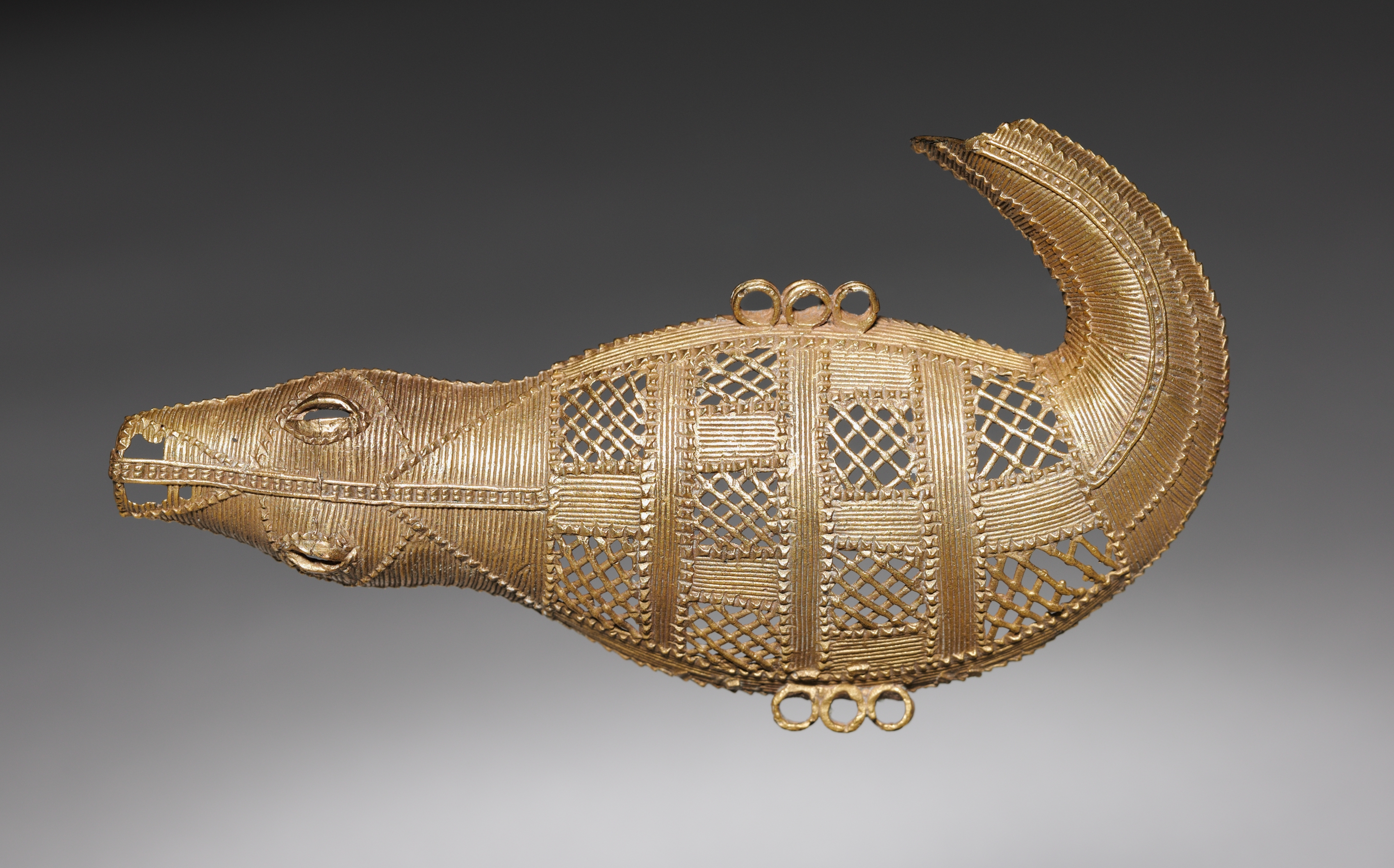
The pendant in question represents a masterful convergence of profound cultural heritage and audacious contemporary vision. Crafted in solid gold, the material choice is the first layer of its narrative. In the Baule tradition, and indeed across many West African cultures, gold is not merely a decorative medium; it is a substance imbued with spiritual and social significance. It symbolizes purity, prestige, a connection to the divine (Nyamien), and the enduring life force of the sun. The technical execution required to achieve the intricate, three-dimensional crocodile form speaks to a goldsmith operating at the zenith of skill, utilizing techniques of lost-wax casting (cire perdue) and meticulous hand-chasing that have been refined over centuries. The weight and warmth of the gold establish an immediate, tactile connection to its origin, making the wearer a custodian of this material legacy.
Deconstructing the Baule Archetype
The designation "probably Baule-style" is crucial. The Baule people of Côte d'Ivoire are renowned for goldwork that balances naturalistic representation with refined abstraction. The crocodile is a potent motif in their visual lexicon. It is an ambivalent symbol of power, adaptability, and primordial wisdom, often associated with chieftaincy, spiritual guardianship, and the dangerous, fertile depths of rivers. A traditional Baule gold pendant would honor this form, likely presenting a cohesive, sculptural representation meant to be worn as a badge of status and spiritual protection. Our analysis must begin by acknowledging this intact archetype: a complete, culturally anchored artifact of immense symbolic density.
Avant-Garde Deconstruction: The "Split-Leaf" Intervention
Here is where the Zoey Fashion Lab intervention performs its radical act of deconstruction. The provided reference—Archive Resonance: 一面是光洁银镜上以黄金镶嵌的纷繁棕叶纹,另一面是冰冷石棺板上以浮雕诉说的生命叙事——《Mirror with Split-Leaf....—is not a literal description but a metaphorical blueprint for the avant-garde process applied to the pendant.
This reference paints a dichotomy: one side is a polished silver mirror inlaid with chaotic, luxurious gold palm-frond patterns (the ornate surface, beauty, reflection). The other is a cold stone sarcophagus panel narrating a life story in relief (the structured substrate, mortality, narrative). This is the conceptual "split." The avant-garde genius of this piece lies in applying this dichotomous thinking to the unified Baule crocodile form.
The "Mirror" Side: Surface, Light, and Fragmentation
One facet of the pendant—the "mirror" side—can be interpreted as an exploitation of gold's material property to capture and refract light. Imagine the crocodile's scales not as a uniform texture, but as a fractured mosaic of highly polished, geometric gold facets interspersed with areas of matte finish. The "纷繁棕叶纹" (chaotic palm-frond patterns) translate into an abstract, almost Art Deco-inspired patterning overlaying the form, breaking the biological realism into a play of light and shadow. This side is about contemporary glamour, perception, and the deconstruction of the whole into shimmering fragments. It speaks the language of modern luxury, where heritage is not worn intact but refracted through a prism of current aesthetic codes.
The "Sarcophagus" Side: Substrate, Narrative, and Time
The reverse side—the "sarcophagus" panel—engages with the deeper narrative and temporal dimensions. Here, the gold is treated differently. The surface may be intentionally oxidized to a cooler hue, textured, or engraved. The "浮雕诉说的生命叙事" (life narrative told in relief) becomes the key. This is where the literal and symbolic biography of the crocodile is inscribed. Fine-line engraving could depict schematic river currents, ancestral symbols, or even fragmented scenes that allude to the Baule mythos surrounding the creature. This side embraces the "coldness" of history, the weight of tradition, and the relief-carved story that exists beneath the glittering surface. It acknowledges the artifact as an object that has emerged from the soil of time and memory.
Synthesis: The Crocodile as a Dialectical Object
The true avant-garde achievement is that these two sides are not separate entities but are forced to coexist on the same three-dimensional form. The wearer experiences a dialectical object. From one angle, it is a dazzling, abstract piece of contemporary jewelry. From another, it is a deeply cultural, storied relic. The "split" is not a physical bisection but a conceptual fissure that runs through the very identity of the pendant.
The crocodile itself, a creature of both water and land, becomes the perfect vessel for this duality. It is suspended between two states, two temporalities, two modes of expression. The Baule-style craftsmanship ensures the form remains recognizable and powerful, preventing the deconstruction from becoming mere disintegration. Instead, it becomes a complexification.
Conclusion: The New Archive
For Zoey Fashion Lab, this analysis posits that the Pendant: Crocodile is more than an accessory; it is a wearable theory of fashion. It demonstrates that avant-garde practice need not erase history but can engage with it in a critical, resonant dialogue. It deconstructs the source material not to destroy its meaning, but to expand its semantic field, placing it in conversation with contemporary philosophies of perception, identity, and time.
The piece creates a new kind of archive—one where the polished mirror of the present constantly reflects off the engraved sarcophagus of the past, each illuminating the other. In wearing this pendant, the client does not simply adorn themselves with a symbol of power; they embody the ongoing, dynamic, and sometimes fractured conversation between heritage and innovation. This is the essence of a truly resonant deconstruction: the past is not worn as a costume, but as a living, breathing, and brilliantly split narrative.