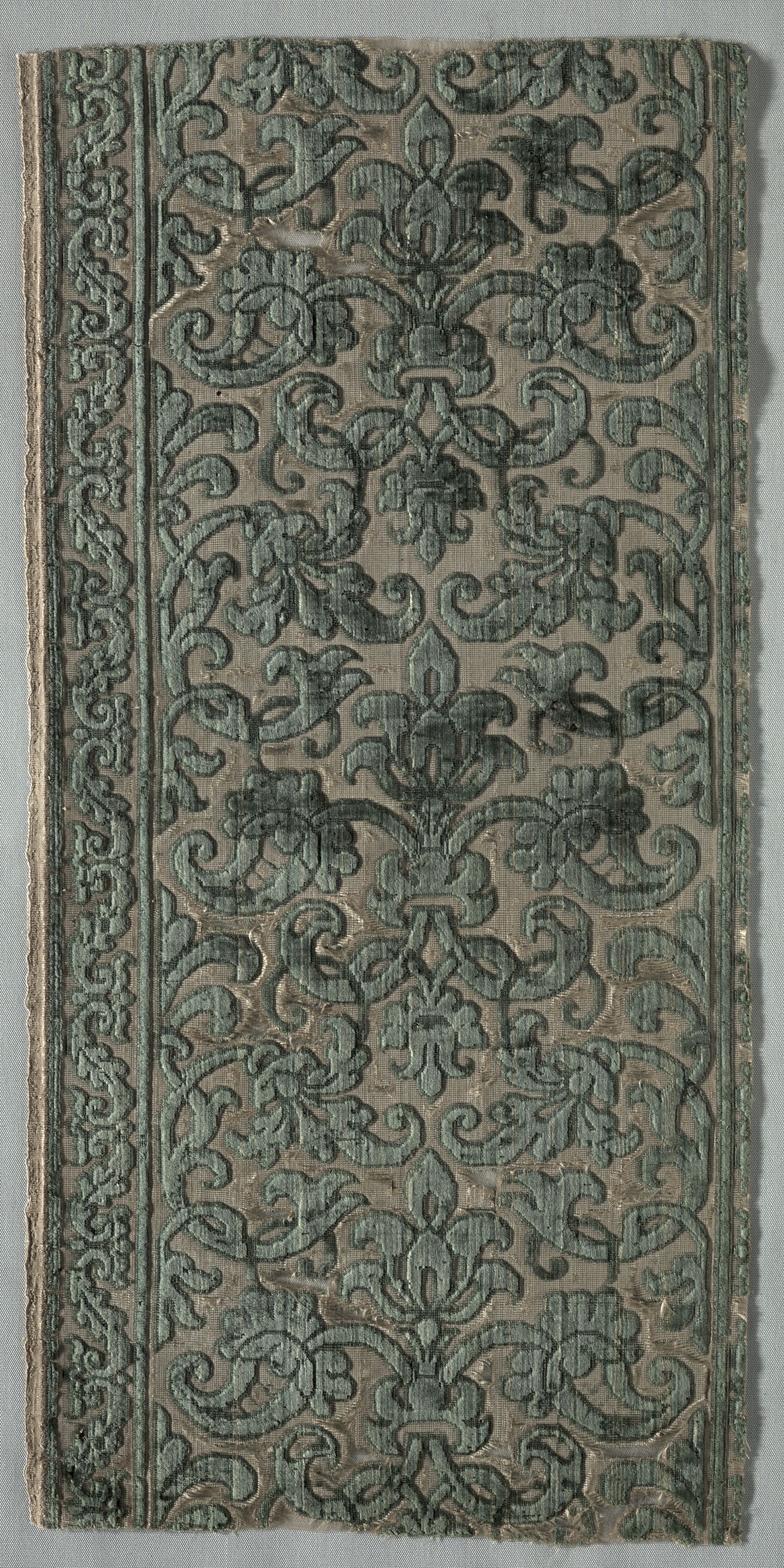
Technical Analysis: Velvet Fragment, Italy, Late 16th Century
The provided velvet fragment represents a pinnacle of Renaissance textile technology and aesthetic ambition. Its foundation is a pure silk base, a material choice that immediately denotes luxury, as sericulture and silk weaving were highly guarded and valuable industries in 16th-century Italy, particularly in centers like Venice, Genoa, and Florence. The defining characteristic is the combination of cut and uncut pile, a technique known as ciselé. This method involves weaving the fabric with supplementary warp threads that form loops. In areas designated as "uncut," these loops remain intact, creating a textured, light-catching surface. In "cut" areas, the loops are severed, producing the signature plush, dense, and light-absorbing nap of velvet. The contrast between these two states is not merely tactile but profoundly visual, allowing for the creation of pattern through light and shadow.
Historical Context and Symbolic Reference
Originating in late 16th-century Italy, this fragment exists at the crossroads of opulence, art, and power. This was an era of immense wealth for Italian city-states, where textiles functioned as currency, social signifiers, and canvases for artistic expression. Velvet, demanding immense skill and time to produce, was a fabric of state, clergy, and aristocracy. The intricate patterns woven into such velvets—often pomegranates, pinecones, scrolls, and arabesques—were not merely decorative but laden with symbolism, referencing fertility, eternity, and the burgeoning humanist interest in the natural world. The reference to a "New DNA Strand" is exceptionally apt. This fragment is, in essence, the DNA of Western luxury fashion—a coded sequence containing the genetic markers of craftsmanship, material innovation, and symbolic communication that would replicate and evolve through centuries of sartorial history.
Deconstructionist Blueprint: The "New DNA Strand" Methodology
For Zoey Fashion Lab, this fragment is not a relic but a living progenitor. Our deconstruction will not preserve its form but isolate and recombine its core genetic components to express a radical, avant-garde vision. The goal is to sequence its historical "DNA" and splice it with contemporary materials and silhouettes, creating a hybrid that speaks to the future while being fundamentally built upon this ancient code.
Core Genetic Components for Extraction:
1. The Binary Code of Texture (Cut/Uncut): This is the primary gene we will isolate. The historical technique created floral patterns; we will reinterpret this binary language at an architectural scale. Imagine a garment where entire panels exist in this contrasting state: a sleeve of severe, light-swallowing cut velvet juxtaposed against a bodice of reflective, looped uncut velvet. We will explore this beyond silk, applying the principle to technical fabrics, recycled synthetics, and even laminated textiles to create a new lexicon of texture.
2. The Chromosome of Light Interaction: Renaissance velvet manipulated light to denote pattern and value. Our avant-garde application will treat light as a co-designer. We will engineer surfaces where the cut/uncut binary interacts with integrated micro-LED filaments or photoluminescent coatings. The pattern would not be static but dynamic, shifting based on movement or external stimulus, making the fabric a living, responsive interface.
3. The Structural Gene of Weight and Drape: Traditional velvet's weight conveys gravity and dignity. We will deconstruct this by dissociating the plush surface from a heavy base. Techniques could include bonding the velvet pile to a weightless mesh or silicone substrate, creating a fabric that appears luxuriously dense but moves with an unnatural, ethereal lightness. Alternatively, we could exaggerate the weight in sections, using strategic weighting to distort silhouette and create deliberate, sculptural imbalance.
Avant-Garde Synthesis: Recombinant Forms
Using these extracted components, we propose the following conceptual directions:
Direction 01: The Amplified Binary. A monolithic garment, perhaps a tailored coat or architectural dress, where the cut/uncut divide is the sole design element, but executed with surgical precision. Seam lines would follow the tension between these textures, creating a topographic map of tactile contrast. The "pattern" becomes the garment's structure itself, blurring the line between surface decoration and construction.
Direction 02: The Degraded Strand. Here, we acknowledge entropy as a creative force. We would subject replicated velvet to controlled degradation—laser etching to selectively obliterate pile, enzymatic washes to create organic, uncut "bald" patches, or thermal processes that melt and fuse the synthetic pile in areas. This creates a narrative of decay and resilience, a "fossilized" velvet that speaks to time and impermanence, directly challenging the fragment's original context of preserved perfection.
Direction 03: The Exoskeletal Framework. This approach inverts the relationship of structure and softness. The velvet, rather than being the garment, becomes an infill or trapped element within a rigid, transparent or metallic exoskeleton. Fragments of the velvet—highlighting the cut/uncut contrast—are suspended in resin panels or encased in articulated polymer frames worn over the body. This treats the historical textile as a precious specimen, a cultural artifact displayed in a futuristic armature.
Conclusion: From Fragment to Future Code
The late 16th-century Italian velvet fragment is our foundational genome. Its value to Zoey Fashion Lab lies not in its floral motif but in its embedded principles: the strategic manipulation of texture, the choreography of light and shadow, and the embodiment of material innovation as status. By deconstructing these principles through an avant-garde lens, we move beyond pastiche. We are not creating "Renaissance-inspired" pieces; we are writing new genetic code using the original base pairs. The resulting collections will be hybrid organisms—visually startling, conceptually rigorous, and materially innovative—that position the Lab at the forefront of fashion where deep historical intelligence fuels radical future forms. The "New DNA Strand" is both our reference and our mission: to sequence the past and design the evolution.