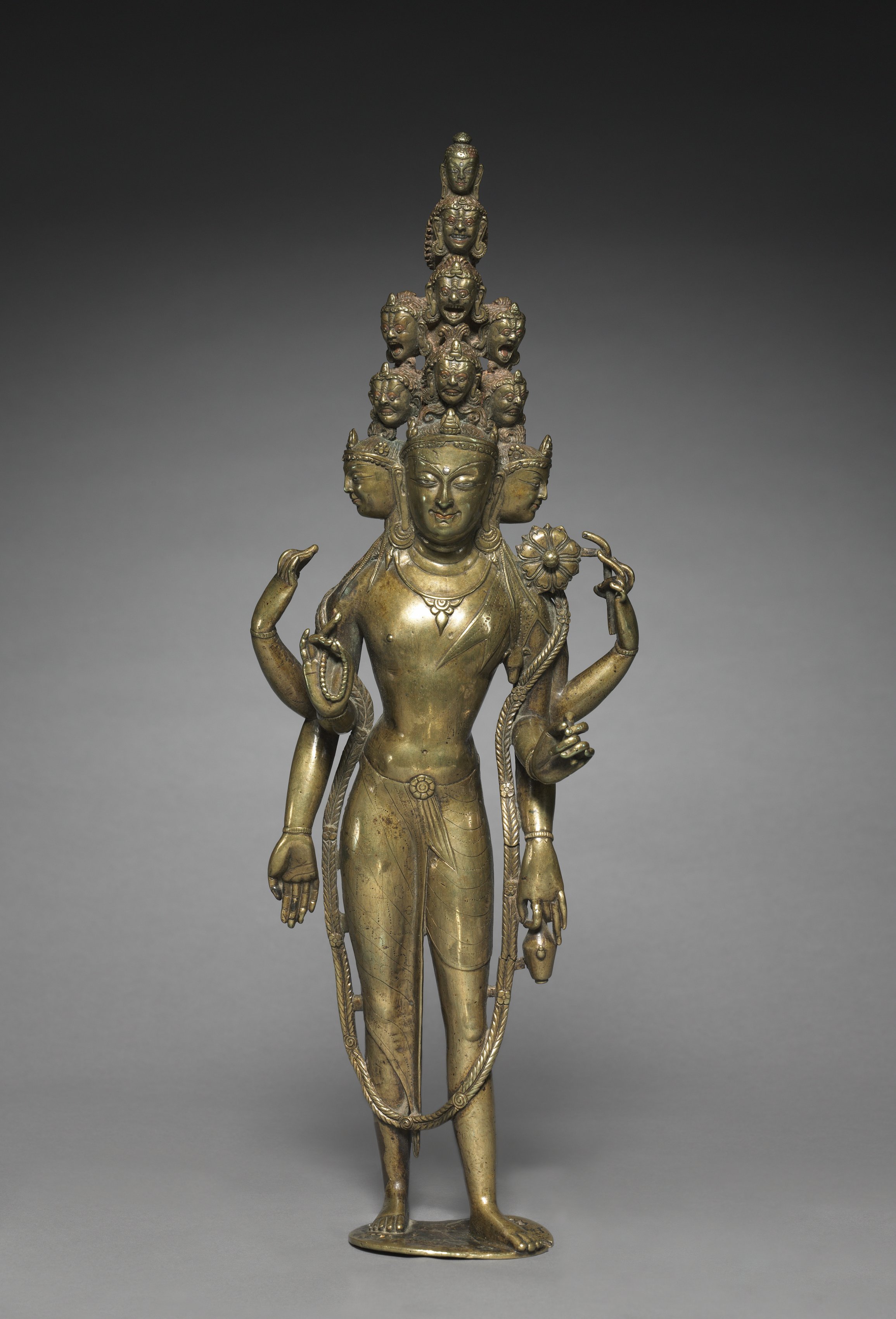
Deconstructing the Divine: An Avant-Garde Reading of the Eleven-Headed Avalokiteshvara
At Zoey Fashion Lab, our mandate transcends the mere analysis of textile and silhouette. We are engaged in the radical reinterpretation of cultural artifacts as proto-fashion statements—objects that encode power, identity, and transcendence within their material language. Today, we turn our deconstructionist lens to a masterpiece of Western Himalayan metallurgy: the Eleven-Headed Bodhisattva of Compassion (Avalokiteshvara), rendered in gilt bronze with silver and copper inlay. This is not merely a devotional icon; it is a wearable architecture of the sublime, a proto-cybernetic interface between the human and the cosmic. Our analysis, framed by the archival resonance of a mirror split between golden foliage and a stone sarcophagus, reveals a garment of paradox—simultaneously luminous and funereal, ornate and austere.
Material Semiotics: The Gilt, the Silver, and the Copper
The technical choice of gilt bronze is the first sartorial declaration. Gilding is not a veneer; it is an act of alchemical transformation, a simulation of eternal light. In avant-garde terms, this is the ultimate "metallic finish"—not a seasonal trend but a permanent state of becoming. The bronze base provides structural weight, a grounding that prevents the piece from dissolving into pure spectacle. This is the tension we prize at Zoey Fashion Lab: the interplay between opulent surface and dense, unyielding core. The silver and copper inlays function as precise, chromatic accents—like haute couture embroidery executed in precious metal. Silver traces the contours of the eyes, suggesting a vision that pierces illusion. Copper, with its warm, arterial hue, delineates the lips and the subtle musculature of the neck, introducing a pulse of organic life within the metallic shell. This is not decoration; it is a chromatic code, a system of signaling that elevates the piece from sculpture to a language of power.
The Eleven Heads: A Modular Headpiece of Omniscience
The most radical element, from a fashion systems perspective, is the stacked configuration of eleven heads. This is not a single silhouette but a modular, expandable structure—a precursor to the contemporary fascination with layered hoods, stacked collars, and augmented headpieces. Each head is a distinct "look" within a single ensemble. The lower tiers express serene, compassionate visages, their silver-inlaid eyes downcast in empathy. The upper tiers escalate in intensity, culminating in the wrathful Vajrapani head, its copper-accented brow furrowed in a fierce, protective grimace. In our deconstruction, this is a study in emotional gradient. The garment does not merely cover; it expresses a spectrum of psychic states—from gentle receptivity to militant guardianship. The eleventh, the Amitabha Buddha at the apex, functions as the ultimate accessory: a crown jewel that signifies the source of all compassion. This vertical stack is a direct challenge to the horizontal, linear construction of Western fashion. It proposes a body that grows not outward but upward, into a state of heightened spiritual awareness.
Archive Resonance: The Mirror and the Sarcophagus
Our reference—a mirror with golden foliage on one side and a sarcophagus relief on the other—is the key to unlocking this piece's avant-garde potential. The gilt bronze of the Bodhisattva is the golden foliage: intricate, organic, and dazzling. It speaks of growth, of the natural world elevated to precious metal. Yet the silver and copper inlays, particularly in the cool, reflective quality of the silver, evoke the stone sarcophagus. They are the cold, permanent markers of mortality. This Bodhisattva is a garment of paradox, embodying both the vitality of the living world and the silence of the tomb. The serene expression on the primary face is not naive bliss; it is the composure of one who has looked into the void and returned with compassion. This is the ultimate avant-garde gesture: to wear the symbols of death and rebirth simultaneously, to present a facade of serene beauty that is undercut by a deep, existential weight.
Silhouette and Structure: The Flowing Robe as Kinetic Architecture
Observe the drapery. The dhoti and shawl are not static; they are rendered in flowing, rhythmic folds that create a kinetic illusion. The gilt surface catches light in a way that makes the metal appear to move, as if the Bodhisattva is perpetually in a state of graceful motion. This is a masterclass in negative space. The deep undercuts between the folds create shadows that are as integral to the design as the metal itself. In our lab, we call this "shadow tailoring"—the deliberate manipulation of darkness to define form. The silhouette is simultaneously modest and revealing. The body is covered, yet the anatomical precision beneath the robes—the subtle suggestion of the chest, the curve of the hip—creates a powerful erotic charge, not of the flesh, but of the spirit. The garment is a membrane between the mundane and the divine, its folds acting as conduits for meditative energy.
Conclusion: A Blueprint for the Spiritual Body
For Zoey Fashion Lab, the Eleven-Headed Avalokiteshvara is not a relic. It is a generative blueprint. It challenges us to consider clothing as a technology of transcendence, not mere covering. The piece deconstructs the very notion of a singular identity, proposing a self that is multiple, layered, and ever-evolving. The use of precious metals is not ostentation but a commitment to permanence, to creating a garment that defies time. The influence of this piece on our upcoming collection is profound. We are exploring modular headwear that can be stacked or deconstructed, metallic mesh fabrics that mimic the play of light on gilt, and asymmetric draping that creates a sense of frozen motion. We are designing for the body as a spiritual vessel, not just a physical form. The Bodhisattva teaches us that true luxury is not about rarity or cost, but about the intensity of presence. It is a garment that does not whisper; it resonates, it commands, and it comforts. In its silent, metallic gaze, we find the ultimate fashion statement: a declaration that the human form, when adorned with intention, can aspire to the divine.